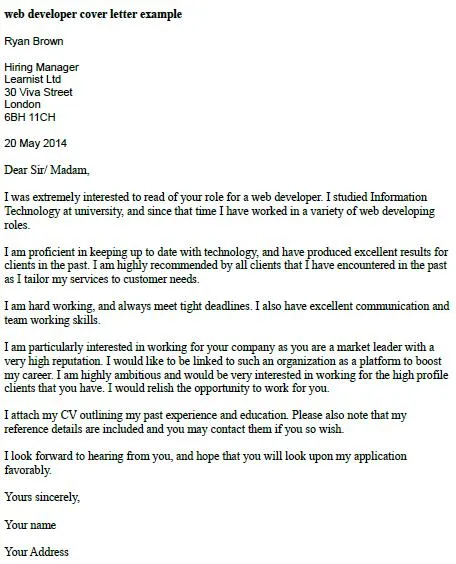
Understanding the Web Development Cover Letter
A web development cover letter is more than just a formality; it’s your first impression and a crucial tool in landing your dream job. It’s a concise, personalized document that introduces you to a potential employer and highlights your qualifications, skills, and enthusiasm for the role. Unlike your resume, which provides a factual overview of your experience, the cover letter allows you to tell a story, explain your motivations, and demonstrate why you’re the perfect fit for the company and the specific position. A well-crafted cover letter significantly increases your chances of getting noticed and securing an interview.
The Purpose of a Cover Letter
The primary purpose of a cover letter is to introduce yourself, express your interest in a specific web development role, and persuade the hiring manager to read your resume. It serves as a bridge between your skills and the company’s needs, demonstrating how your abilities align with their requirements. A cover letter provides an opportunity to elaborate on experiences mentioned in your resume, explain any gaps in your employment history, and showcase your personality and communication skills. It’s your chance to stand out from the crowd and make a memorable first impression.
Why a Cover Letter Matters in Web Development

In the competitive field of web development, a well-written cover letter is invaluable. It allows you to demonstrate your passion for web technologies and your understanding of the specific job requirements. It lets you highlight relevant projects that showcase your coding abilities and your problem-solving skills, which are essential in web development. Moreover, a cover letter shows your ability to communicate effectively, a crucial skill in collaborative projects and client interactions. It’s an opportunity to show that you’ve researched the company and understand their projects and challenges, proving that you are genuinely interested in contributing to their team.
Key Components of a Web Development Cover Letter
A compelling web development cover letter is structured into several key components, each playing a vital role in conveying your qualifications and enthusiasm. These components work together to create a cohesive narrative that grabs the reader’s attention and makes them want to learn more about you. The following sections provide a blueprint for crafting a cover letter that effectively highlights your skills, experience, and passion for web development.
Contact Information and Introduction
Start with your contact information, including your name, phone number, email address, and optionally, your LinkedIn profile URL and portfolio website. This ensures the recruiter can easily reach you. In the introduction, address the hiring manager by name if possible. State the position you are applying for and briefly explain where you found the job posting. Express your enthusiasm for the role and the company, setting a positive tone from the beginning. This opening paragraph should be concise, engaging, and immediately convey your intent.
Highlighting Your Skills and Expertise

This section is where you showcase your web development skills. Identify the specific skills required in the job description and highlight your proficiency in those areas. Focus on the skills that match the job requirements, using keywords from the job posting to show you understand their needs. This demonstrates your value proposition and makes it easy for the recruiter to see the connection between your abilities and the job requirements. Use action verbs to describe your accomplishments and quantify your achievements whenever possible.
Technical Skills
List your technical skills, including programming languages (e.g., HTML, CSS, JavaScript, Python, PHP), frameworks (e.g., React, Angular, Vue.js, Laravel, Django), and tools (e.g., Git, VS Code, database management). Be specific about your level of proficiency with each skill, and tailor this section to match the job description’s requirements. If the job requires expertise in a particular technology, emphasize your experience in that area. Providing specific examples of how you’ve used these skills in the past will strengthen your application.
Soft Skills
While technical skills are essential, don’t neglect soft skills. Mention your abilities in areas such as problem-solving, communication, teamwork, time management, and adaptability. Provide examples of how you’ve demonstrated these skills in past projects or work experiences. Soft skills are crucial for successful collaboration and project delivery in web development. Emphasizing these skills proves you are not just a skilled coder, but also a valuable team member.
Showcasing Your Projects

Highlight 2-3 relevant projects that demonstrate your skills and experience. Briefly describe each project, your role, and the technologies you used. If you have a portfolio, link to it for easy access. Focus on projects that align with the job requirements. It’s beneficial to quantify your achievements within these projects. Provide metrics such as increased user engagement, improved loading times, or successful deployment of new features. This demonstrates your capabilities and shows your ability to achieve tangible results.
Quantifiable Achievements
Whenever possible, quantify your achievements. Use numbers and data to demonstrate the impact of your work. For example, instead of saying ‘Improved website performance’, say ‘Improved website loading speed by 30%, resulting in a 15% increase in user engagement’. Quantifiable achievements add credibility to your claims and help employers understand the value you can bring to their team. Use metrics to showcase your impact and impress potential employers.
Tailoring Your Cover Letter to the Job
One of the most critical aspects of a successful web development cover letter is tailoring it to the specific job you’re applying for. Generic cover letters rarely make a strong impression. Customizing your letter demonstrates that you’ve taken the time to research the company, understand the role, and are genuinely interested in the opportunity. It shows that you are invested in their success and understand what they are looking for. This targeted approach will significantly increase your chances of getting noticed.
Researching the Company and the Role

Before writing your cover letter, research the company. Visit their website, read their ‘About Us’ section, and explore their recent projects. Understand their mission, values, and culture. Also, carefully analyze the job description. Identify the key requirements, skills, and responsibilities. This knowledge will help you tailor your letter to match the company’s needs and demonstrate your genuine interest in working there. Showing that you understand the company’s goals will make your application stand out.
Using Keywords from the Job Description
Carefully review the job description and identify the keywords used to describe the required skills and experience. Incorporate these keywords naturally into your cover letter. This helps applicant tracking systems (ATS) recognize your application and ensures that your qualifications align with the role’s requirements. However, avoid keyword stuffing. Integrate the keywords organically within your sentences to maintain readability and professionalism. Using the right keywords shows that you have the necessary skills to succeed and will make your application stand out.
Formatting and Tone
The formatting and tone of your web development cover letter are just as important as the content. Professional formatting and a consistent tone demonstrate your attention to detail and ability to communicate effectively. A well-formatted, professionally written cover letter makes a positive impression on potential employers. It increases the likelihood that they will take your application seriously and invite you for an interview.
Professional Formatting Tips

Use a professional font like Arial, Calibri, or Times New Roman, with a font size between 10 and 12 points. Keep the letter concise, ideally no more than one page. Use clear, concise language and short paragraphs. Ensure proper spacing between paragraphs and sections for readability. Use bullet points to highlight key skills or achievements. Proofread meticulously to eliminate any grammatical errors or typos. Formatting consistency is crucial to make your cover letter easy to read.
Choosing the Right Tone
Maintain a professional but enthusiastic tone throughout your cover letter. Avoid overly casual language, slang, or jargon. Show your passion for web development and express your genuine interest in the role and the company. Be confident but not arrogant. The tone should be friendly and approachable, reflecting your personality. Demonstrating your personality can make your application more memorable.
Proofreading and Editing
Proofreading and editing your web development cover letter is essential for ensuring that it is polished and professional. Errors in grammar, spelling, or punctuation can create a negative impression and undermine your credibility. Taking the time to proofread carefully will greatly improve your chances of landing an interview. A polished cover letter demonstrates your attention to detail and professionalism.
Common Mistakes to Avoid
Avoid generic cover letters. Always tailor your letter to the specific job. Don’t just repeat your resume; use the cover letter to expand on your experience and explain why you are a good fit for the role. Proofread meticulously to eliminate any errors. Do not include irrelevant information. Focus on the skills and experience that directly relate to the job requirements. Finally, do not use overly formal or informal language.
The Importance of a Strong Conclusion and Call to Action
The conclusion of your web development cover letter should leave a lasting positive impression. A well-crafted conclusion reiterates your interest in the role, summarizes your key qualifications, and encourages the hiring manager to take the next step. It’s your final chance to persuade the reader and make a memorable impact.
Expressing Enthusiasm and Next Steps
Reiterate your enthusiasm for the role and the company in your conclusion. Briefly summarize why you are a good fit for the position. Include a clear call to action, such as expressing your interest in an interview. Thank the hiring manager for their time and consideration. Reiterate your willingness to discuss your qualifications further. Ending with a positive and proactive note demonstrates your strong interest and increases your chances of getting a response.
Offering to Provide Additional Information
Offer to provide additional information, such as references or further details about your projects. Let the hiring manager know that you are available for an interview at their earliest convenience. Express your excitement about the opportunity. Ensure your contact information is easily accessible for them to reach you. By including a clear and compelling call to action, you encourage them to take the next step and move your application forward.