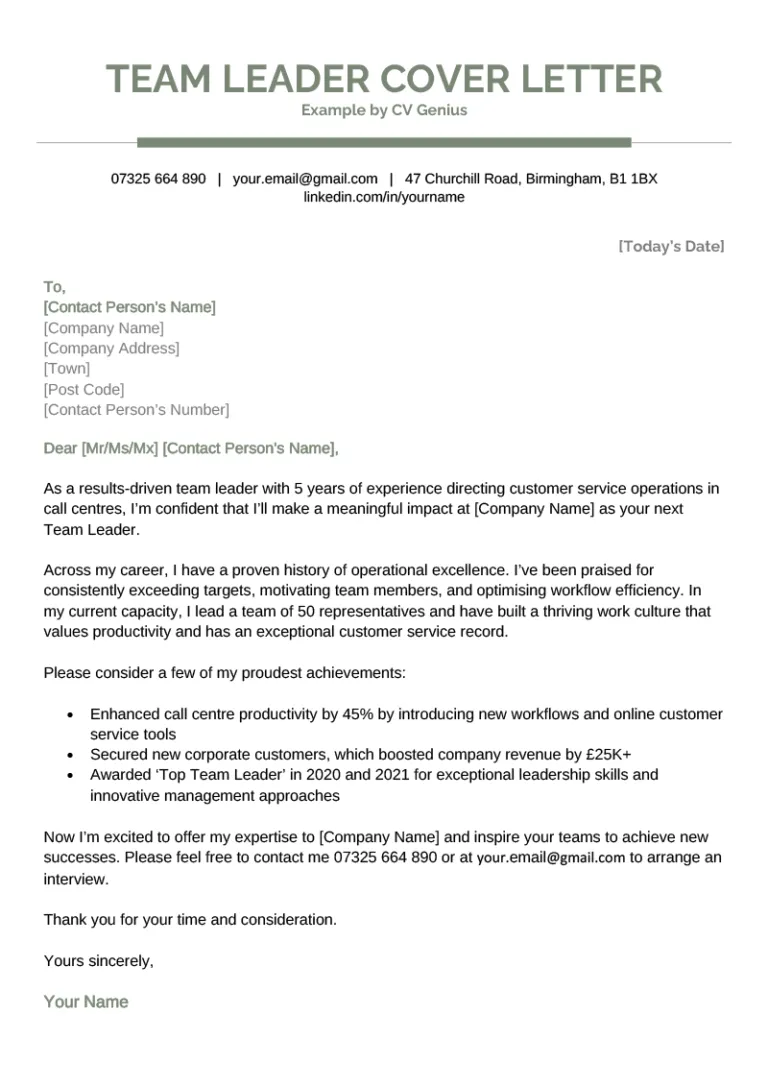
Crafting the Perfect Team Leader Cover Letter
A well-crafted cover letter is a critical component of your application for a team leader position. It provides you with the opportunity to showcase your leadership skills, relevant experience, and enthusiasm for the role. Unlike a resume, which provides a factual overview of your career, a cover letter allows you to tell your story, connect with the hiring manager on a personal level, and highlight why you are the ideal candidate. This guide offers top tips and examples to help you create a compelling cover letter that secures you an interview.
Understanding the Importance of a Cover Letter
The importance of a cover letter cannot be overstated, especially for leadership positions. A cover letter serves as your first impression, and it can make or break your chances of getting an interview. It allows you to elaborate on your resume, providing context and demonstrating your personality. It’s your chance to convince the hiring manager that you’re not just qualified, but that you’re a great fit for their team and company culture. A well-written cover letter significantly increases your chances of getting noticed in a competitive job market.
Highlighting Leadership Skills

Team leader roles demand strong leadership skills. Your cover letter should clearly demonstrate these skills. Focus on examples where you’ve led teams, motivated individuals, and achieved specific goals. Mention your abilities in delegation, conflict resolution, communication, and decision-making. Show, don’t just tell. Instead of stating “I am a good leader,” provide concrete examples, such as “Managed a team of five, increasing project efficiency by 15% through effective delegation and clear communication.” Leadership skills are not just about managing; they’re about inspiring, guiding, and empowering others to reach their full potential. (Image: leadership-skills-examples.webp)
Demonstrating Relevant Experience
Your cover letter should also highlight your relevant experience. Mention previous team leader positions, projects where you’ve taken the lead, and any specific industry experience that aligns with the job description. Tailor your experience to the specific requirements of the role. If the job description emphasizes project management, highlight your project management experience. If it focuses on customer service, emphasize your experience in customer service leadership. Connect your past experiences with the needs of the new role, showing the hiring manager that you understand their challenges and can contribute to their success. Focus on achievements and results rather than just listing responsibilities. (Image: team-leader-cover-letter-writing.webp)
Essential Components of a Team Leader Cover Letter
Header and Contact Information

Your cover letter should start with a professional header. Include your full name, contact information (phone number and email address), and the date. If you know the hiring manager’s name, address your letter to them. If not, use a general greeting like “Dear Hiring Manager.” Ensure your contact information is accurate and up-to-date so that the hiring team can easily reach you. A well-formatted header sets a professional tone and makes it easy for the reader to identify you and contact you. This seemingly small detail speaks volumes about your attention to detail and professionalism.
The Opening Paragraph: Grabbing Attention
The opening paragraph is your opportunity to grab the reader’s attention. State the position you are applying for and where you saw the job posting. Briefly mention why you are interested in the role and the company. The goal is to immediately convey your enthusiasm and highlight your relevant qualifications. Instead of a generic opening, consider starting with a compelling statement that showcases your key strengths. For example, “With a proven track record of leading successful teams and exceeding performance goals, I am excited to apply for the Team Leader position at [Company Name].” This shows confidence and immediately presents your value. (Image: cover-letter-components.webp)
Body Paragraphs: Showcasing Achievements
The body paragraphs are where you showcase your achievements and skills in detail. Use these paragraphs to provide specific examples of your leadership experience. Focus on quantifiable results whenever possible. Use the STAR method (Situation, Task, Action, Result) to structure your examples. Describe the situation, the task you faced, the actions you took, and the positive results you achieved. For instance, “In my previous role, I identified a bottleneck in the project workflow (Situation). My task was to streamline the process (Task). I implemented a new project management tool and provided team training (Action). As a result, we reduced project completion time by 20% (Result).” This approach makes your accomplishments clear and compelling.
Tailoring Your Cover Letter to the Role

Always tailor your cover letter to each specific job. Review the job description carefully and identify the key requirements and keywords. Then, incorporate those keywords and requirements into your cover letter. Highlight the skills and experiences that align most closely with the job description. This shows the hiring manager that you have taken the time to understand the role and that you are a good fit. Generic cover letters can be easily spotted and often result in rejection. The more personalized your cover letter, the more likely you are to get noticed.
Quantifying Your Accomplishments
Whenever possible, quantify your accomplishments. Use numbers and data to demonstrate the impact of your work. Instead of saying, “Improved team performance,” say, “Improved team performance by 15% through targeted training and motivation initiatives.” Instead of, “Managed projects effectively,” say, “Managed 10+ projects simultaneously, consistently delivering them on time and within budget.” Quantifiable results make your achievements more credible and demonstrate the value you can bring to the company. Numbers speak louder than words and make it easy for the hiring manager to understand your impact.
The Closing Paragraph: Call to Action
The closing paragraph should reiterate your interest in the position and the company. Summarize why you are a strong fit for the role and reiterate your enthusiasm. Include a clear call to action. For example, “I am eager to discuss how my skills and experience can contribute to [Company Name]’s success. Thank you for your time and consideration. I look forward to hearing from you soon.” Express your gratitude for their time and restate your availability for an interview. A strong closing paragraph reinforces your interest and makes it easy for the hiring manager to move forward with your application.
Formatting and Presentation Tips

Choosing the Right Font and Size
Choose a professional and easy-to-read font, such as Times New Roman, Arial, or Calibri. Use a font size between 10 and 12 points. Ensure that the font size is readable without being overwhelming. Proper formatting improves readability and enhances your professional image. Avoid using overly fancy or distracting fonts, which can make your letter difficult to read. Consistency in font choice and size throughout the document creates a polished and professional look. (Image: cover-letter-formatting.webp)
Proofreading and Editing
Proofread your cover letter carefully for any grammatical errors, spelling mistakes, or typos. Even small errors can create a negative impression and undermine your credibility. Read your cover letter aloud to catch any awkward phrasing or unclear sentences. Ask a friend, family member, or career counselor to review your letter for feedback. A well-proofread cover letter demonstrates your attention to detail and professionalism. Before sending your cover letter, make sure to edit it thoroughly for clarity, accuracy, and overall impact.
Cover Letter Examples for Inspiration

Example 1: Project Management Focused
This example focuses on the Project Management aspects of the team leader position. The candidate emphasizes project delivery, team collaboration, and achieving project goals. This sample cover letter demonstrates how to highlight your experience in leading project teams and delivering successful results, which is an essential aspect of any team leader role. (Image: project-management-cover-letter.webp)
Example 2: Customer Service Leadership
This cover letter emphasizes leadership in a customer service environment. It should highlight experiences in improving customer satisfaction, training customer service representatives, and resolving customer issues effectively. The candidate shows how to leverage their customer service leadership skills to improve team performance and drive customer loyalty, crucial for any organization focused on customer satisfaction. (Image: customer-service-cover-letter.webp)
Example 3: Technical Team Lead

This cover letter example is focused on technical expertise and leadership, highlighting skills relevant to a tech team lead role. The candidate focuses on their technical expertise, ability to lead technical teams, and experience in software development or IT support. This example provides a great template to illustrate how to demonstrate experience in a technical area along with your ability to manage and lead tech-focused teams. (Image: technical-team-cover-letter.webp)