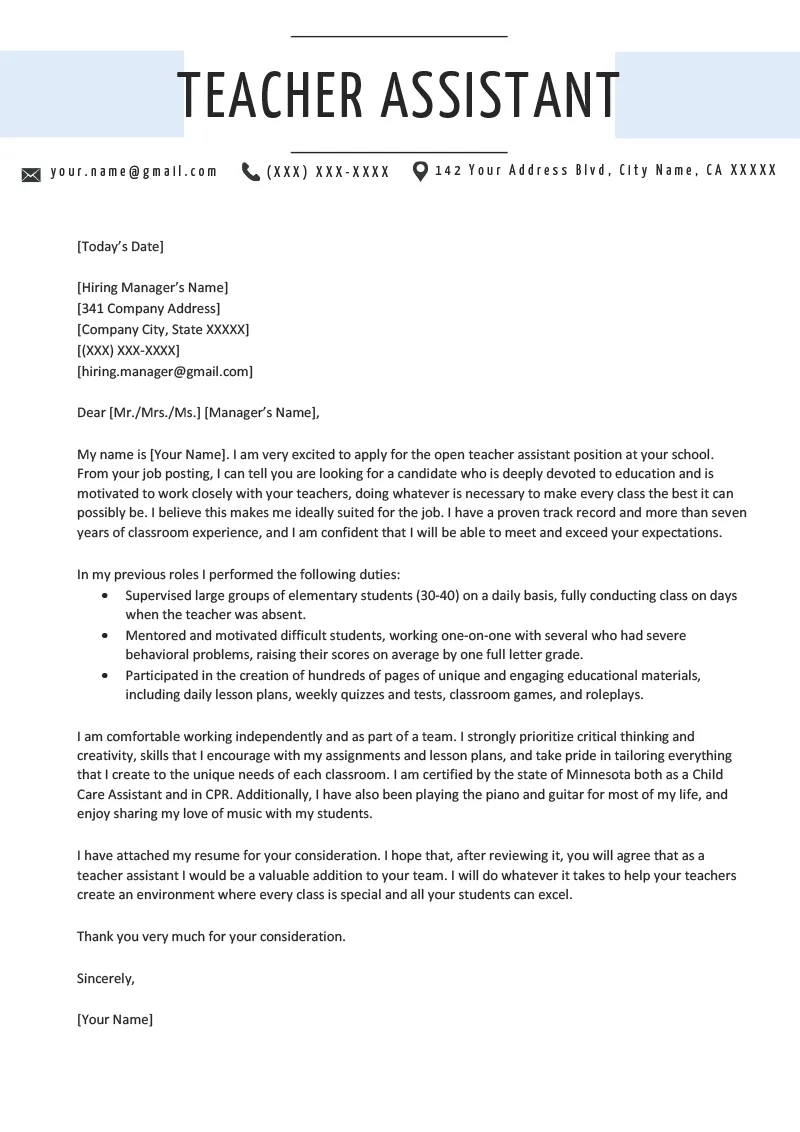
Understanding the Teaching Assistant Role
A teaching assistant (TA) plays a vital role in supporting educators and students within educational environments. Their responsibilities extend beyond simply assisting the teacher; they are integral to fostering a positive and effective learning atmosphere. TAs often work in diverse settings, from elementary schools to universities, adapting their duties to suit the specific needs of the students and the curriculum. The role requires a blend of organizational skills, patience, and a genuine desire to aid in the educational journey of others. Understanding the scope and demands of the position is the first step in crafting a compelling cover letter that showcases your suitability for the job.
Key Responsibilities of a Teaching Assistant
The duties of a teaching assistant are multifaceted and can vary significantly depending on the educational institution and the age group of the students. Generally, TAs are tasked with providing assistance to the lead teacher in a range of activities, from preparing classroom materials and grading assignments to supervising students during lessons and activities. A crucial aspect of the role involves offering individualized support to students who may require extra help, working with small groups to reinforce concepts and provide guidance. Furthermore, teaching assistants often contribute to creating and maintaining a structured, conducive learning environment, managing classroom behavior, and communicating with parents or guardians regarding student progress.
Essential Skills for Teaching Assistants

A successful teaching assistant possesses a combination of essential skills that contribute to their effectiveness in the classroom. Strong communication skills are paramount, as TAs must be able to convey information clearly and concisely to students, teachers, and parents. Organizational skills are equally important, enabling TAs to manage their time effectively, prepare materials efficiently, and maintain an orderly classroom. Patience and empathy are crucial for working with students of all abilities and backgrounds, creating a supportive and understanding learning environment. Adaptability is another key trait, allowing TAs to adjust to different teaching styles, student needs, and unexpected situations that may arise during the school day.
Crafting Your Teaching Assistant Cover Letter
Your cover letter is your opportunity to make a strong first impression and showcase your qualifications for the teaching assistant position. It should be thoughtfully written and tailored to the specific requirements of the job and the educational institution. A well-crafted cover letter demonstrates your understanding of the role, highlights your relevant skills and experience, and expresses your genuine interest in contributing to the education of students. It should complement your resume, providing additional context and elaboration on your capabilities and aspirations. Therefore, taking the time to create a compelling cover letter is a critical step in the application process.
Formatting Your Cover Letter
The format of your cover letter plays a crucial role in its overall effectiveness. A well-structured cover letter is easy to read and presents information in a logical and concise manner. Begin by ensuring your cover letter is properly formatted with appropriate margins, font size, and spacing. A professional-looking format conveys attention to detail and professionalism. Generally, you should use a standard font such as Times New Roman or Arial, with a font size of 11 or 12 points. Maintain consistent spacing throughout the document to improve readability. Using clear headings and paragraphs helps to organize your thoughts and make it easier for the reader to find the most important information quickly. Ensure the tone of your letter is professional and engaging.
Contact Information and Date

Begin your cover letter with your contact information, including your full name, address, phone number, and email address. This allows the hiring manager to easily reach you. Following your contact information, include the date. It’s essential to keep your contact details up to date to ensure that you can be contacted quickly if an interview opportunity arises. Accurate contact details ensure that the hiring manager can readily reach out to you.
Salutation
Address your cover letter with a professional salutation. If you know the name of the hiring manager, use it. For example, “Dear Mr. Smith.” If the name of the hiring manager isn’t provided, use a general greeting, such as “Dear Hiring Manager” or “To Whom It May Concern.” Addressing the reader by name creates a more personal connection, showing that you have taken the time to research and personalize your application. Always make sure to double-check the name and title to avoid errors.
Body Paragraph 1: Introduction
In the introductory paragraph, state the position you are applying for and where you found the job posting. Briefly mention your enthusiasm for the role and your initial impression of the educational institution. This paragraph should immediately capture the reader’s attention and clearly communicate your intentions. Keep your introduction concise but impactful, highlighting your main motivations and key qualifications. Briefly mention your strong interest in education or your dedication to students to capture their attention. Demonstrate your awareness of the school’s mission, programs, or values.
Body Paragraph 2: Highlighting Skills and Experience

The second paragraph is the core of your cover letter, where you demonstrate your skills and experience. Focus on relevant skills that match the job description. Provide specific examples of how you have used these skills in the past. Quantify your achievements whenever possible to showcase your impact. For instance, instead of saying “assisted students,” you might say “provided individualized support to 20 students, resulting in a 15% improvement in their grades.” This is the section where you connect your accomplishments with the requirements of the teaching assistant role. Emphasize the skills most valued by the employer, such as communication, patience, organization, and adaptability.
Body Paragraph 3: Demonstrating Passion
Show your passion for the role and your commitment to education in this paragraph. Explain why you are interested in becoming a teaching assistant and what motivates you to work with students. Share your understanding of the school’s mission or values and how you can contribute to its educational environment. You might describe your philosophy on education, your dedication to creating a positive learning environment, or your desire to help students succeed. It is important to show the hiring manager that you are not just looking for a job, but that you genuinely care about the educational success and well-being of students.
Body Paragraph 4: Closing and Call to Action
In the closing paragraph, reiterate your interest in the position and express your enthusiasm for the opportunity. Include a call to action, such as requesting an interview. Thank the hiring manager for their time and consideration. Restate your contact information, and make sure to proofread your cover letter carefully to avoid any spelling or grammatical errors. Be sure to keep the tone professional and show your excitement to discuss your qualifications in more detail.
Cover Letter Examples for Teaching Assistant Jobs

Reviewing different examples can give you a solid understanding of how to format and structure your cover letter. Below are a few examples, adapted for different situations. These examples can serve as inspiration, but remember to personalize your own cover letter with your specific experience and skills. Tailoring the content is key to make your application more effective.
Example 1 Elementary School Teaching Assistant
Dear Hiring Manager, I am writing to express my keen interest in the Teaching Assistant position at [School Name], as advertised on [Platform]. I was immediately drawn to [School Name]’s commitment to [mention a school value], which aligns with my belief in creating a nurturing environment for young learners. As a recent graduate with a degree in Elementary Education, I have experience working with children aged 5-11, and I am eager to support their educational journey. In my previous role as a volunteer at [Organization], I assisted teachers with lesson preparation, managed classroom activities, and provided individualized support to students who were struggling with reading. My patience, strong communication skills, and ability to adapt to different learning styles make me well-suited to this role. I am excited to contribute to [School Name]’s mission and am available for an interview at your earliest convenience. Thank you for your time and consideration.
Example 2 High School Teaching Assistant
Dear [Hiring Manager Name], I am applying for the Teaching Assistant position at [High School Name], as advertised on [Platform]. I am impressed by the school’s focus on preparing students for college and beyond. As a former student of [Subject] at [University Name], I have a strong academic background and a passion for assisting high school students in their studies. During my studies, I tutored high school students in [Subject], helping them improve their grades and comprehension. I am proficient in creating and implementing effective study strategies, providing personalized support, and fostering a positive learning environment. I am eager to bring my skills to [High School Name] and help your students succeed. I look forward to the opportunity to discuss my qualifications further. Thank you for your consideration.
Example 3 Special Education Teaching Assistant

Dear Hiring Manager, I am writing to express my interest in the Special Education Teaching Assistant position at [School Name], as advertised on [Platform]. I am deeply committed to supporting students with special needs and creating inclusive learning environments. My experience includes working as a volunteer in [Organization], where I provided one-on-one assistance to students with various learning disabilities, helping them with their daily tasks, and ensuring they felt safe and supported. I am proficient in adapting teaching materials, managing classroom behavior, and collaborating with teachers and parents. I am patient, compassionate, and dedicated to ensuring all students have the opportunity to thrive. I am excited about the chance to contribute to [School Name]’s special education program. Thank you for considering my application.
Common Mistakes to Avoid
Several mistakes can undermine the effectiveness of your cover letter. Avoiding these pitfalls can significantly improve your chances of landing an interview. One common mistake is submitting a generic cover letter that is not tailored to the specific job or school. Failing to carefully proofread your cover letter can result in errors that make your cover letter appear unprofessional. Avoid using excessive jargon or overly complex language, which can confuse the reader. Another pitfall is focusing too much on your needs rather than the needs of the school. Be sure to provide details to demonstrate how you will benefit the school. It is extremely important to be accurate, providing honest statements.
Proofreading Your Cover Letter
Proofreading is an essential step in the application process, ensuring your cover letter is free of errors. Errors in grammar and spelling can make your cover letter appear careless and unprofessional. Before submitting your cover letter, read it carefully, and use a grammar checker to identify any mistakes. Ask a friend, family member, or career counselor to review your letter and provide feedback. Ensure the language is clear, concise, and easy to understand. Accurate proofreading assures that your cover letter is polished and professional, thus creating a strong impression.
Tailoring Your Cover Letter

Tailoring your cover letter to each specific job application is crucial. Take the time to review the job description carefully and identify the specific skills and qualifications the employer is seeking. Customize your cover letter to highlight your relevant experience and skills that match those requirements. Research the school or educational institution and demonstrate your understanding of its mission and values. By tailoring your cover letter, you can show the hiring manager that you are genuinely interested in the specific role and that you have the right qualifications to succeed. Address the hiring manager by name, if possible, and mention any specific programs or initiatives at the school that interest you.
The Importance of a Strong Cover Letter
A strong cover letter is more than just a formality; it is a critical tool in your job search. It is your opportunity to make a positive first impression, highlight your key qualifications, and express your genuine interest in the teaching assistant position. A well-written cover letter can set you apart from other applicants, increasing your chances of securing an interview. Remember to tailor your cover letter to each specific job, proofread it carefully, and showcase your passion for supporting students and educators. Investing the time and effort to create a compelling cover letter is a worthwhile investment in your career, making you stand out from the competition and increasing your chances of securing your desired role.