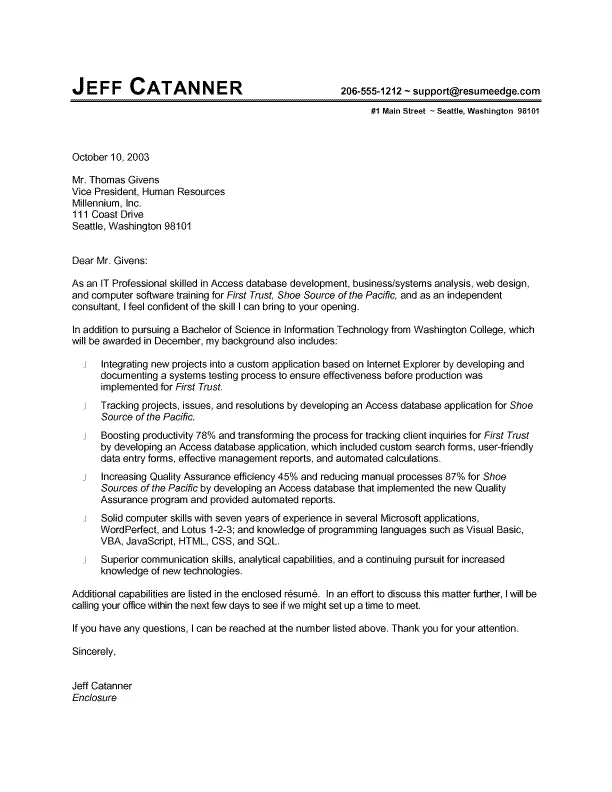
Why Cover Letters Matter in the IT Field
In the competitive world of Information Technology, a well-crafted cover letter is your first opportunity to make a strong impression and secure an interview. It’s more than just a formality; it’s a crucial tool to showcase your personality, passion, and professional skills. While your resume provides a snapshot of your experience and qualifications, the cover letter allows you to tell a story, connect with the hiring manager, and explain why you’re the perfect fit for the role and the company. It demonstrates your communication skills and your understanding of the specific job requirements. A great cover letter can significantly increase your chances of getting noticed and moving forward in the hiring process, differentiating you from other applicants.
Highlighting IT Skills
When highlighting your IT skills, be specific and relevant. Instead of simply listing generic skills like “proficient in Microsoft Office,” provide more detail. For example, you could state “Experienced in administering and maintaining Windows Server 2019, including Active Directory, Group Policy, and DNS.” Tailor the skills you mention to the specific job description. If the role requires expertise in cloud computing, emphasize your experience with platforms like AWS, Azure, or Google Cloud. If the role focuses on cybersecurity, highlight your certifications, such as CISSP or CompTIA Security+, and detail your experience with firewalls, intrusion detection systems, and vulnerability assessments. Quantify your skills whenever possible. For example, “Reduced server downtime by 15% through proactive monitoring and maintenance.” This level of detail demonstrates a strong understanding of the technical aspects of the job and shows that you have the practical experience to succeed.
Quantifiable Achievements

Quantifiable achievements are the cornerstone of a compelling cover letter. They provide concrete evidence of your accomplishments and demonstrate the value you can bring to a potential employer. Instead of saying “Improved network performance,” state “Improved network performance by 20% by optimizing network configurations and upgrading outdated hardware.” Use numbers, percentages, and specific metrics to showcase your successes. For example, you might highlight that you “reduced IT support tickets by 25%” or “implemented a new security protocol that decreased security breaches by 30%.” Focus on achievements that directly relate to the job requirements. If the job description emphasizes project management skills, describe a project you successfully managed, including the budget, timeline, and results. This demonstrates that you can deliver tangible results and that you’re not just stating your skills, but have proven your abilities.
Understanding the IT Job Market
The IT job market is dynamic, with constant evolution in technologies and demands. To write a winning cover letter, it’s essential to understand current trends and employer expectations. Research the types of roles in high demand, such as cybersecurity specialists, cloud engineers, data scientists, and DevOps engineers. Understand the specific skills and certifications that are sought after in these roles. Stay current with industry news, such as which companies are expanding and what technologies are gaining traction. Tailor your cover letter to the specific company and the role. Look at the company’s recent projects and initiatives to see how your skills and experience align. Many companies are looking for professionals with soft skills, such as communication, teamwork, and problem-solving, as well as technical proficiency. Highlighting these soft skills in your cover letter can also give you an advantage.
Tailoring Your Cover Letter to the Job Description
A generic cover letter is easily discarded. To make a positive impression, you must tailor your cover letter to each job application. Start by carefully reading the job description and identifying the key requirements and desired skills. Note the specific keywords used and incorporate them naturally throughout your letter. Address the specific needs of the employer and explain how your skills and experience align with their requirements. Give examples that directly correlate with the job’s duties. For example, if the job description requires experience with a specific software, highlight your experience with it and describe how you used it in previous roles. Personalize your letter by mentioning the company and the hiring manager (if you know their name). Research the company’s mission, values, and recent projects. This shows that you are genuinely interested in the opportunity and that you have taken the time to understand their needs. Show how your values align with theirs.
Researching the Company Culture

Understanding a company’s culture is crucial for crafting a cover letter that resonates with the hiring manager. Research the company’s website, social media profiles, and employee reviews on platforms like Glassdoor. Look for information about the company’s values, mission, and work environment. Does the company emphasize collaboration, innovation, or work-life balance? Incorporate this information into your cover letter. For example, if the company values teamwork, mention your experience working in collaborative environments and describe how you contributed to team successes. If they prioritize innovation, highlight your experience with new technologies or your ability to solve complex problems. This shows that you understand the company and that you are a good cultural fit. Avoid generic statements. Instead, personalize your letter by mentioning something specific that you admire about the company or its work.
Showcasing Your Technical Expertise
In an IT cover letter, showcasing your technical expertise is paramount. Go beyond listing your skills; provide specific examples of how you’ve applied them. Use the STAR method (Situation, Task, Action, Result) to describe your accomplishments. For instance, “In a previous role at [Company Name], I was tasked with improving the performance of our database. The situation was slow query times and frequent server crashes. My task was to optimize the database performance. I took action by restructuring the database, implementing indexing strategies, and upgrading the server hardware. As a result, the query times decreased by 40% and server crashes were eliminated, improving overall efficiency.” Mention specific projects where you used your skills, outlining the technologies involved and the outcomes you achieved. This will demonstrate that you can apply your skills practically, solving real-world problems. Always tailor your technical expertise to align with the job description, focusing on the skills and technologies most relevant to the role.
Formatting Your IT Cover Letter
A well-formatted cover letter is easy to read and demonstrates professionalism. Choose a clear and professional font, such as Times New Roman, Arial, or Calibri, and use a font size between 10 and 12 points. Keep your letter concise, ideally no more than one page. Use clear headings, subheadings, and bullet points to break up the text and make it easy to scan. Ensure your letter has sufficient white space, with consistent margins and line spacing. Use a professional letter format, including your contact information, the date, and the recipient’s information at the top. Use a professional and grammatically correct tone. Avoid using slang, contractions, or overly casual language. Proofread your cover letter carefully for any typos or grammatical errors. A polished format showcases your attention to detail and your commitment to professionalism.
Contact Information and Header

Your contact information should be at the top of your cover letter. Include your full name, phone number, email address, and LinkedIn profile URL. If you have a professional website or portfolio, you can include its URL as well. Make sure your email address is professional; avoid using nicknames or unprofessional email addresses. The header of your letter should include the date and the recipient’s information. If possible, address the hiring manager by name; this shows you have taken the time to personalize your application. Include the hiring manager’s title and the company’s address. If the job posting doesn’t specify a contact person, try to research the name of the hiring manager online, or address it to the hiring team or the hiring manager, if the name isn’t available. This shows that you are thorough and detail-oriented.
Professional Tone and Language
The tone and language you use in your cover letter should be professional and reflect your understanding of the IT industry. Use clear, concise language and avoid jargon that may not be familiar to the reader. Focus on your accomplishments and how you can contribute to the company. Use strong action verbs to describe your achievements. Instead of saying “Responsible for managing servers,” write “Managed and maintained over 50 servers, ensuring 99.9% uptime.” Maintain a positive and enthusiastic tone throughout the letter. Avoid being overly casual or using slang. Proofread your letter carefully for any typos or grammatical errors. Ensure that your cover letter flows well and demonstrates your communication skills. This is your chance to demonstrate that you possess the essential soft skills.
Using Keywords Effectively
Using relevant keywords is essential for getting your cover letter noticed, especially since many companies use Applicant Tracking Systems (ATS) to screen applications. Read the job description carefully and identify the key skills, qualifications, and keywords the employer is looking for. Incorporate these keywords naturally throughout your cover letter. Don’t stuff keywords; instead, use them contextually and in a way that makes sense. For example, if the job description mentions “cloud computing,” use this term when describing your experience with AWS, Azure, or Google Cloud. Use keywords in your skills section, your accomplishments, and when describing your responsibilities. Review and adjust your cover letter to match each job description to ensure you include the most relevant keywords. Remember that the goal is to demonstrate your skills and qualifications in a way that resonates with the employer and clearly shows that you are a good fit.
Cover Letter Examples

Reviewing cover letter examples can provide insights and ideas for writing your own. Here are a few examples tailored for different IT roles. They demonstrate how to highlight different aspects and tailor the content to specific job requirements and experience levels. Remember, it is only a starting point and you need to modify them to fit your specific skills and experience.
Junior IT Professional Sample
Dear [Hiring Manager Name],
I am writing to express my keen interest in the Junior IT Support Specialist position at [Company Name]. With my recent degree in Information Technology from [University Name] and hands-on experience in troubleshooting hardware and software issues, I am confident I possess the skills to excel in this role.
During my internship at [Previous Company], I assisted in resolving over 50 technical issues per week, improving user satisfaction. I am proficient in Windows and macOS operating systems, and have experience with help desk software, such as [Software Name]. I am a quick learner, a dedicated team player, and eager to contribute to your team.
I am excited about the opportunity to learn from experienced professionals at [Company Name]. Thank you for your time and consideration. I look forward to hearing from you soon.
Sincerely, [Your Name]
Mid-Level IT Specialist Sample
Dear [Hiring Manager Name],
I am writing to apply for the IT Specialist position at [Company Name], as advertised on [Platform]. With over five years of experience in network administration and cybersecurity, I am well-equipped to address your needs.
In my previous role at [Previous Company], I implemented and maintained a network infrastructure that supported over 200 users, leading to a 15% improvement in network efficiency. I have certifications in CompTIA Network+ and Security+, and I have practical experience with firewalls, intrusion detection systems, and vulnerability assessments. I am proficient in [Specific Technologies], and I am dedicated to ensuring secure and efficient IT operations.
I am impressed by [Company Name]’s commitment to innovation, and I am eager to contribute my expertise to your team. Thank you for your consideration. I have attached my resume for your review.
Sincerely, [Your Name]
Senior IT Manager Sample

Dear [Hiring Manager Name],
I am writing to express my interest in the Senior IT Manager position at [Company Name], as advertised on [Platform]. With over ten years of experience in IT management, including strategic planning, budget management, and team leadership, I am confident that I can make a significant impact.
In my previous role at [Previous Company], I led a team of 20 IT professionals, managing a budget of over $2 million. I oversaw the implementation of [Specific Project], which increased efficiency by 20% and reduced operational costs by 10%. I am certified in ITIL and PMP, and I am proficient in [Specific Technologies]. I am a strategic thinker, a strong communicator, and I am adept at motivating teams and delivering results.
I am particularly drawn to [Company Name]’s innovative approach to [Specific Area]. I am excited about the opportunity to lead your IT department and to contribute to your continued success. Thank you for your time and consideration. I look forward to hearing from you soon.
Sincerely, [Your Name]
Common Mistakes to Avoid
While crafting a cover letter, it’s crucial to avoid common mistakes that can detract from your application. These mistakes can range from simple errors to fundamental flaws in your approach. By knowing these, you can ensure your cover letter is polished and professional, significantly improving your chances of getting noticed.
Typos and Grammatical Errors
Typos and grammatical errors are easily avoided, but they can make a negative impression on hiring managers. Proofread your cover letter carefully before submitting it. Use spell-check and grammar-check tools, but do not solely rely on them. Read your letter aloud to catch any awkward phrasing or errors. If possible, have a friend or colleague review your letter as well. Multiple sets of eyes can often identify mistakes that you might miss. Pay attention to punctuation, capitalization, and sentence structure. Even minor errors can make you appear unprofessional and can lead to your application being immediately rejected. Double-check all details, including the company name, the hiring manager’s name, and job title.
Generic Cover Letters
Generic cover letters, or those that could be sent to any company or any role, are a major turnoff for hiring managers. Avoid using a template and not personalizing your message. Each cover letter should be tailored to the specific job you are applying for. Demonstrate that you understand the company’s needs and that your skills and experience align with their requirements. Research the company and the role, and use this information to customize your letter. Mention specific projects, technologies, or challenges that you can address. Show genuine interest in the company and the opportunity. If you show you understand the company’s values, mission, and recent initiatives, you will distinguish yourself from applicants who are simply sending out mass applications.
Ignoring the Job Description
Ignoring the job description is one of the most common mistakes in cover letter writing. The job description is your roadmap to a successful application. Carefully read the job description and identify the key skills, qualifications, and keywords the employer is looking for. Tailor your cover letter to address these requirements specifically. Highlight your relevant experience and skills, and provide concrete examples of your accomplishments. If the job description mentions specific technologies, make sure to mention your experience with them. Failing to address the requirements listed in the job description shows that you either haven’t taken the time to read the job posting or that you are not a good fit for the role. The more you address those needs, the higher your chance of securing an interview.
Conclusion
Writing a professional IT cover letter is a critical step in your job search process. It provides a space to showcase your skills, personality, and passion for the IT field. By highlighting your expertise, quantifying your achievements, and tailoring your letter to each job application, you can increase your chances of making a positive impression and securing an interview. Remember to avoid common mistakes, such as typos, generic content, and ignoring the job description. With a well-crafted cover letter, you can stand out from the competition and take a significant step towards landing your dream IT job. Good luck!