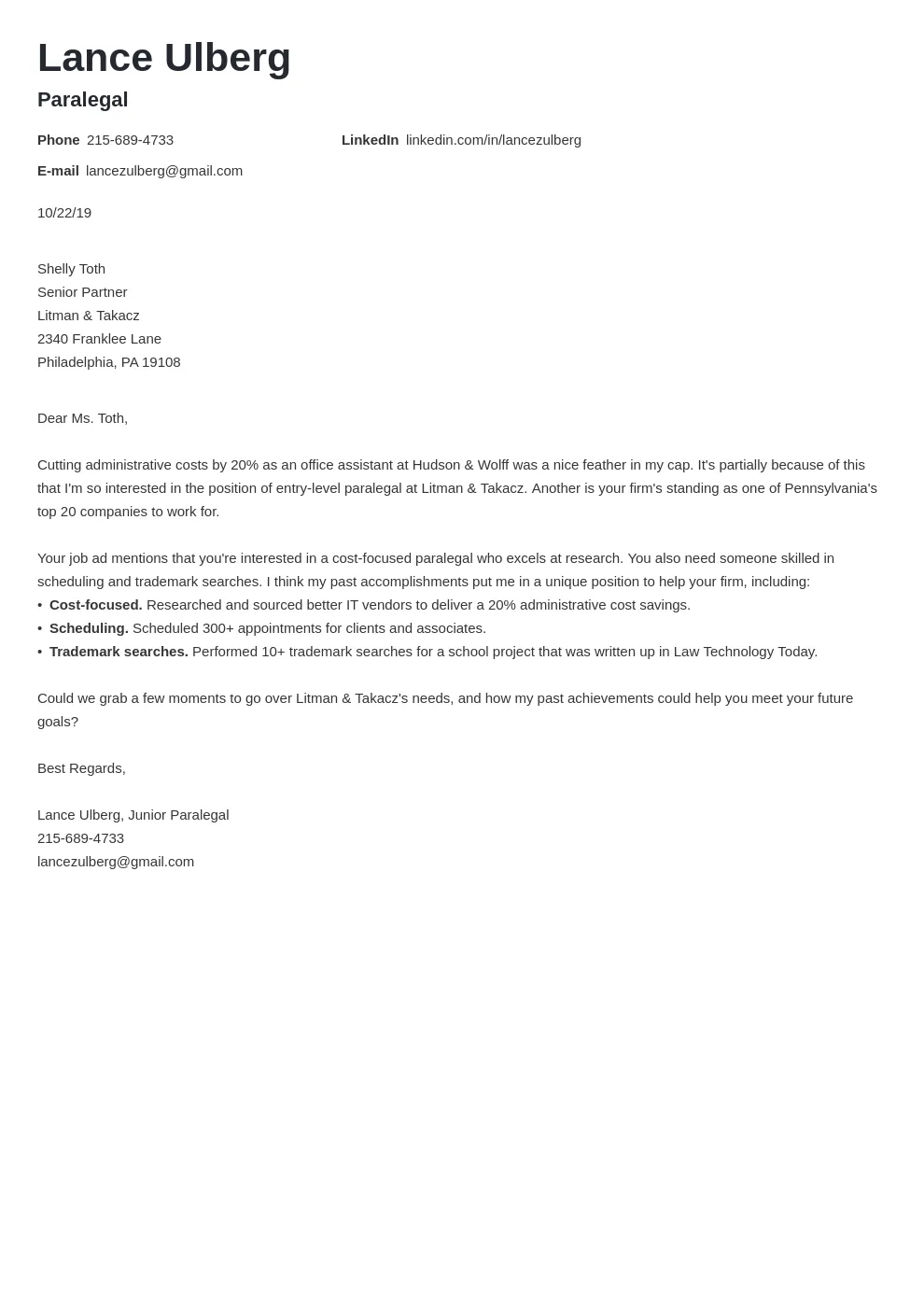
Crafting the Perfect Paralegal Cover Letter
A well-crafted cover letter is your first chance to make a positive impression on a potential employer. For paralegals, this document is crucial because it complements your resume by providing context and demonstrating your communication skills. It’s more than just a formality; it’s a marketing tool that showcases your personality, expertise, and enthusiasm for the role. A poorly written cover letter can easily lead to your application being overlooked, no matter how impressive your qualifications are. This guide will offer actionable tips to help you create a compelling cover letter that stands out. Remember, this document gives you the opportunity to elaborate on your skills and experiences, and to explain why you’re the ideal candidate for the position.
Highlighting Your Skills and Experience
Your paralegal cover letter should prominently feature your relevant skills and experience. Think of it as a snapshot of your professional capabilities tailored specifically for the job. Start by reviewing the job description carefully. Identify the key skills and qualifications the employer is seeking. Then, use your cover letter to provide evidence of your abilities, providing specific examples from your work history that demonstrate your proficiency. Your goal is to show the employer that you possess the skills and experience they are looking for. This is the opportunity to tell the employer why you’re the best fit for the job by showcasing a combination of hard and soft skills, and how those skills match the requirements of the paralegal position.
Showcasing Relevant Skills

Highlighting relevant skills is crucial in your cover letter. Focus on the skills most pertinent to the paralegal role you’re applying for. These might include legal research, drafting legal documents, case management, and client communication. Provide concise, clear examples of how you have used these skills in previous roles. For instance, if the job description emphasizes legal research, you could mention your experience using Westlaw or LexisNexis and the successful outcomes of your research efforts. For example, you can discuss your experience in preparing legal documents, outlining the types of documents and the successful outcomes. The aim is to quickly demonstrate to the reader that your skill set aligns well with their needs, reinforcing your suitability for the position.
Quantifying Your Achievements
Quantifying your achievements adds credibility to your cover letter. Instead of simply stating what you did, demonstrate the impact of your work. Use numbers, percentages, or specific data to show your accomplishments. For example, instead of saying you ‘managed cases,’ you could state that you ‘managed a caseload of 50+ cases simultaneously, consistently meeting deadlines and reducing case processing time by 15%.’ This approach provides concrete evidence of your capabilities and helps the employer understand your value. It helps set you apart from other applicants. Consider how you can measure your impact, such as the number of documents drafted, successful outcomes achieved, or client satisfaction levels. Use action verbs to describe your contributions.
Tailoring to the Specific Job
A generic cover letter will likely end up in the digital trash. Customization is vital. Each cover letter should be tailored to the specific job and the employer. This shows you’ve taken the time to understand the role and the organization’s needs. Begin by carefully reviewing the job description, paying attention to the required qualifications, responsibilities, and the company culture. Use this information to customize your letter, highlighting the skills and experiences that directly align with their requirements. Also, demonstrate your knowledge of the organization. This might involve mentioning a specific case the firm handled or its reputation in the legal community. This level of personalization shows genuine interest and makes you a more compelling candidate. Demonstrating this level of preparation sets you apart.
Researching the Law Firm or Company

Thorough research of the law firm or company is critical to a successful cover letter. Knowing the firm’s practice areas, recent cases, and values helps you tailor your letter. Visit the company website, review their social media profiles, and read news articles or press releases related to the firm. Note any special initiatives, awards, or recognition the company has received. If possible, research the hiring manager or any individuals who work at the firm. This information allows you to address specific aspects of the firm’s work in your cover letter. By demonstrating you have researched the organization, you signal to the employer that you are truly interested in working there. This also allows you to use the same keywords as the company and show you are a good fit.
Addressing the Hiring Manager Directly
Whenever possible, address your cover letter to the hiring manager by name. This personal touch makes your letter more engaging and demonstrates you’ve taken the initiative to learn more about the company. If you can’t find the name of the hiring manager, you can try searching on LinkedIn or the company website. If all else fails, use a professional greeting, such as ‘Dear Hiring Manager’ or ‘Dear [Department Name] Hiring Team.’ Avoid generic salutations such as ‘To Whom It May Concern.’ It is important to start off your cover letter with this greeting, it sets the tone for the rest of the document. Personalizing your cover letter from the start gives you an advantage. It demonstrates you are proactive and eager to connect with the company.
Formatting and Presentation Matters
The formatting and presentation of your cover letter are essential components in making a great first impression. A well-formatted cover letter is easy to read, visually appealing, and reflects your attention to detail. Choose a professional font like Times New Roman, Arial, or Calibri in a readable size (11-12 points). Use a clean layout with clear margins (1 inch is standard) and ample white space. Break up your text into concise paragraphs and use bullet points to highlight key information. Proofread your cover letter carefully and use a professional template. A well-formatted cover letter suggests that you are organized, detail-oriented, and capable of producing high-quality work. The layout shows you are a good communicator and take the time to pay attention to detail.
Using a Professional Tone

The tone of your cover letter should be professional and appropriate for a legal environment. Use formal language, avoid slang, contractions, and overly casual expressions. Your writing should be clear, concise, and grammatically correct. Demonstrate confidence and assertiveness in your writing style. Frame your experiences and skills to highlight how they align with the requirements of the paralegal position. Even if you are unsure about your abilities, the proper professional tone can give you a leg up. Make sure to proofread your cover letter, and use a professional tone that reflects your commitment to the legal profession. A professional tone builds your credibility and helps to set you apart.
Proofreading and Editing Meticulously
Proofreading and editing are crucial steps in creating a polished cover letter. Typos, grammatical errors, and formatting inconsistencies can undermine your professionalism and credibility. Proofread your letter multiple times, checking for any errors in spelling, grammar, punctuation, and sentence structure. Read your cover letter aloud to catch any awkward phrasing or unclear statements. Ask a friend, family member, or career counselor to review your cover letter for a second opinion. Consider using online tools such as Grammarly or ProWritingAid to help identify errors. The best way to show you are detail-oriented is to proofread meticulously. A well-edited cover letter demonstrates your commitment to producing high-quality work and attention to detail, which are essential qualities for a paralegal.
Making a Strong First Impression
Your cover letter is the first introduction to a potential employer. It should make a strong first impression. Start with a compelling opening that grabs the reader’s attention. Briefly state your interest in the position and highlight your key qualifications. In the body paragraphs, showcase your most relevant skills and experiences, providing specific examples to support your claims. End your cover letter with a confident closing statement that expresses your enthusiasm for the opportunity and your desire to discuss your qualifications further. The first impression you make is the most important. Make the most of your first impression, and show the employer you are the right person for the job. Think of your cover letter as your chance to sell yourself. Your first impression should emphasize your qualifications, and show that you are the ideal candidate.
Expressing Enthusiasm and Interest

Expressing enthusiasm and interest is a crucial part of your cover letter. It is one of the most important elements. Show genuine excitement about the position and the company. Mention specific aspects of the role or organization that appeal to you. Convey your eagerness to contribute to the team. Use positive and energetic language throughout your letter. Avoid sounding generic. Personalize your statements to demonstrate your genuine interest. For example, if you are particularly drawn to a law firm’s commitment to a certain area of law, mention it. Doing this shows your genuine interest in the company. This enthusiasm makes a positive impression on the hiring manager and increases the likelihood of your application being considered.
Adding a Call to Action
Include a clear call to action in your cover letter. This encourages the employer to take the next step in the hiring process. State that you are eager for an interview to discuss your qualifications further. Provide your contact information, including your phone number and email address, and express your availability for an interview. Make it easy for the hiring manager to contact you. This could be done by adding a line that you are available to interview at their earliest convenience. A clear call to action shows confidence and proactive engagement. It will leave the employer feeling like you are serious about the role and are eager to start.