Crafting Your New Grad RN Cover Letter
As a new graduate Registered Nurse (RN), the job market can seem daunting. One of the most critical tools in your arsenal is a well-crafted cover letter. This document serves as your introduction to potential employers, providing a glimpse into your skills, experiences, and personality. Unlike your resume, which lists your qualifications, your cover letter allows you to tell a story, demonstrating your passion for nursing and why you are the perfect fit for their organization. This guide will provide you with the secrets to writing a cover letter that stands out from the crowd and lands you your dream nursing job.
Understanding the Importance of a Cover Letter for New RN Grads
The significance of a cover letter for a new grad RN cannot be overstated. It’s your chance to make a strong first impression, especially when you may lack extensive professional experience. A compelling cover letter showcases your enthusiasm, highlights relevant coursework, clinical rotations, and any volunteer work. It also allows you to explain any gaps in your resume or career changes. Moreover, a well-written cover letter demonstrates your communication skills and attention to detail, qualities that are highly valued in the nursing profession. It sets you apart from other candidates who may simply submit a resume without a personalized introduction.
Highlighting Your Skills and Experiences

Even without years of professional experience, you possess valuable skills gained through your nursing education and clinical rotations. Your cover letter should emphasize these skills, tailoring them to match the requirements of the specific job. This involves identifying the key skills the employer is seeking and demonstrating how your experiences have equipped you with those skills. For example, if the job description mentions a need for strong critical thinking skills, provide an example from your clinical experience where you successfully applied critical thinking to assess a patient’s condition and implement an appropriate intervention. Use action verbs to describe your accomplishments and highlight your abilities.
Showcasing Relevant Clinical Experience
Your clinical rotations are your primary source of experience as a new grad. Your cover letter should highlight the most relevant experiences gained during these rotations. Describe the settings you worked in (e.g., medical-surgical unit, ICU, emergency room), the types of patients you cared for, and the specific skills you utilized. For instance, you might mention your experience with medication administration, patient assessment, wound care, or electronic health records. Quantify your achievements whenever possible. For example, “Assisted in the care of 10+ patients daily, consistently providing excellent patient care and advocating for patient needs.”
Emphasizing Soft Skills and Attributes
While clinical skills are essential, don’t neglect the importance of soft skills in your cover letter. Nursing requires empathy, communication, teamwork, and problem-solving abilities. Demonstrate these qualities by providing examples from your experiences. For example, you could describe a situation where you effectively communicated with a patient’s family to address their concerns, collaborated with a multidisciplinary team to improve patient outcomes, or resolved a conflict with a coworker. Use words like “compassionate,” “detail-oriented,” “organized,” “team player,” and “adaptable” to showcase your personality and work ethic.
Tailoring Your Cover Letter to the Job

One of the biggest mistakes new grads make is sending out generic cover letters. To make your application stand out, tailor each cover letter to the specific job and the organization. This shows the employer that you have taken the time to understand their needs and are genuinely interested in the position. Start by carefully reviewing the job description and identifying the key skills and qualifications they are seeking. Then, customize your cover letter to reflect how your skills and experiences align with those requirements. This may involve changing the order of the information presented or emphasizing certain accomplishments over others.
Researching the Hospital or Clinic
Before writing your cover letter, research the hospital or clinic you are applying to. Visit their website to learn about their mission, values, and patient care philosophy. Look for information about their specialized units, recent achievements, and any community involvement. This research will allow you to personalize your cover letter by mentioning specific aspects of the organization that appeal to you and demonstrating your genuine interest in working there. Highlighting something specific about the organization will show them you have done your homework and are not just sending out a generic application.
Analyzing the Job Description
The job description is your roadmap. Carefully analyze the job description, noting the key requirements, skills, and responsibilities. Identify the keywords and phrases used in the description and incorporate them into your cover letter where appropriate. However, avoid simply repeating the job description verbatim. Instead, use it as a guide to demonstrate how your skills and experiences align with the employer’s needs. Provide specific examples that showcase your ability to meet the job requirements. If the description requires experience with electronic medical records, then mention a specific EHR system, if applicable.
Customizing Your Cover Letter Content

Once you have researched the organization and analyzed the job description, customize your cover letter content. Highlight the skills and experiences that are most relevant to the position. For example, if the job description emphasizes experience in critical care, focus on your ICU or CCU clinical rotations. Use the STAR method (Situation, Task, Action, Result) to describe your accomplishments and quantify your achievements whenever possible. For instance, “During my ICU rotation, I was faced with a patient experiencing a sudden cardiac event. My task was to act quickly. I initiated CPR, worked with the team, and the patient recovered.”
Structuring Your New Grad RN Cover Letter
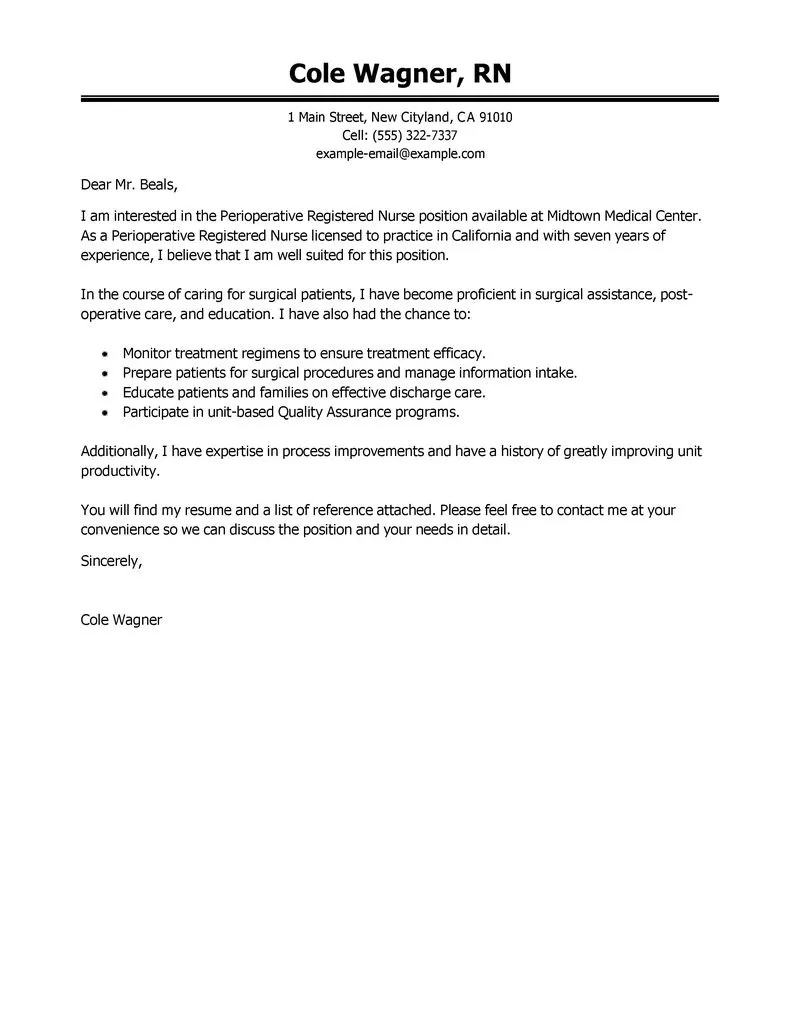
A well-structured cover letter is easy to read and makes a positive impression. Your cover letter should be concise, typically no more than one page in length. Use a professional font, such as Times New Roman or Arial, and maintain a consistent font size (11 or 12 points). Use clear headings and subheadings to break up the text and make it easier to scan. Proofread carefully for any grammatical errors, spelling mistakes, or typos. Your goal is to present a polished and professional document that reflects your attention to detail.
The Header Contact Information
Your header should include your name, address, phone number, and email address. Make sure your email address is professional. If you have a LinkedIn profile, include a link to it in the header. The header should be consistent with the contact information on your resume. The header is the first thing the hiring manager will see, so ensure it is accurate and easy to read. Use a clean and simple format for the header, with your name displayed prominently.
The Opening Paragraph Grabbing Attention

Your opening paragraph should grab the reader’s attention and state your purpose. Begin by clearly stating the position you are applying for and where you saw the job posting. Then, briefly highlight your key qualifications and express your enthusiasm for the opportunity. Consider mentioning a specific aspect of the hospital or clinic that resonates with you or a particular skill that you possess. For example, “I am writing to express my keen interest in the Registered Nurse position at [Hospital Name], as advertised on [Job Board]. I am a highly motivated and compassionate new graduate RN with a strong foundation in critical care nursing, and I am eager to contribute to your team.”
The Body Paragraphs Showcasing Skills
The body paragraphs are the core of your cover letter. Here, you will showcase your skills and experiences in more detail. Use the body paragraphs to highlight your accomplishments, explain how your qualifications align with the job requirements, and provide examples of your skills in action. Use the STAR method to structure your examples, providing context, describing the task, outlining the actions you took, and summarizing the results. Focus on the skills and experiences that are most relevant to the position. For example, if the job requires experience with electronic health records, describe your experience with specific EHR systems and how you used them.
Quantifying Achievements and Experiences
Whenever possible, quantify your achievements and experiences. Instead of saying “I provided excellent patient care,” say “Consistently provided care to 10-12 patients daily, resulting in a 95% patient satisfaction rate.” Numbers and statistics add credibility to your claims and demonstrate your ability to achieve measurable results. Quantifying your accomplishments also makes them more memorable. Consider using numbers to illustrate your ability to improve patient outcomes, reduce medication errors, or improve patient satisfaction. Provide concrete examples to back up your claims.
The Closing Paragraph Call to Action

Your closing paragraph should summarize your interest in the position and express your eagerness to learn more about the opportunity. Reiterate your enthusiasm and thank the hiring manager for their time and consideration. Indicate your availability for an interview and provide your contact information again. A strong closing paragraph includes a call to action, encouraging the hiring manager to contact you to discuss your qualifications further. For example, “Thank you for considering my application. I am excited about the opportunity to contribute to [Hospital Name] and would welcome the chance to discuss my qualifications in an interview. I can be reached at [Phone Number] or [Email Address].”
Formatting and Proofreading
Attention to detail is paramount in nursing, and your cover letter should reflect this. Ensure your cover letter is free of errors. Proofreading is crucial for a professional appearance, and it also demonstrates your ability to pay attention to detail, a critical skill in nursing. Before submitting your cover letter, review your cover letter multiple times. Check for grammatical errors, spelling mistakes, and typos. Read your cover letter aloud to catch any awkward phrasing. Ask a friend, family member, or career counselor to review it as well. They might notice something you missed.
Ensuring Professional Formatting
Professional formatting is essential for making a positive impression. Use a standard, easy-to-read font, such as Times New Roman or Arial, in a 12-point font size. Use single-spacing and a one-inch margin on all sides of the document. Ensure your contact information is consistent with your resume and easy to find. Use clear headings and subheadings to break up the text and make it easier to scan. Maintain a consistent style throughout your cover letter, including the use of bolding, italics, and bullet points.
Proofreading for Errors

Proofreading is the final step. After writing and formatting your cover letter, carefully proofread it for any errors. Check for spelling mistakes, grammatical errors, and typos. Read your cover letter aloud to catch any awkward phrasing or sentences that don’t make sense. Consider using grammar and spell-check tools, but don’t rely on them entirely. Ask a friend, family member, or career counselor to review your cover letter as well. A fresh pair of eyes can often catch mistakes you might have missed.
Common Mistakes to Avoid
Several common mistakes can undermine your cover letter and hurt your chances of getting hired. By being aware of these errors and taking steps to avoid them, you can significantly improve your chances of success. Pay attention to all of the aspects of the cover letter, from the writing style to the structure and the tone.
Generic Cover Letters
Submitting a generic cover letter is one of the biggest mistakes new grads can make. A generic cover letter is not tailored to the specific job or organization, and it often uses vague language that could apply to any nursing position. Employers can easily spot generic cover letters, and they will likely discard them. Instead, always customize your cover letter to the specific job and the organization. Research the hospital or clinic, analyze the job description, and highlight the skills and experiences that are most relevant to the position. Personalizing your cover letter demonstrates your genuine interest in the opportunity.
Focusing on What You Want
Avoid writing a cover letter that focuses primarily on what you want. Your cover letter should demonstrate how you can meet the employer’s needs and contribute to their organization. While it’s important to express your career goals, your primary focus should be on showcasing your skills, experiences, and how they align with the job requirements. Frame your experiences in a way that highlights the benefits you can bring to the organization. Emphasize the value you can add to their team. Showcase your expertise and accomplishments.
Ignoring the Job Requirements
Failing to address the job requirements is a critical mistake. If the job description specifies particular skills or qualifications, ensure that your cover letter highlights your experience and expertise in those areas. Analyze the job description carefully and use it as a guide to tailor your cover letter. Use the STAR method to provide specific examples of your skills and how you have applied them in the past. If the job posting requires experience with a particular system, mention your experiences and how you gained them.
Resources for New Grad RNs
Several resources can help you write a compelling cover letter and navigate your job search. Utilize these resources to enhance your application and increase your chances of landing your dream job. From templates to career advisors, take advantage of the available tools.
Cover Letter Templates and Examples
Online resources offer various cover letter templates and examples for new grad RNs. These templates can provide a starting point for your own cover letter, guiding you on the structure and content. However, be careful to customize the template to reflect your skills, experiences, and the specific job you are applying for. Don’t simply copy and paste a template; make it your own. Browse cover letter examples to see how other new grads have highlighted their qualifications. These can provide inspiration for the language, formatting, and content of your own cover letter.
Additional Tips for New Grad RNs
In addition to writing a strong cover letter, consider these additional tips to increase your chances of success. Preparing for your job search and interview will give you a leg up in the hiring process and show that you are serious about the position.
Following Up on Your Application
After submitting your application, follow up with the hiring manager or the contact person listed in the job posting. This demonstrates your continued interest in the position and allows you to reiterate your qualifications. Send a brief email or make a phone call a week or two after submitting your application. In your follow-up, express your enthusiasm for the opportunity and ask about the status of your application. Thank the hiring manager for their time and consideration. This follow-up strategy increases your chances of getting an interview.