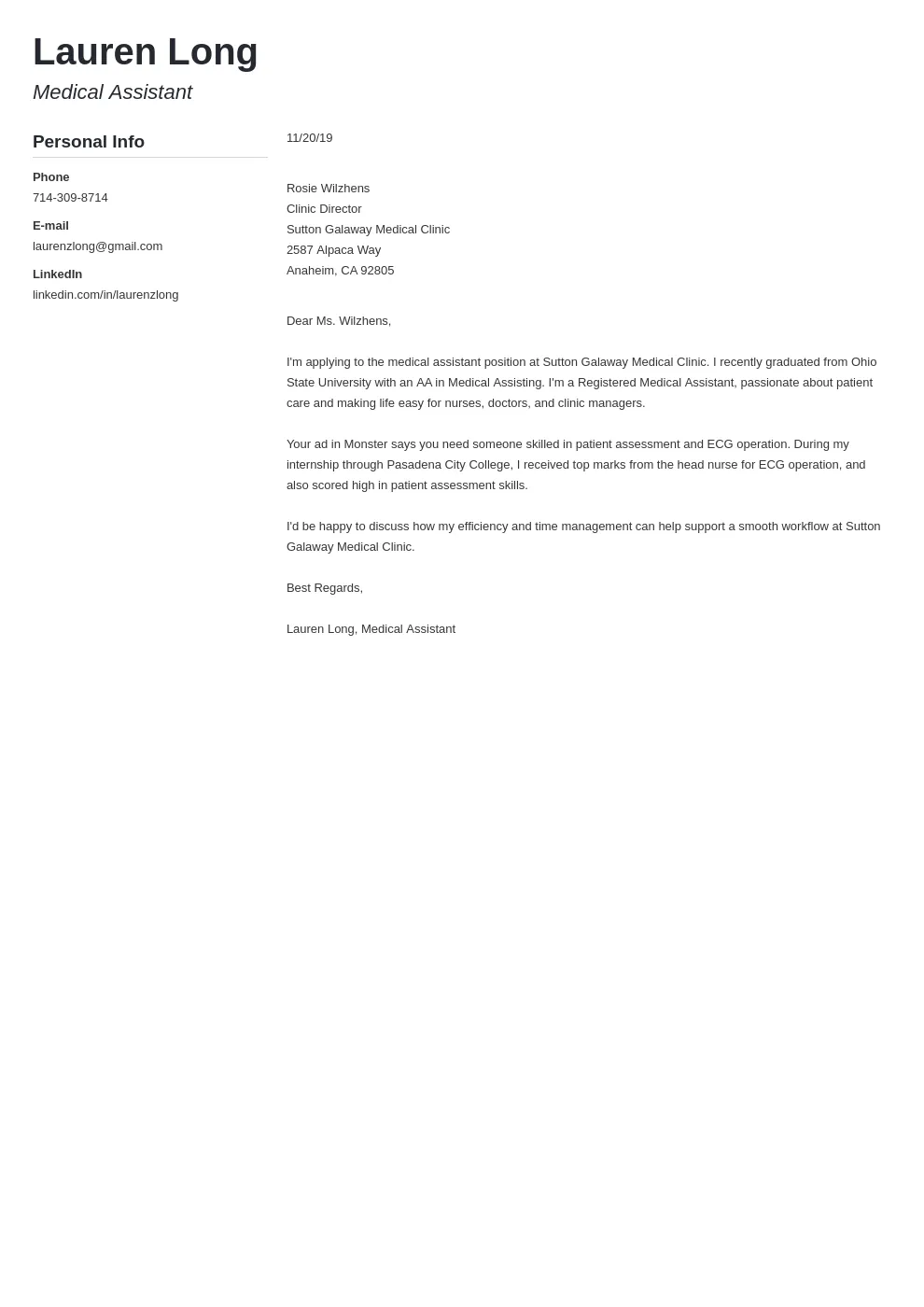
Highlighting Your Skills for Medical Assistant Roles
A compelling cover letter is your first opportunity to make a strong impression and convince the hiring manager that you are the perfect fit for the Medical Assistant position. It’s more than just a formality; it’s a powerful marketing tool where you can showcase your skills and experiences, setting yourself apart from other applicants. Your cover letter provides an opportunity to go beyond the information listed in your resume, allowing you to demonstrate personality, enthusiasm, and a genuine interest in the role and the healthcare facility. Highlighting the right skills and tailoring the letter to each specific job description is the key to landing an interview and ultimately, the job. This guide unveils the secrets to crafting a winning Medical Assistant cover letter that grabs attention and gets you hired.
Medical Assistant Skills to Showcase
The most effective cover letters highlight a balanced mix of clinical, administrative, and soft skills essential for success in the Medical Assistant role. By specifically mentioning these skills and providing tangible examples, you demonstrate your ability to handle various responsibilities and contribute positively to the healthcare team. Remember to align your skills with the job description; if the posting emphasizes patient care, ensure you elaborate on your patient interaction abilities. Showcasing a range of relevant skills is crucial for demonstrating your competence and adaptability in a medical setting.
Clinical Skills

Clinical skills form the bedrock of a Medical Assistant’s daily tasks. These include taking patient histories and vital signs, assisting with physical examinations, preparing and administering medications and injections, and performing basic lab tests. When describing your clinical expertise, focus on specific procedures and technologies you are proficient in. For instance, instead of merely stating ‘competent in taking vital signs,’ you might write, ‘Proficient in accurately recording patient vital signs, including blood pressure, temperature, pulse, and respiration using both manual and automated equipment.’ If you have experience with EMR (Electronic Medical Records) systems, specifically mention the systems you are familiar with, such as Epic or Cerner, as this is a highly desirable skill.
Administrative Skills
Administrative skills are equally important for a Medical Assistant, covering duties such as scheduling appointments, managing patient records, handling insurance claims, and processing billing. In your cover letter, give details about your organizational capabilities, mentioning software or systems you’ve used. For example, instead of saying ’experienced in scheduling appointments,’ you could say, ‘Managed patient scheduling and maintained appointment calendars using [Specific software], ensuring efficient patient flow and minimizing wait times.’ Also include any experience with insurance verification and prior authorizations as this is valuable for employers.
Soft Skills The Key to Success
Soft skills are often the differentiating factor between a good Medical Assistant and an exceptional one. These interpersonal and personal attributes enhance your ability to work effectively with patients, colleagues, and healthcare providers. Highlight your soft skills to showcase your ability to contribute to a positive work environment and patient experience. Demonstrate how you have used these skills in practical situations within your previous roles.
Detail-Oriented and Organized

Medical Assistants deal with detailed information and strict procedures. Your cover letter should reflect your ability to be meticulous and organized. Mention how you have managed complex tasks, maintained accurate records, and adhered to protocols. Include examples where your organizational skills improved efficiency or reduced errors. For example, ‘Successfully implemented a new filing system that reduced paperwork errors by 15%.’
Communication and Interpersonal Skills
Excellent communication is crucial for interacting with patients, doctors, and other healthcare professionals. Highlight your ability to communicate clearly, listen actively, and build rapport. Include any experience with explaining medical procedures, addressing patient concerns, or collaborating in a team environment. A sentence like, ‘Effectively communicated treatment plans to patients, resulting in improved patient understanding and adherence to medical advice,’ demonstrates your communication skills.
Empathy and Compassion
Medical Assistants should display empathy and compassion. In your cover letter, you might say, ‘Demonstrated empathy towards patients, providing comfort and support during difficult times.’ This helps show that you can handle sensitive patient situations and create a supportive atmosphere. You can mention your involvement in patient care, showing your commitment to the well-being of others.
Showcasing Your Experience

When describing your work experience, the STAR method (Situation, Task, Action, Result) is a powerful technique for illustrating your capabilities. Briefly describe the situation, outline the task at hand, detail the actions you took, and, most importantly, highlight the positive results. Quantify your achievements whenever possible. This method provides concrete evidence of your skills and their impact. Use this method to show how you have solved problems or improved processes in previous roles.
Structuring Your Cover Letter
The structure of your cover letter is as important as the content. A well-structured letter is easy to read, making it more likely that the hiring manager will fully understand your qualifications and enthusiasm. A standard cover letter typically consists of an opening statement, body paragraphs, and a closing. Each section should serve a specific purpose, contributing to the overall goal of getting you an interview. Ensure the formatting is consistent, professional, and tailored to the job.
Opening Statement Grabbing Their Attention
Your opening statement is the first impression, so make it count. Start with a strong, attention-grabbing sentence that immediately states why you are interested in the position and what makes you a good fit. Avoid generic phrases and instead, demonstrate your knowledge of the company or role. Express your enthusiasm and connect it to your skills and experience, showing your interest in the specific role. You can mention where you saw the job posting and highlight something about the company that aligns with your goals.
Body Paragraphs Demonstrating Value

In the body paragraphs, elaborate on your skills and experiences, providing specific examples and quantifiable results. Structure your paragraphs around the key requirements of the job description, and explain how your skills match those requirements. Use the STAR method to showcase your accomplishments, emphasizing actions that led to positive outcomes. Be sure to use keywords from the job posting to illustrate that you are a strong match.
Closing Making a Strong Impression
Your closing paragraph should reiterate your interest in the position and express your availability for an interview. Thank the hiring manager for their time and consideration. Restate your enthusiasm for the opportunity and make sure to include a call to action. Make it clear that you look forward to hearing from them soon.
Tailoring Your Cover Letter
Generic cover letters are easy to spot and often get discarded. The key to success is tailoring your cover letter to each specific job application. This shows the employer that you’ve done your research and are truly interested in the specific role. You should tailor your cover letter to highlight the skills and experience that align with the requirements listed in the job posting.
Researching the Employer

Before writing your cover letter, thoroughly research the healthcare facility or practice. Understand their mission, values, and the services they provide. This information can help you personalize your letter, showing that you understand their goals and are eager to contribute. Use their website, social media pages, and any available news articles to gather this information. Demonstrating this knowledge can significantly boost your chances.
Matching Skills to Requirements
Carefully review the job description and identify the key skills and qualifications. Then, tailor your cover letter to directly address these requirements. Use the same keywords that are in the job posting. Explain how your experience and skills align with their needs. This approach assures the hiring manager that you have the capabilities they seek, and shows you understand what the role entails.
Formatting and Proofreading
A well-formatted and error-free cover letter demonstrates your professionalism and attention to detail. Pay close attention to the layout, font, and overall presentation. Proofreading is a must, as typos and grammatical errors can detract from your qualifications.
Formatting Your Cover Letter

Choose a professional font such as Times New Roman, Arial, or Calibri. Keep the font size between 10 and 12 points, and use consistent spacing. Make your cover letter easy to read by using appropriate margins, usually one inch on all sides. Use clear headings and bullet points when listing skills or accomplishments. This format makes the information easier to scan and highlights the most important points. Ensure the layout is clean, organized, and visually appealing.
Proofreading and Editing for Errors
Carefully proofread your cover letter for any spelling or grammatical errors. Mistakes can undermine your credibility. Use spell-check and grammar-check tools, but also read the letter aloud to catch errors that automated tools might miss. Ask a friend or colleague to review your cover letter for a fresh perspective. Double-check all names, titles, and contact information to ensure accuracy. Correct errors can make you stand out from the competition.
By following these tips, you will create a Medical Assistant cover letter that highlights your skills, experience, and enthusiasm. A well-crafted cover letter is your key to opening doors and securing interviews, bringing you one step closer to your dream job in healthcare.