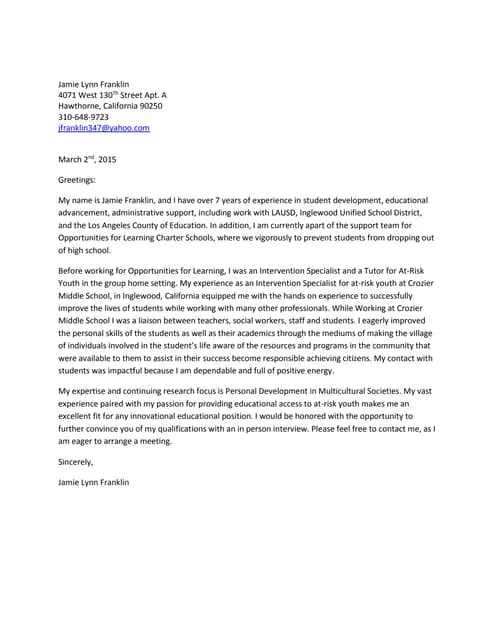
Understanding the Education Cover Letter
An education cover letter is a crucial document that accompanies your resume when applying for teaching positions, administrative roles in educational institutions, or other jobs within the education sector. It serves as your first introduction to a potential employer, providing an opportunity to highlight your qualifications, experience, and passion for education. Unlike a resume, which offers a snapshot of your professional history, a cover letter allows you to tell a story, explaining why you are the ideal candidate and how your skills align with the specific requirements of the job. It’s a chance to make a strong first impression and set yourself apart from other applicants. A well-crafted cover letter demonstrates your communication skills, attention to detail, and genuine interest in the position.
Why is an Education Cover Letter Important?
The importance of an education cover letter cannot be overstated. It’s often the deciding factor in whether or not a hiring manager will invite you for an interview. A compelling cover letter immediately captures the reader’s attention and provides context to your resume. It allows you to personalize your application, showcasing your understanding of the school or institution and your alignment with its values and mission. A cover letter gives you the space to explain any gaps in your employment history, career changes, or unique experiences that make you a strong fit for the role. Moreover, it’s a chance to demonstrate your writing skills and ability to communicate effectively, which are essential in the field of education. By taking the time to write a thoughtful and well-written cover letter, you significantly increase your chances of landing an interview and ultimately securing the job.
Key Components of a Successful Education Cover Letter

A successful education cover letter includes several key components that work together to create a compelling narrative. These include clear contact information, a professional introduction, a compelling explanation of your qualifications and experience, and a tailored approach to the specific position. Highlighting your skills and achievements, demonstrating your passion for education, and showing your understanding of the educational sector are also essential. Furthermore, the letter should be well-formatted, free of grammatical errors, and tailored to the specific requirements of the job and the school or institution. A strong conclusion that reiterates your interest and includes a call to action, such as requesting an interview, is equally important. By including these elements, you can craft a cover letter that effectively showcases your strengths and increases your chances of success.
Contact Information & Introduction
Begin your education cover letter with your contact information, including your full name, phone number, email address, and optionally, your LinkedIn profile URL. This information should be at the top of the letter, clearly visible and easy to read. Next, address the hiring manager by name if possible. Research the school’s website or LinkedIn to find the name of the person responsible for hiring. A personalized greeting shows you’ve taken the time to do your homework. In your introduction, state the position you are applying for and how you learned about the opportunity. Briefly mention your most relevant qualifications or a compelling achievement that immediately grabs the reader’s attention. The introduction sets the tone for the rest of the letter, so make it engaging and tailored to the specific job and institution.
Highlighting Your Qualifications and Experience
In the body of your cover letter, elaborate on your qualifications and experience. Reference your resume, but don’t simply repeat it. Instead, provide details and context that showcase your suitability for the role. Focus on the skills and experiences most relevant to the job description. For each qualification, explain how you’ve used it in the past, what results you achieved, and how it aligns with the needs of the school or institution. Consider using the STAR method (Situation, Task, Action, Result) to structure your examples. This approach helps you provide specific, quantifiable evidence of your abilities. Be sure to tailor your examples to the specific requirements of the job, demonstrating your understanding of the challenges and opportunities of the role.
Showcasing Your Skills and Achievements

Go beyond listing your skills; demonstrate them through examples. Instead of simply stating that you possess excellent communication skills, describe a situation where you effectively communicated with parents, colleagues, or students to achieve a positive outcome. Quantify your achievements whenever possible. For example, instead of saying ‘Improved student test scores,’ say ‘Improved student test scores by 15% through the implementation of a new teaching strategy.’ Highlighting specific achievements, such as awards, recognitions, or successful projects, can also significantly boost your application. Focus on achievements that align with the school’s mission or the specific requirements of the job. Providing concrete evidence of your skills and accomplishments is far more effective than making generic claims.
Tailoring Your Letter to the Specific Position
One of the most critical steps in writing an effective education cover letter is tailoring it to the specific position and the school or institution. Avoid using a generic cover letter; instead, customize each one to align with the specific requirements of the job description. Carefully review the job posting and identify the key skills, qualifications, and experiences the employer is seeking. Then, in your cover letter, explicitly address these requirements, providing examples of how your skills and experience match what they are looking for. Highlight any specific projects, initiatives, or experiences that align with the school’s values, mission, or programs. Demonstrating that you’ve taken the time to understand the specific needs of the role shows your genuine interest and increases your chances of making a strong impression.
Researching the School or Institution
Before you start writing your cover letter, take the time to research the school or institution thoroughly. Visit their website, read their mission statement, and learn about their values, programs, and community. Understanding the school’s culture and priorities will help you tailor your cover letter to align with their specific needs. Look for information about recent initiatives, awards, or challenges the school is facing. If possible, connect with current teachers or administrators to gain insights into the school’s environment and expectations. When writing your cover letter, reference specific aspects of the school’s mission or programs to demonstrate your understanding and interest. This level of research will set you apart from other applicants and show the hiring manager that you are genuinely interested in joining their team.
Addressing the Key Requirements of the Job

Carefully analyze the job description and identify the key requirements for the position. These may include specific qualifications, skills, or experiences. In your cover letter, directly address each of these requirements, providing concrete examples of how you meet them. For example, if the job description requires experience with a particular curriculum, describe your experience implementing that curriculum in the classroom. If the job emphasizes collaboration, provide examples of your ability to work effectively with colleagues, parents, or community members. Use keywords from the job description throughout your cover letter to demonstrate that you understand the specific needs of the role. By addressing the key requirements directly, you show the hiring manager that you are a qualified candidate and a good fit for the position.
Expressing Your Passion for Education
Your cover letter is an excellent opportunity to express your passion for education. Share what motivates you to teach or work in the education sector. Describe your philosophy of education and how it aligns with the school’s values. Discuss any experiences that have shaped your passion for teaching or working with students. For example, you might describe a transformative teaching moment, a successful project, or a volunteer experience that fueled your interest in education. Authenticity is key. Let your enthusiasm shine through, but keep your tone professional and focused. Show the hiring manager that you are not just looking for a job but are committed to making a positive impact on the lives of students.
Demonstrating Your Understanding of the Education Sector
Demonstrate your understanding of current trends, challenges, and opportunities in the education sector. Show that you are knowledgeable about best practices in teaching and learning, curriculum development, and educational technology. Discuss any professional development activities, certifications, or courses you have completed that reflect your commitment to staying current in the field. If you have specific knowledge or experience related to the school’s mission or programs, be sure to highlight it. For example, if the school emphasizes inclusive education, discuss your experience working with students with diverse learning needs. By demonstrating your awareness of the broader educational landscape, you show the hiring manager that you are a forward-thinking and informed candidate.
Highlighting Relevant Skills

Identify the skills most relevant to the specific job and highlight them in your cover letter. Focus on both hard skills (e.g., curriculum development, data analysis) and soft skills (e.g., communication, teamwork, problem-solving). Provide specific examples of how you’ve used these skills in the past. Quantify your achievements whenever possible. For example, instead of saying you are a good communicator, describe a situation where you effectively communicated with parents to resolve a conflict or improved student performance by implementing a new communication strategy. When showcasing your skills, tailor your examples to the specific requirements of the job description. Demonstrate your skills through concrete examples and quantifiable results.
Classroom Management
Classroom management is a critical skill for any educator. Highlight your strategies for creating a positive and productive learning environment. Describe how you establish clear expectations, implement effective discipline techniques, and foster a sense of community in your classroom. Provide specific examples of how you have successfully managed student behavior, addressed conflicts, and created a supportive environment. If you have a specific classroom management model or philosophy that you use, describe it and explain why you find it effective. Show the hiring manager that you can create a safe and engaging learning environment where students feel supported and motivated to learn. Emphasize your ability to build positive relationships with students and create a classroom culture conducive to learning.
Curriculum Development
If you have experience with curriculum development, be sure to highlight it. Describe your experience designing and implementing lesson plans, units, and assessments. Mention any curriculum frameworks you are familiar with, such as Common Core or state standards. If you have a specific approach to curriculum design, describe it and explain how it aligns with your teaching philosophy and the school’s educational goals. Provide examples of successful projects you have developed or implemented, including the results you achieved. Show the hiring manager that you can create engaging and effective learning experiences for students. Emphasize your ability to align your curriculum with state standards and the school’s specific goals.
Communication and Collaboration

Effective communication and collaboration are essential for educators. Highlight your ability to communicate effectively with students, parents, colleagues, and administrators. Provide examples of your ability to build strong relationships, resolve conflicts, and work effectively as part of a team. Describe any experience you have collaborating with other teachers, specialists, or community members to support student learning. Emphasize your ability to communicate clearly and professionally, both verbally and in writing. Show the hiring manager that you can contribute to a positive and collaborative school environment. Highlight your ability to effectively communicate with parents, address their concerns, and involve them in their children’s education.
Effective Writing and Formatting
The quality of your writing and formatting reflects your professionalism and attention to detail. Ensure that your cover letter is well-written, grammatically correct, and free of spelling errors. Use clear and concise language, avoiding jargon or overly complex sentences. Choose a professional font and size, such as Times New Roman or Arial, size 11 or 12. Use a standard business letter format with appropriate spacing, margins, and headings. Keep your letter concise, ideally no more than one page. Divide the content into clear paragraphs with headings and subheadings to improve readability. Proofread your letter carefully before submitting it, or have someone else review it for errors. Effective writing and formatting demonstrate your communication skills and professionalism.
Formatting Your Cover Letter
Proper formatting is essential for creating a professional and readable cover letter. Use a standard business letter format, including your contact information at the top left or right, followed by the date, the hiring manager’s name and title (if known), and the school’s address. Use a clear and professional font, such as Times New Roman or Arial, size 11 or 12. Maintain consistent margins (typically one inch on all sides) and spacing (single-spaced within paragraphs, double-spaced between paragraphs). Use headings and subheadings to break up the text and improve readability. Keep your letter concise, ideally no more than one page. Proofread your letter carefully before submitting it, and ensure that it is free of formatting errors.
Choosing the Right Font and Size

The font and size you choose for your cover letter can significantly impact its readability and professionalism. Stick to standard, easy-to-read fonts such as Times New Roman, Arial, or Calibri. Avoid using decorative or overly stylized fonts, as they can be difficult to read and may detract from the content of your letter. Select a font size of 11 or 12 points. This size is large enough to be easily read without appearing too large or unprofessional. Ensure the font size is consistent throughout the document. Your goal is to make your cover letter easy to read, so the hiring manager can focus on the content rather than struggling with the font. Choosing a professional and readable font and size demonstrates your attention to detail.
Using Proper Grammar and Spelling
Grammar and spelling errors can significantly undermine your credibility and make a negative impression on a hiring manager. Before submitting your cover letter, carefully proofread it for any errors. Use a spell checker and grammar checker, but don’t rely solely on these tools; they may not catch all errors. Read your letter aloud to yourself to catch any awkward phrasing or grammatical mistakes. Have someone else review your letter for errors. A fresh pair of eyes can often catch mistakes that you may have missed. Ensure that your grammar and spelling are impeccable, and that your writing style is clear, concise, and professional. Correct grammar and spelling errors demonstrate your attention to detail and your ability to communicate effectively.
Proofreading and Editing Your Letter
Proofreading and editing your cover letter are crucial steps in ensuring its quality and professionalism. After you have written your letter, set it aside for a day or two, then review it with fresh eyes. Look for any errors in grammar, spelling, punctuation, and formatting. Ensure that your writing is clear, concise, and easy to understand. Check for consistency in your use of language and formatting. If possible, have someone else proofread your letter. A second opinion can often catch errors that you may have missed. When reviewing your letter, pay close attention to the content. Ensure that it accurately reflects your qualifications and experience and that it effectively conveys your passion for education. Proofreading and editing demonstrate your attention to detail and your commitment to presenting a professional application.
Tips for Making Your Education Cover Letter Stand Out

To make your education cover letter stand out, consider implementing these tips. First, use action verbs to describe your skills and achievements. Instead of saying ‘Responsible for,’ use words like ‘Led,’ ‘Managed,’ ‘Developed,’ or ‘Implemented.’ Second, quantify your achievements whenever possible. Provide specific numbers and data to demonstrate the impact of your work. Third, show, don’t just tell. Instead of stating that you are a good communicator, provide an example of a time when you successfully communicated with parents or colleagues. Fourth, include a strong call to action. Clearly state your interest in the position and request an interview. Finally, tailor your letter to each specific job and institution. Customize your letter to highlight the skills and experiences most relevant to the role. By implementing these tips, you can create a cover letter that captures the hiring manager’s attention and showcases your unique qualifications.
Use Action Verbs
Using strong action verbs can make your cover letter more dynamic and engaging. Action verbs describe what you have done and accomplished, providing concrete examples of your skills and experience. Instead of using passive language, opt for active verbs that highlight your contributions. For example, instead of saying ‘Was responsible for,’ use action verbs like ‘Managed,’ ‘Led,’ ‘Developed,’ ‘Implemented,’ ‘Created,’ or ‘Achieved.’ Using action verbs makes your cover letter more impactful and allows you to clearly demonstrate your skills and accomplishments. Choose action verbs that are relevant to the specific requirements of the job and use them consistently throughout your letter. By using action verbs, you can bring your experience to life and make a strong impression on the hiring manager.
Quantify Your Achievements
Quantifying your achievements is a powerful way to demonstrate the impact of your work and make your cover letter more persuasive. Whenever possible, provide specific numbers, data, or statistics to illustrate your accomplishments. For example, instead of saying ‘Improved student test scores,’ say ‘Improved student test scores by 15% through the implementation of a new teaching strategy.’ Instead of saying ‘Increased parent involvement,’ say ‘Increased parent involvement by 20% by implementing a new communication system.’ Quantifying your achievements provides concrete evidence of your skills and contributions. It shows the hiring manager the tangible results of your work and highlights your ability to make a difference. When describing your achievements, use data and numbers to create a compelling and memorable impression.
Show, Don’t Just Tell
Instead of simply stating that you possess certain skills, provide specific examples that demonstrate those skills in action. This approach allows the hiring manager to understand how you have applied your skills in the past and what results you have achieved. For example, instead of saying ‘I am a good communicator,’ describe a situation where you effectively communicated with parents, colleagues, or students to achieve a positive outcome. Instead of saying ‘I am a skilled classroom manager,’ describe how you establish clear expectations, implement effective discipline techniques, and create a supportive learning environment. Showing, rather than telling, makes your cover letter more engaging and memorable. It provides concrete evidence of your abilities and demonstrates your ability to apply your skills in real-world situations. Use the STAR method (Situation, Task, Action, Result) to structure your examples and provide specific, quantifiable evidence of your skills.
Including a Strong Call to Action
A strong call to action encourages the hiring manager to take the next step and consider you for an interview. Clearly state your interest in the position and express your desire to discuss your qualifications further. Include a specific request, such as ‘I am eager to learn more about this opportunity and discuss how my skills and experience can benefit your school. I am available for an interview at your earliest convenience.’ or ‘Thank you for your time and consideration. I have attached my resume for your review and welcome the opportunity to discuss my qualifications in an interview.’ Avoid generic phrases like ‘Thank you for your consideration.’ or ‘I look forward to hearing from you.’ A strong call to action shows your enthusiasm for the position and makes it easy for the hiring manager to contact you. Be sure to include your contact information in the closing, in case it has been missed.
Reviewing and Submitting Your Cover Letter
Before submitting your education cover letter, take the time to review it carefully. Proofread for any errors in grammar, spelling, and punctuation. Ensure that your writing is clear, concise, and professional. Verify that your contact information is accurate and up-to-date. If possible, have someone else review your letter for a fresh perspective. Once you are satisfied with the content and format of your letter, save it as a PDF to preserve the formatting. When submitting your cover letter, follow the instructions provided in the job posting. Attach your cover letter to your email or application and submit it promptly. A well-written and carefully reviewed cover letter increases your chances of making a strong impression and securing an interview. By following these steps, you can create a cover letter that effectively showcases your skills and qualifications.