Why a Teacher Cover Letter Is Essential
In the competitive world of education, securing a teaching position often hinges on more than just a resume. A well-crafted teacher cover letter serves as your first impression, a critical opportunity to showcase your personality, enthusiasm, and suitability for the role. Even if you lack direct classroom experience, a compelling cover letter can highlight your potential and differentiate you from other candidates. It’s a chance to tell your story, explain your aspirations, and convince the hiring committee that you are the right fit for their school. This document allows you to personalize your application beyond the standard resume, providing context and demonstrating your genuine interest in the specific teaching position and the school’s values. Think of it as your personal introduction, setting the stage for a successful interview and, ultimately, landing your dream job.
Key Components of a Strong Teacher Cover Letter
A strong teacher cover letter is not merely a formality; it is a strategic tool designed to capture the attention of hiring managers and make a positive impact. To create a compelling letter, you must incorporate several key components. These elements work in concert to present a clear, concise, and enthusiastic portrait of your qualifications and personality. Begin by addressing your letter correctly with professional header and greetings. Then, tailor the content to resonate with the specific school and the job description. Be sure to show your skills, even when there is no experience by emphasizing transferable skills and relevant experiences. Finally, your cover letter should conclude with a call to action, inviting the hiring manager to further consider your application and schedule an interview. These crucial components will establish your application as professional and enhance your chances of landing an interview.
Header and Contact Information

The header of your teacher cover letter is the first element a hiring manager will see. It’s essential to ensure it’s professional, organized, and includes all necessary information. Start with your full name, address, phone number, and professional email address. Make sure the contact information is current and accurate; a mistake here could lead to missed opportunities. Align your contact details to the left or center of the page for a clean look. Following your information, include the date. Below the date, add the hiring manager’s name (if known), their title, and the school or district’s name and address. Researching the hiring manager’s name can personalize your letter and demonstrate your attention to detail. This header sets the tone for the entire document, establishing your professionalism and attention to detail. Remember to use a professional font and layout to maintain a polished appearance. (Image: teacher-cover-letter-header.webp)
Personalized Greeting and Opening
Begin your cover letter with a personalized greeting. If you know the hiring manager’s name, address them directly (e.g., “Dear Mr. Smith”). This personal touch immediately grabs their attention and demonstrates that you’ve taken the time to research the role and the school. If you are unsure of the hiring manager’s name, use a professional alternative like “Dear Hiring Committee.” The opening paragraph is your chance to make a strong first impression. State the position you are applying for and briefly explain why you are interested in the role. Show your enthusiasm for teaching and express your admiration for the school or district. Be concise, focusing on your key strengths and what makes you a suitable candidate, even without extensive teaching experience. This initial statement should be inviting and intriguing, prompting the reader to continue reviewing your application. Aim to create a connection from the outset.
Highlighting Your Skills and Qualifications
Even without direct teaching experience, you can still showcase your skills and qualifications. Reflect on your educational background, any relevant coursework, and any certifications you possess. Highlight any specializations or areas of expertise, such as experience with specific age groups, subjects, or teaching methodologies. Use the job description as your guide. Identify the key skills and qualifications the school is looking for and then demonstrate how your skills align with their needs. Provide specific examples of how you’ve applied those skills, even in non-teaching contexts. This could include leadership experience, organizational abilities, communication skills, or experience working with children. Focus on your strengths and how they can be translated into effective teaching strategies. Providing concrete evidence of your capabilities will make you a strong contender. (Image: teacher-cover-letter-skills.webp)
Emphasizing Transferable Skills

Transferable skills are the cornerstone of a successful cover letter when you have limited teaching experience. These are skills you’ve acquired in other settings – such as volunteer work, internships, or previous jobs – that are directly applicable to teaching. Common transferable skills include communication, leadership, teamwork, problem-solving, organization, and adaptability. Identify these skills and provide specific examples of how you’ve demonstrated them. For instance, if you have experience leading a team, describe the situation, your actions, and the positive outcomes. If you have excellent communication skills from a customer service role, explain how you can use these skills to effectively communicate with students, parents, and colleagues. Tailor your examples to resonate with the needs of the school, emphasizing how your transferable skills will help you excel in a classroom setting. Demonstrate how you can bring value from your past experiences to support your application.
Showcasing Relevant Experiences
Even if you lack formal teaching experience, consider any experiences that are relevant. Did you volunteer at a summer camp, tutor students, or lead any workshops or training sessions? Include details about these experiences, highlighting your roles and responsibilities. Describe any activities that involved working with children or adolescents, emphasizing what you learned and how it prepared you for a teaching position. For example, if you mentored a student, explain the strategies you used to support them and the positive results. If you have any experience related to curriculum development, classroom management, or lesson planning, be sure to include it. Demonstrate your proactive approach to gaining experience by mentioning any professional development courses, workshops, or seminars you’ve attended. If you have any student teaching experience, describe this experience in detail, focusing on the skills and strategies you developed. (Image: teacher-cover-letter-experience.webp)
Addressing the Lack of Direct Teaching Experience
Addressing the elephant in the room is crucial, especially when applying for a teaching position without direct classroom experience. Be upfront about this, but frame it positively. Instead of apologizing for your lack of experience, acknowledge it and pivot to your strengths. For instance, you can say, “While I may not have formal classroom experience, my passion for education, coupled with my skills in X and Y, makes me confident in my ability to be an effective teacher.” Focus on your eagerness to learn and your willingness to grow. Highlight your commitment to professional development, such as plans to pursue additional certifications or enroll in relevant training courses. Showcase your enthusiasm for the school and the role, and demonstrate that you’re a highly motivated and adaptable individual who is ready to take on the challenge. Demonstrate that you’re a quick learner by emphasizing your strong work ethic and willingness to seek guidance.
Focusing on Passion and Enthusiasm

Your passion and enthusiasm for teaching are crucial components of your cover letter. Use the letter to convey your genuine love for education and your commitment to making a positive impact on students’ lives. Share a personal anecdote that demonstrates your passion, such as a story about how you inspired a younger sibling to love reading or an instance when you successfully helped a student understand a difficult concept. Show how you’ve been preparing for this role and why you are drawn to teaching. Be specific about why you want to teach, what motivates you, and what you hope to achieve as an educator. Speak about your teaching philosophy, and share your approach to student engagement and classroom management. By communicating your enthusiasm, you’ll leave a lasting impression on the hiring manager, making them more likely to consider your application. (Image: teacher-cover-letter-passion.webp)
Demonstrating a Growth Mindset
A growth mindset is an essential attribute for any teacher, as it shows your willingness to learn, adapt, and improve. In your cover letter, emphasize your commitment to continuous learning and professional development. Mention any courses, workshops, or training programs you’ve attended or plan to attend to enhance your skills. Express your enthusiasm for feedback and your openness to suggestions from mentors and colleagues. Showcase your ability to learn from your experiences, both positive and negative, and describe how you would use these lessons to grow as an educator. Highlight your eagerness to explore new teaching methodologies, and your openness to feedback from colleagues and mentors. By demonstrating a growth mindset, you demonstrate that you are not only ready to teach but also committed to evolving as a professional educator.
Tailoring Your Cover Letter
Tailoring your cover letter is critical to showing the hiring manager that you are genuinely interested in their specific role and school. Do not send a generic cover letter. Instead, take the time to carefully review the job description and research the school’s mission, values, and programs. Highlight any specific elements of the job description that align with your skills and experiences. Explain how you would contribute to the school’s community. Make sure to mention specific programs, initiatives, or teaching methodologies the school uses, and explain your interest in these areas. Customizing your cover letter demonstrates that you’re committed to the role and have invested time and effort in understanding the school’s needs. This level of dedication significantly increases your chances of success. (Image: teacher-cover-letter-tailoring.webp)
Researching the School or District

Before writing your cover letter, research the school or district. Visit the school’s website, explore its mission statement, and review any information available about its programs and values. Look for information about the school’s culture, teaching philosophies, and student demographics. If possible, read about recent school achievements or community events. This research will provide you with insights you can incorporate into your cover letter to demonstrate your genuine interest and understanding of the school. Mentioning specific initiatives, programs, or values can demonstrate that you have taken the time to learn about the institution. By showcasing your knowledge, you prove that you are prepared for the role and eager to be part of the school community.
Matching Your Skills to the Job Description
The job description is your roadmap to crafting a successful cover letter. Carefully read the job description, identifying the key skills, qualifications, and experiences the school is seeking. Then, carefully review the job description again to identify key keywords and phrases. As you write your cover letter, strategically incorporate these keywords into your descriptions of skills, qualifications, and experiences. Use specific examples to demonstrate how your skills match the requirements listed in the job description. Tailor your letter to highlight the most relevant skills and experiences, making your application stand out. For example, if the job description emphasizes classroom management, provide specific examples of how you have successfully managed groups or resolved conflicts. Show the hiring manager that you’re a good fit by aligning your qualifications with their needs.
Proofreading and Editing
Proofreading and editing your cover letter is a crucial step in ensuring its professionalism and impact. Errors in grammar, spelling, or punctuation can undermine your credibility and make you appear careless. After writing your cover letter, carefully review it multiple times. Check for any typos, grammatical errors, and awkward phrasing. Then, ask a friend, family member, or career advisor to review your cover letter. Fresh eyes can often catch errors that you might have missed. Make sure the tone is professional and enthusiastic throughout. Pay attention to the formatting of the letter, ensuring that it is clean, well-organized, and easy to read. Ensure consistency in the formatting of your document by using the same font type and font size. Correcting errors and refining your cover letter will reflect well on your attention to detail and your commitment to quality.
Formatting Your Cover Letter

The formatting of your cover letter contributes to its overall readability and professionalism. Use a standard, easy-to-read font such as Times New Roman, Arial, or Calibri. Keep the font size between 11 and 12 points. Use single-spacing within paragraphs and double-spacing between paragraphs. Left-align the text and use a professional header and footer. Ensure your margins are 1 inch on all sides. Keep your letter concise, ideally, no longer than one page. Use clear headings, bullet points, and white space to break up the text and make it easy to scan. Formatting makes your letter easier to read and highlights its key elements. A well-formatted letter is a testament to your organizational skills and attention to detail. (Image: teacher-cover-letter-formatting.webp)
Effective Closing and Call to Action
The closing paragraph of your cover letter provides your final opportunity to make a strong impression. Express your gratitude for the hiring manager’s time and consideration. Clearly state your interest in the role and reiterate your enthusiasm for the opportunity. Include a call to action, encouraging the hiring manager to contact you for an interview. For example, you might say, “Thank you for your time and consideration. I am eager to discuss my qualifications further and welcome the opportunity to interview for this position.” Provide your contact information again to make it easy for the hiring manager to reach you. Close with a professional closing like “Sincerely” or “Respectfully” followed by your full name. A strong closing leaves a lasting impression and sets the stage for the next step in the hiring process.
Expressing Gratitude
Expressing gratitude is a key element of an effective cover letter closing. Thank the hiring manager for taking the time to review your application and for considering you for the position. Show your appreciation for the opportunity and for the time they invested in reviewing your application. This demonstrates your professionalism, respect, and appreciation for the opportunity. By expressing gratitude, you leave a positive impression, showing that you value their time and consideration. A simple “Thank you for your time and consideration” is a respectful and effective way to express your appreciation. Adding a phrase that reiterates your enthusiasm will make your closing even more impactful.
Providing Contact Information

Ensure your contact information is easy to find and up-to-date. In your closing, reiterate your contact details. Including your phone number and email address makes it easy for the hiring manager to reach you promptly. Double-check that all the information is correct before submitting your cover letter. Provide your contact information in your header and then repeat it in your closing to ensure easy access. A correct and accessible contact is critical to the hiring process and increases the likelihood of you being contacted for an interview.
Sample Teacher Cover Letter No Experience Included
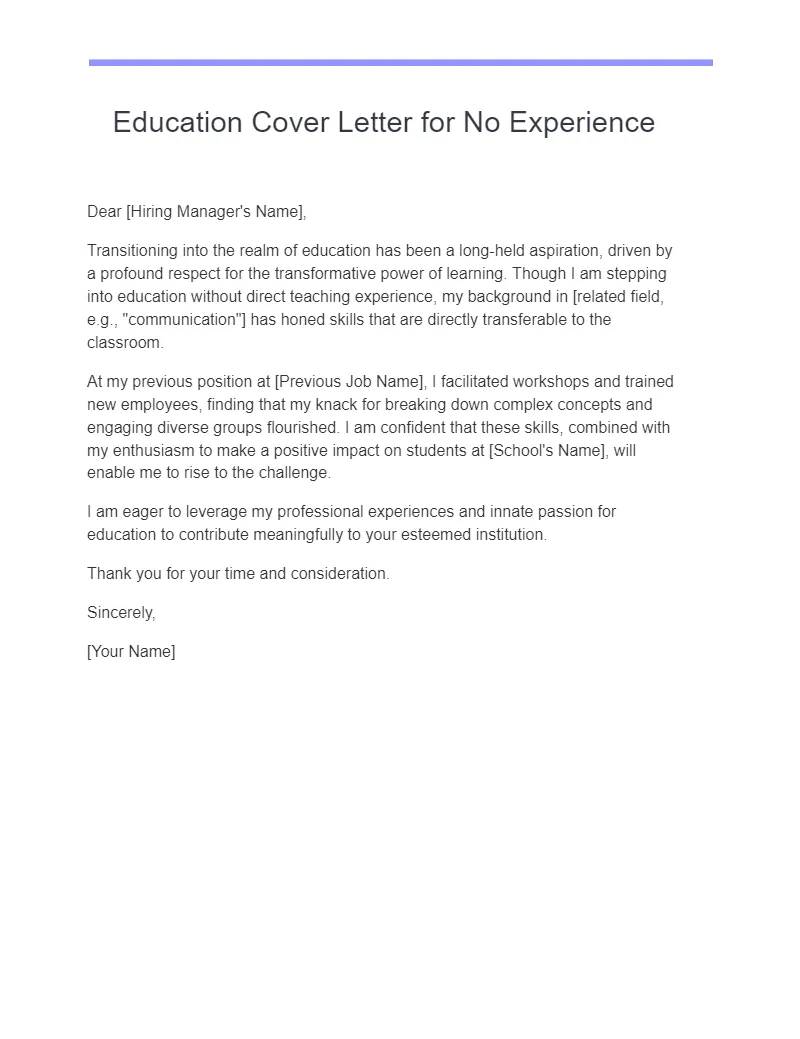
To help you get started, here is a sample teacher cover letter for a candidate with no experience. The sample includes all the key components discussed, emphasizing transferable skills, enthusiasm, and a growth mindset. Modify the sample letter to include your information, skills, and passion. Remember to tailor it to the specific job description and school. This sample is a template to help you get started and showcase your potential as a teacher, even without prior classroom experience. (Image: teacher-cover-letter-sample.webp)