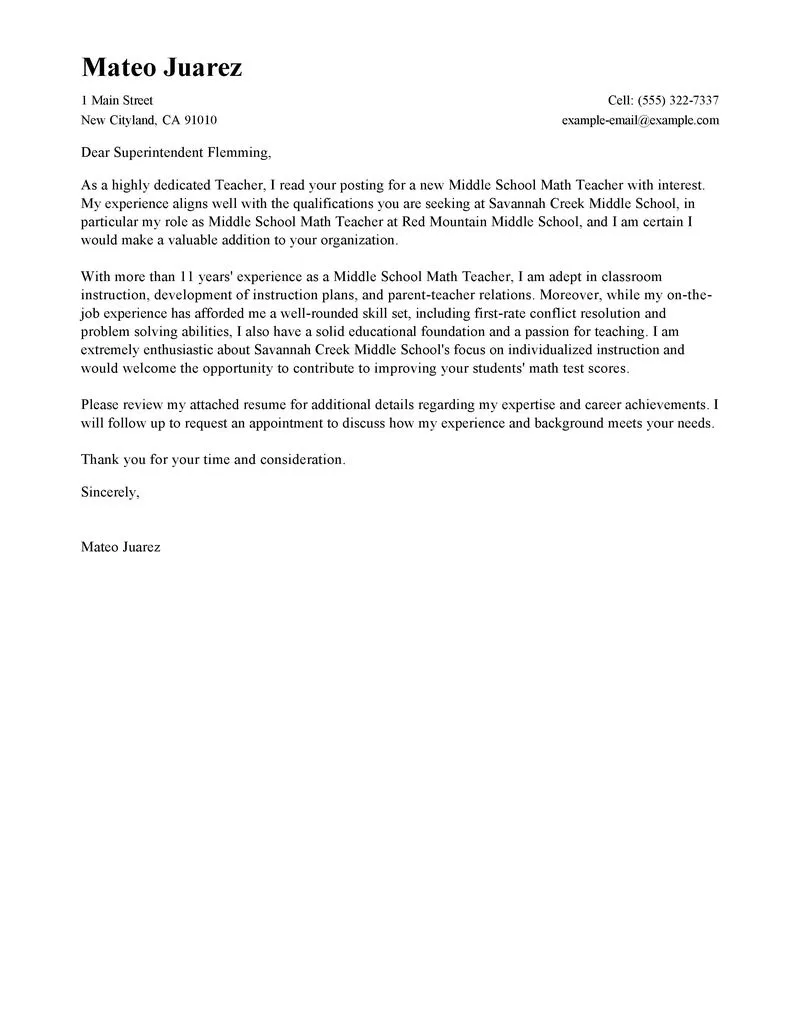
Understanding the Teacher Cover Letter
A teacher cover letter is a crucial document in your job application, acting as your first introduction to a potential employer. It provides an opportunity to showcase your personality, teaching philosophy, and qualifications beyond what’s listed in your resume. Unlike a resume, which is a factual overview of your experience, a cover letter allows you to tell your story, explaining why you’re the ideal candidate for the position and how your skills align with the school’s needs. It should be well-written, concise, and tailored to each specific job application, demonstrating your genuine interest in the role and the school.
Why is a Teacher Cover Letter Important
The importance of a teacher cover letter cannot be overstated. It’s your chance to make a strong first impression and set yourself apart from other applicants. A well-crafted cover letter demonstrates your communication skills, attention to detail, and enthusiasm for teaching. It allows you to address any potential gaps in your resume, explain your career goals, and highlight your unique strengths. Moreover, a cover letter shows that you’ve taken the time to research the school and understand its values, indicating your genuine interest in joining their team. Hiring managers often use cover letters to gauge a candidate’s writing ability, which is a critical skill for educators.
Highlighting Your Skills and Experience

When highlighting your skills and experience, focus on the qualities and achievements that are most relevant to the job description. Start by identifying the key requirements and keywords mentioned in the job posting, and then provide specific examples from your past experiences where you’ve demonstrated those skills. Quantify your accomplishments whenever possible; for example, instead of saying “Improved student test scores,” say “Increased student test scores by 15% within one academic year.” Also, consider using the STAR method (Situation, Task, Action, Result) to structure your examples, providing context, explaining your role, describing your actions, and detailing the positive outcomes. Remember to emphasize your ability to create a positive and engaging learning environment.
Essential Components of a Teacher Cover Letter
A well-structured teacher cover letter includes several key components. First, your contact information and the date should be clearly displayed at the top. Next is the salutation, where you address the hiring manager or principal by name (if possible). The opening paragraph should grab the reader’s attention and state the position you’re applying for. The body of the letter should showcase your qualifications, teaching philosophy, and classroom management skills, with specific examples. Finally, the closing paragraph should express your enthusiasm for the role and thank the reader for their time and consideration. Make sure to proofread the entire letter carefully before submitting it.
Contact Information and Date
At the top of your cover letter, provide your full name, address, phone number, and professional email address. Ensure your email address is appropriate and professional. The date should follow your contact information, typically formatted as Month Day, Year (e.g., May 15, 2024). This information is essential, as it allows the hiring manager to easily contact you. Keep the formatting consistent with your resume and other application materials, making a good first impression. Ensure your contact information is up-to-date and that your voicemail is set up with a professional greeting.
The Salutation — Addressing the Hiring Manager
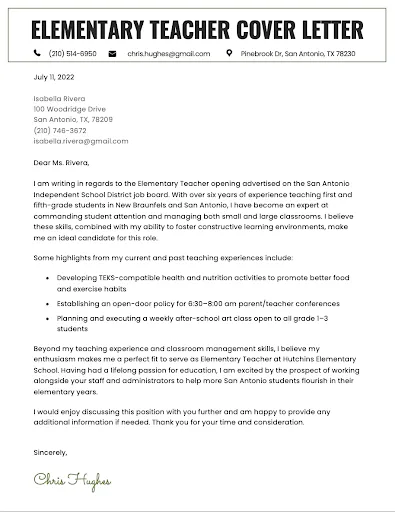
The salutation sets the tone for your cover letter. If you know the hiring manager’s name (e.g., “Dear Ms. Smith”), using it demonstrates that you’ve done your research and taken the time to personalize your application. If you’re unsure of the hiring manager’s name, it’s acceptable to use a professional alternative such as “Dear Hiring Committee” or “Dear Principal.” Avoid generic salutations like “To Whom It May Concern,” as they can make your letter feel impersonal. Always double-check the spelling of the hiring manager’s name and the school’s name to show your attention to detail.
Crafting a Compelling Opening Paragraph
The opening paragraph is your opportunity to grab the reader’s attention and make a strong first impression. Start by stating the specific position you’re applying for and where you saw the job posting. Briefly mention your most relevant qualifications or experience. Aim to convey your enthusiasm for the opportunity and your understanding of the school’s mission or values. This paragraph should be concise and engaging, encouraging the reader to continue reading. For example, you could start with a statement about your passion for education or your alignment with the school’s philosophy. The goal is to pique their interest immediately.
Showcasing Your Qualifications and Achievements
In the body paragraphs, provide specific examples of your qualifications and achievements that align with the job requirements. Use action verbs (e.g., “developed,” “implemented,” “managed,” “achieved”) to describe your accomplishments. Quantify your achievements whenever possible; for example, “Developed a new reading program that improved student literacy rates by 20%.” Mention your relevant skills, such as curriculum development, differentiated instruction, classroom management, and assessment. Relate your experiences to the needs of the school, emphasizing how you can contribute to student success and create a positive learning environment. Provide specific examples and use the STAR method to demonstrate your capabilities.
Highlighting Your Teaching Philosophy

Your teaching philosophy reveals your core beliefs about education and how you approach teaching. Briefly describe your philosophy, emphasizing your commitment to student-centered learning, creating a positive classroom environment, or fostering critical thinking. Include how you create engaging lessons, meet the needs of diverse learners, and assess student progress. Connect your philosophy to the school’s mission and values, showing that you’re a good fit. Provide examples of how you put your philosophy into practice in the classroom. Let your passion for teaching shine through.
Demonstrating Your Classroom Management Skills
Classroom management is essential for a successful learning environment. Highlight your ability to create a structured and supportive classroom where students feel safe, respected, and engaged. Describe your strategies for managing student behavior, establishing clear expectations, and building positive relationships with students and parents. Provide examples of how you’ve successfully handled challenging situations, such as implementing restorative justice practices or using positive reinforcement. Show how you proactively address potential behavioral issues and create a learning environment that promotes respect, responsibility, and a love of learning.
Expressing Your Enthusiasm and Fit
Throughout your cover letter, show your genuine enthusiasm for the role and the school. Explain why you’re interested in the specific position and how your skills and experience align with the school’s needs and values. Mention any specific aspects of the school that appeal to you, such as its innovative programs, commitment to diversity, or strong sense of community. Show that you’ve researched the school and understand its mission and goals. Make it clear that you’re not just looking for a job but are excited about the prospect of joining their team and contributing to their students’ success.
Closing Your Cover Letter Professionally

End your cover letter with a strong closing paragraph that reiterates your interest in the position and thanks the reader for their time and consideration. Reiterate your enthusiasm and express your eagerness to discuss your qualifications further in an interview. Include a call to action by stating your availability for an interview and how you can be reached. Use a professional closing such as “Sincerely” or “Respectfully,” followed by your typed name. Ensure that your closing reflects your professionalism and leaves a positive lasting impression.
Proofreading and Editing Your Cover Letter
Before submitting your cover letter, carefully proofread and edit it to ensure it is free of errors. Check for typos, grammatical errors, and inconsistencies in formatting. Read your cover letter aloud to catch any awkward phrasing or unclear sentences. It’s also helpful to have a trusted friend, mentor, or career counselor review your cover letter for feedback. Ensure that your tone is professional, and your writing is clear and concise. A well-proofread cover letter shows your attention to detail and professionalism, making a positive impression on the hiring manager.
Formatting Your Teacher Cover Letter
Your cover letter should be easy to read and visually appealing. Use a standard font like Times New Roman, Arial, or Calibri, and set the font size to 11 or 12 points. Use single-space within paragraphs and double-space between paragraphs. Maintain consistent formatting throughout the document. Left-align your text, and avoid using excessive bolding or italics. Ensure your cover letter is one page long. Use clear headings and subheadings to break up the text and make it easy to scan. A well-formatted cover letter presents you as organized and professional.
Utilizing Keywords and Action Verbs

To maximize your chances of success, use keywords and action verbs in your cover letter. Review the job description and identify the key skills and qualifications the school is seeking. Incorporate these keywords naturally throughout your letter. Use action verbs (e.g., “developed,” “implemented,” “led,” “managed,” “created,” “facilitated,” “assessed”) to describe your achievements and responsibilities. This helps you to showcase your skills and experiences. Using the right keywords also makes your cover letter more likely to be picked up by applicant tracking systems (ATS) used by some schools, ensuring your application is reviewed.
Tailoring Your Cover Letter to the Specific Job
Avoid using a generic cover letter. Tailor each cover letter to the specific job and school. Research the school’s mission, values, and programs, and address how your skills and experiences align with their needs. Reference the job description and highlight the qualifications and skills that match their requirements. Show that you understand the specific needs of the school and demonstrate your interest in their community. Customizing your cover letter demonstrates that you’ve taken the time to understand the opportunity, increasing your chances of getting an interview. This personalization helps you stand out from the crowd.
Customizing for Elementary, Middle, and High School Positions
The content and tone of your cover letter should be tailored to the age group and subject matter of the teaching position. For elementary school positions, highlight your experience with early childhood development, creating engaging lesson plans, and fostering a positive classroom environment. For middle school positions, focus on your ability to connect with adolescent students, manage behavior, and create engaging lessons. For high school positions, emphasize your expertise in your subject area, your ability to teach complex concepts, and your skills in preparing students for college and careers. Always adjust your language to suit the tone and expectations of the grade level.