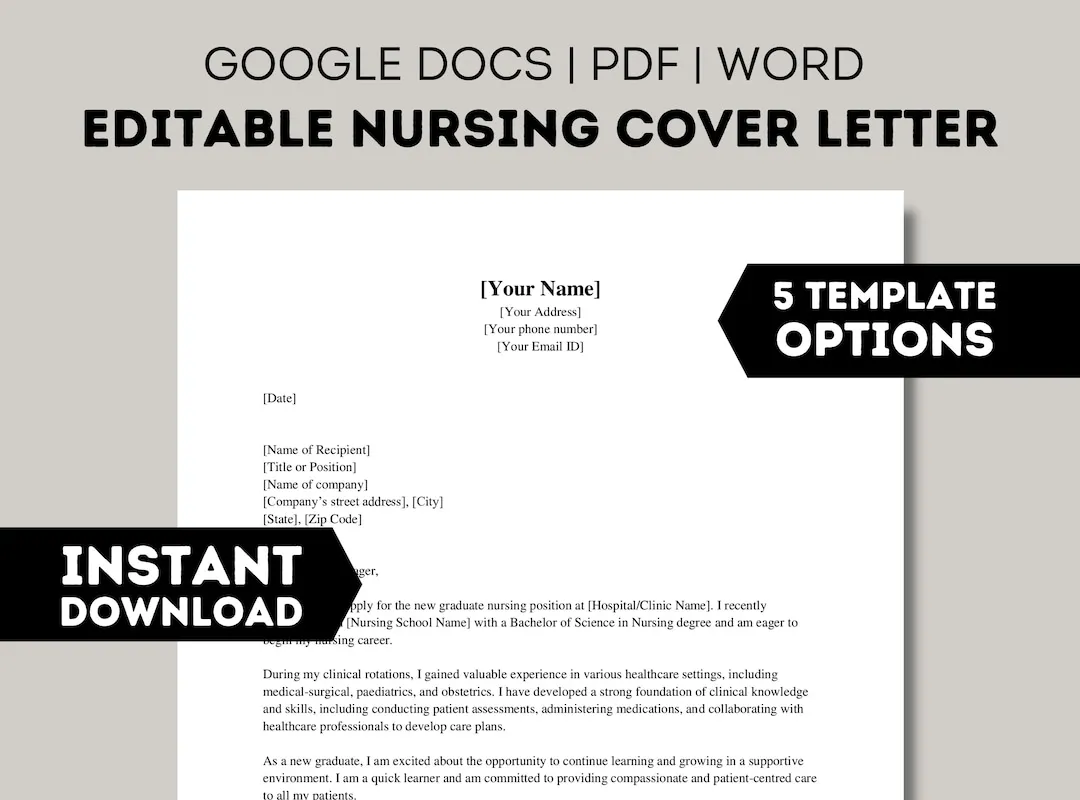
The Importance of a Strong New Grad RN Cover Letter
As a new graduate registered nurse (RN), your cover letter is your first impression on potential employers. It is your opportunity to showcase your skills, passion, and potential to make a significant contribution to their healthcare team. Unlike experienced nurses who can rely on a more extensive work history, new grads need to craft a compelling cover letter that highlights their educational background, clinical rotations, and any relevant experiences. A well-written cover letter demonstrates your professionalism, attention to detail, and enthusiasm for the nursing profession. This document provides an avenue to go beyond the constraints of a resume and share your unique story, explain your career goals, and convey why you are the ideal candidate. A standout cover letter can significantly increase your chances of landing an interview and ultimately securing your first nursing job.
Key Components of a Successful Cover Letter
Header and Contact Information

Applicant’s Name and Contact Details
Begin your cover letter with your full name, address, phone number, and professional email address. Ensure your email address is appropriate and easy to read. This information should be clearly displayed at the top of the document, making it easy for the hiring manager to contact you. Accuracy is crucial here, as even a small error can prevent you from being contacted for an interview. Make your contact information easily accessible, and use a readable font size. Always double-check all the details to confirm everything is accurate.
Hiring Manager’s Details
If possible, address your cover letter to a specific person, such as the hiring manager or nurse recruiter. Research the hospital or clinic to find out who is responsible for hiring. If you can’t find a specific name, use a professional salutation like ‘Dear Hiring Manager.’ Addressing the letter to a specific person demonstrates that you have done your research and that you care enough to find the right person. It makes the letter feel more personal and can make a positive impression. If you are unsure, it is acceptable to call the hospital’s human resources department to ask.
Professional Greeting

Start your cover letter with a professional greeting. ‘Dear [Hiring Manager’s Name]’ is a standard and appropriate salutation. If you do not know the name, use ‘Dear Hiring Manager’ or ‘Dear Nurse Recruiter.’ Avoid casual greetings like ‘Hi’ or ‘Hello.’ The greeting sets the tone for the entire letter, and a professional greeting shows respect and indicates that you are taking the application process seriously. Ensure you use the correct title (e.g., Dr., Ms., Mr.) if you know the hiring manager’s name. A well-chosen greeting shows you pay attention to detail.
Crafting a Compelling Opening Paragraph
Your opening paragraph is your first chance to grab the reader’s attention. State the position you are applying for, where you saw the job posting, and a brief overview of why you are interested in the role. This opening should be concise and engaging. Mentioning the specific position immediately shows the reader your intent. Briefly express your enthusiasm for the role or the hospital. Briefly state how your skills align with the job requirements. Focus on the key aspects of why you want to work for that specific organization. Don’t just reiterate what’s on your resume, use this as an opportunity to tell a concise story that conveys your interest in the role.
Highlighting Your Passion for Nursing
Express your passion for nursing and what motivates you to pursue a career in healthcare. Talk about the specific aspects of nursing that you are most drawn to. This could be patient care, a particular specialty, or the collaborative team environment. Sharing your passion will make your application stand out. Mention any personal experiences that sparked your interest in nursing. This could be a family member’s experience or a volunteer opportunity. Describe your goals and aspirations within the nursing profession. This shows the hiring manager that you are committed to a long-term career. Express your interest in continued learning and professional development. This showcases your dedication.
Mentioning the Specific Position and Hospital

Make it clear that you are applying for a specific position. Mention the job title and the hospital or clinic. Customizing your cover letter for each application is essential. This shows the hiring manager that you’ve put effort into tailoring your application. Mention the specific department or unit you are interested in, if applicable. Research the hospital’s mission and values. Show how your values align with the organization. Talk about why you want to work at that particular hospital, mentioning the hospital’s reputation, programs, or values. Demonstrating that you have an understanding of the hospital will show your genuine interest and commitment to the organization.
Showcasing Your Skills and Experience
The main body of your cover letter should highlight your skills and experiences. As a new grad, focus on your educational background, clinical rotations, and any relevant experiences. Match your skills to the job requirements, using the job description as a guide. Quantify your achievements whenever possible. Use action verbs to describe your accomplishments and responsibilities. Demonstrate how your skills and experiences make you a good fit for the role. Provide examples to show how you have used your skills in a clinical setting. This section should demonstrate your potential and ability to provide effective care. Show that you understand the needs of the role and the patient.
Education and Certifications
Detail your nursing education, including the name of your nursing school, the degree you earned (e.g., BSN, ADN), and your graduation date. Mention your GPA if it is above average, but don’t feel obligated to if it’s not. Include any relevant certifications you hold, such as BLS, ACLS, or any specialty certifications. Provide the dates of your certifications. Highlight any academic achievements, awards, or honors. These demonstrate your commitment to learning and your academic performance. Make sure your educational background aligns with the requirements of the position. List any relevant coursework or projects.
Clinical Experience and Rotations

Describe your clinical rotations, including the units or specialties you have experience in (e.g., medical-surgical, ICU, pediatrics). Highlight the most relevant experiences for the position. Mention the number of clinical hours you completed in each setting. Describe your role and responsibilities in each rotation. Use action verbs to describe your clinical tasks and accomplishments. Share any specific skills you gained, such as patient assessment, medication administration, or wound care. Discuss any unique patient cases or experiences that highlight your skills. Provide context for your experience, detailing the environment, team dynamics, and patients involved.
Skills and Abilities
List the skills and abilities that are relevant to the nursing position you are applying for. Include both clinical skills (e.g., medication administration, wound care, patient assessment) and soft skills (e.g., communication, teamwork, problem-solving). Refer to the job description to identify the specific skills the employer is seeking. Provide examples of how you have demonstrated these skills in your clinical rotations or other experiences. Use keywords from the job description to make your letter more targeted. Demonstrate your knowledge of nursing procedures and patient care. Highlight your ability to adapt to different situations and environments.
Quantifiable Achievements
Whenever possible, quantify your achievements. Use numbers and data to demonstrate your impact. For example, you could mention the number of patients you cared for or the number of successful procedures you assisted with. Instead of saying you ‘provided excellent patient care,’ you could say ‘administered medications to 20 patients daily with 100% accuracy.’ Quantifying your accomplishments makes them more concrete and impressive. Provide data on any positive outcomes you contributed to, such as reduced patient readmission rates or improved patient satisfaction scores. Quantifying your achievements provides concrete evidence of your abilities. Use metrics to showcase your performance and effectiveness. Highlighting these results shows your dedication.
Emphasizing Soft Skills

Highlight your soft skills, which are essential for success in nursing. These include communication, teamwork, empathy, problem-solving, and critical thinking. Provide examples of how you have demonstrated these skills in your clinical rotations or other experiences. For instance, ’effectively communicated with patients and families to provide education and support.’ Illustrate your teamwork skills by describing how you collaborated with other healthcare professionals. Show your empathy by discussing how you provided compassionate care to patients. Demonstrate your ability to solve problems by describing a challenging situation you encountered and how you resolved it. Soft skills are critical for patient care.
Closing Your Cover Letter
The closing of your cover letter is your last opportunity to make a positive impression. Reiterate your interest in the position, express your enthusiasm, and make it easy for the hiring manager to contact you. Thank the hiring manager for their time and consideration. This section should leave a lasting positive impression and ensure your application will be considered. The closing should be polite, professional, and confident.
Expressing Enthusiasm and Availability
Reiterate your interest in the position and the hospital or clinic. Express your enthusiasm and reiterate your suitability. State your availability for an interview. Indicate when you are available to start working, if known. Thank the hiring manager for their time and consideration. Express your eagerness to discuss your qualifications further. Conclude on a positive note, reinforcing your strong interest in the role. This ensures that you leave a lasting impression and show that you are truly interested in the opportunity.
Formal Closing and Signature

Use a professional closing, such as ‘Sincerely,’ ‘Best regards,’ or ‘Thank you for your consideration.’ Follow the closing with your typed name. If you are submitting a hard copy, leave space for your signature above your typed name. Make sure your signature is clear and legible. Ensure your contact information is included at the end of the letter. Proofread the entire cover letter to ensure it is error-free and professional. Make sure it leaves a lasting impression.
Formatting and Proofreading for Perfection
The appearance of your cover letter is just as important as the content. Proper formatting and proofreading can make a significant difference in how your application is perceived. A polished, well-formatted cover letter demonstrates professionalism and attention to detail. Pay careful attention to the presentation, including the font, margins, and overall layout. Errors can create a negative impression and detract from your qualifications. Always proofread the letter thoroughly, and consider having a friend or mentor review it.
Font and Formatting Guidelines
Use a professional, easy-to-read font, such as Times New Roman, Arial, or Calibri. Use a font size between 10 and 12 points. Use standard 1-inch margins on all sides. Left-align your text and use single spacing. Ensure your letter is well-organized with clear headings and paragraphs. Use bullet points to highlight key skills or experiences, as it makes it easier for the reader to scan the information. Keep the letter to one page, if possible. Use white space effectively to make the letter visually appealing. Create a clean and organized look that is easy to read. Ensure the letter is easy on the eye.
Proofreading and Editing

Proofread your cover letter multiple times for any typos, grammatical errors, and punctuation mistakes. Errors can undermine your credibility and make it seem like you do not pay attention to detail. Use a spell-checker and grammar checker, but do not rely on them completely. Read the letter aloud to catch any awkward phrasing or sentence structures. Ask a friend, mentor, or career counselor to review your cover letter. Seek feedback on the content, formatting, and overall presentation. Make sure the letter is tailored to the specific job description. Check that all the information is accurate, including dates, names, and titles. A well-proofread letter shows your commitment and professionalism.
Cover Letter Examples
Reviewing cover letter examples can help you get ideas and see how others have successfully presented their qualifications. Tailor the examples to fit your situation and the specific job you are applying for. Use these examples as a guide, but make sure your letter is original and reflects your unique skills and experience. Adapt the examples to highlight your specific strengths and match the requirements of the job. The right examples provide a clear foundation.
Example 1 Recent Graduate with Limited Experience
Dear [Hiring Manager’s Name],
I am writing to express my enthusiastic interest in the Registered Nurse position at [Hospital Name], as advertised on [Platform]. As a recent graduate of [Nursing School] with a Bachelor of Science in Nursing, I am eager to begin my career and contribute to your esteemed team. During my clinical rotations, I gained extensive experience in medical-surgical nursing, including patient assessment, medication administration, and wound care. I am proficient in EMR systems and demonstrated excellent teamwork. I am also BLS and ACLS certified. I am passionate about providing compassionate, patient-centered care, and I am excited about the opportunity to learn and grow within [Hospital Name]. I am eager to start, and I look forward to the chance to discuss my qualifications further. Thank you for your time and consideration.
Sincerely, [Your Name]
Example 2 Candidate with Relevant Clinical Experience
Dear [Hiring Manager’s Name],
I am writing to express my interest in the Registered Nurse position at [Hospital Name], as seen on [Platform]. With a strong foundation in nursing from [Nursing School] and experience in a variety of clinical settings, I am confident I can bring great value to your team. Throughout my clinical rotations at [Hospital name], I developed strong skills in patient assessment and medication administration, and gained experience in emergency care. As the lead nurse in charge of the unit, I was in charge of patient care for over 10 patients per day. I am skilled in electronic health record systems and have excellent teamwork and communication abilities. I am currently ACLS and BLS certified, and I am dedicated to providing exceptional care. I am excited to work with you and help make a difference at the hospital. I am looking forward to a chance to discuss my qualifications. Thank you for your consideration.
Sincerely, [Your Name]
Common Mistakes to Avoid
Avoid making common mistakes that can harm your chances of getting hired. These mistakes can create a negative impression. Pay close attention to the details and take the time to ensure your cover letter is polished and professional. Avoiding these errors will help you make a positive impact on potential employers. Keep your writing professional and accurate, and avoid these common pitfalls.
Generic Content
Avoid using generic, generic cover letters that are not tailored to the specific job or hospital. Generic cover letters demonstrate a lack of interest and effort. Every letter should be customized to show the applicant’s sincere interest in the role. Research the hospital or clinic and personalize your letter. Highlight how your skills and experience align with the job requirements. Demonstrate that you have taken the time to understand the organization and the specific role. Generic content shows a lack of effort and care, reducing your chances of consideration.
Typos and Grammatical Errors
Typos and grammatical errors can damage your credibility. Ensure that your cover letter is free of any errors. Proofread carefully before sending your application. Use spell-check, but don’t rely on it entirely. Have someone else review your letter. Errors create a negative impression. Sloppy work indicates a lack of attention to detail. Correctness is crucial for professional applications. Accuracy shows respect and consideration.
Lack of Enthusiasm
Avoid writing a cover letter that lacks enthusiasm. Your letter should reflect your passion for nursing and your interest in the specific position. Express your excitement about the opportunity. Be sure to convey your enthusiasm in a genuine manner. Highlight specific aspects of the job or hospital that interest you. Demonstrate your knowledge of the hospital and its values. Express your passion for the profession. Show a genuine interest in the role. Express your enthusiasm for learning. The more enthusiasm you demonstrate, the more likely you are to be noticed.
Conclusion
A well-written cover letter is essential for new grad RNs. It is your chance to make a great first impression and demonstrate your passion, skills, and potential to employers. By following the guidelines and tips in this guide, you can craft a cover letter that stands out. It will help you secure your first nursing job. Make sure your letter is customized, well-formatted, and free of errors. Focus on the content. Show enthusiasm. Tailor your letter to each job application. Remember to proofread and edit before submitting. With a strong cover letter, you will be well on your way to a successful nursing career. Good luck with your job search!