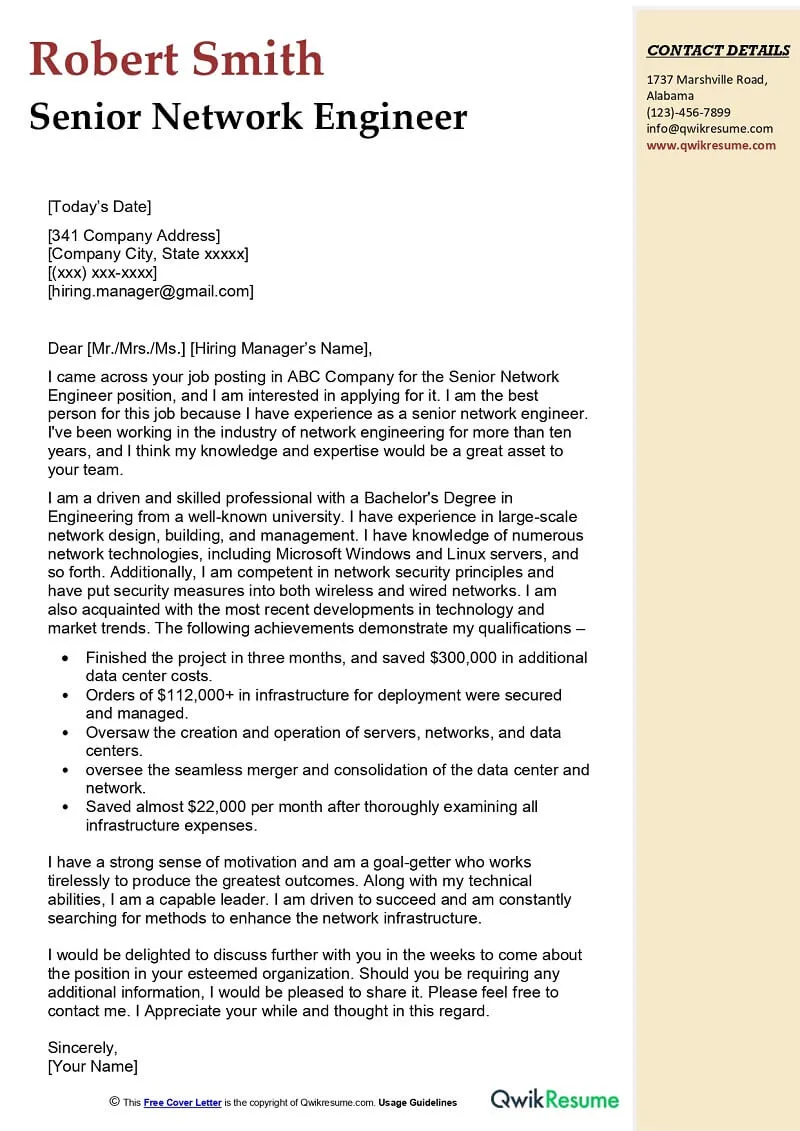
What is a Network Engineer Cover Letter?
A network engineer cover letter is a crucial document that accompanies your resume when applying for network engineer positions. It serves as an introduction, allowing you to highlight your skills, experience, and enthusiasm for the role. Unlike a resume, which provides a factual overview of your qualifications, a cover letter offers an opportunity to showcase your personality and explain why you’re the ideal candidate. Think of it as your personal sales pitch, designed to grab the hiring manager’s attention and convince them to read your resume. This document gives you a chance to elaborate on specific experiences and demonstrate your understanding of the company’s needs, helping you stand out from the competition.
Importance of a Network Engineer Cover Letter
The importance of a well-crafted cover letter cannot be overstated, particularly in the competitive field of network engineering. A cover letter provides an invaluable opportunity to make a strong first impression, setting the tone for your application. It allows you to explain career gaps, address specific job requirements, and demonstrate your genuine interest in the position and the company. A cover letter helps personalize your application, showcasing not only your technical abilities but also your soft skills, such as communication, problem-solving, and teamwork. In a sea of resumes, a compelling cover letter can be the deciding factor that lands you an interview, making it an indispensable tool in your job search arsenal. This is your chance to make a lasting impression.
Essential Components of a Network Engineer Cover Letter

A successful network engineer cover letter includes several key components, each designed to contribute to a cohesive and compelling presentation of your qualifications. The following sections are critical for conveying your value to a potential employer. Ensuring that all these elements are present and well-executed can significantly increase the effectiveness of your job application. Remember, each element should be crafted with precision to leave a lasting impression on the reader.
Contact Information
Begin your cover letter with your contact information at the top. Include your full name, phone number, professional email address, and optionally, your LinkedIn profile URL. This ensures that the hiring manager can easily reach you. Make sure that your email address is professional and reflects your name, avoiding any informal nicknames. Double-check all the information for accuracy to avoid any communication issues, such as missed calls or emails.
Date
Below your contact information, include the date you are writing the letter. This is a standard practice and demonstrates professionalism. The date helps keep track of your application and adds to the letter’s formal appearance.
Hiring Manager’s Name and Title

Address your cover letter to a specific person whenever possible. Research the company to identify the hiring manager or the person responsible for reviewing applications for the network engineer position. Using the hiring manager’s name shows that you have taken the time to research the company and are attentive to details. Addressing the letter to “Dear Mr./Ms. [Last Name]” is more personal and demonstrates a genuine interest in the role. If you cannot find a specific name, use a general greeting like “Dear Hiring Manager” as a second option. This extra step can leave a positive impression.
Greeting
Start your cover letter with a professional greeting. As mentioned earlier, the best approach is to use “Dear Mr./Ms. [Last Name]”. If you don’t know the hiring manager’s name, you can use a general greeting such as “Dear Hiring Manager” or “Dear [Company Name] Hiring Team.” Avoid overly casual greetings like “Hi” or “Hello”. The greeting sets the tone for the rest of your letter, so a professional approach is important.
Body of the Cover Letter
The body of your cover letter is where you make your case for why you’re the perfect candidate. It should be well-structured and persuasive, highlighting your skills and experience in a way that directly relates to the job requirements. This section gives you the opportunity to expand on your resume, providing context and demonstrating your enthusiasm for the position. Focus on what you can offer the company, and why you’re interested in the specific role. Be clear, concise, and ensure that the body of the letter flows logically, making it easy for the hiring manager to follow your key points. Your language should be professional and engaging.
Highlighting Your Skills and Experience

This is the core of your cover letter, where you showcase your relevant skills and experience. Start by mentioning the position you’re applying for and where you found the job posting. Then, explain how your qualifications align with the job description. Use specific examples from your past roles to demonstrate your capabilities. Quantify your achievements whenever possible; for example, state the number of networks you managed or the percentage by which you improved network performance. By providing concrete evidence of your skills, you make a strong argument for your ability to excel in the role.
Technical Skills
Network engineers need a range of technical skills. In your cover letter, highlight your proficiency with relevant technologies, such as routing protocols (OSPF, BGP), switching, firewalls, and network monitoring tools. Mention specific vendors like Cisco, Juniper, or Palo Alto Networks if you have experience with their products. Emphasize any certifications, such as CCNA, CCNP, or CCIE, as these demonstrate a commitment to your profession. Ensure that your technical skills align with the requirements mentioned in the job description, as this will show that you are a suitable candidate. Using precise language and showing how you’ve used those skills in practice can make a strong impression.
Experience in Network Technologies
Detail your experience with various network technologies. This includes experience with LAN and WAN architectures, VPNs, cloud networking, and network security. Describe the types of projects you have worked on, your role in these projects, and the outcomes you achieved. If you have experience designing, implementing, and maintaining network infrastructure, be sure to mention this. Showcase your experience with troubleshooting network issues and providing solutions. Use specific examples from your work history to demonstrate your ability to manage network systems effectively. This shows potential employers the value that you bring to a team and your ability to manage complex networks.
Quantifiable Achievements

Quantify your achievements whenever possible to demonstrate the value you bring to previous roles. Instead of simply stating that you improved network performance, specify by how much (e.g., “reduced network latency by 30%”). If you have saved the company money, managed a significant budget, or led successful projects, provide the details. These figures demonstrate your impact and help the hiring manager understand the practical results of your work. Quantifiable achievements provide concrete evidence of your abilities and make your cover letter more compelling and impactful. Use data to support your claims; it shows that you are results-oriented.
Tailoring Your Cover Letter
Customize your cover letter for each job application. Generic cover letters rarely make a strong impression. Tailoring your letter demonstrates that you have carefully considered the specific requirements of the role and the needs of the company. This shows that you are genuinely interested and have the relevant skills and experience. Customization involves researching the company, matching your skills to the job requirements, and incorporating relevant keywords.
Researching the Company
Before you start writing, research the company thoroughly. Visit their website, read news articles, and explore their social media profiles to gain an understanding of their mission, values, and current projects. Mentioning the company’s initiatives or recent successes in your cover letter demonstrates your interest and shows that you’ve done your homework. Identifying the company’s challenges and explaining how your skills can help address them can significantly increase your chances of securing an interview. This research will also enable you to use the correct terminology and ensure you align your skills with their specific needs.
Matching Skills with Job Requirements

Carefully review the job description and identify the key skills and qualifications the employer is seeking. Then, align your skills and experience with these requirements. Provide specific examples that showcase how you have successfully utilized these skills in past roles. Tailoring your cover letter allows you to show the hiring manager that you are a strong match for the position. It also demonstrates your attention to detail and your commitment to meeting the job requirements. This targeted approach greatly improves your chances of getting an interview.
Using Keywords
Incorporate keywords from the job description into your cover letter. Many companies use Applicant Tracking Systems (ATS) to scan applications for relevant keywords. By including these words, you increase the likelihood that your cover letter will pass the initial screening. The goal is to make your cover letter stand out. However, do not overuse keywords; ensure they fit naturally into your writing. Using the correct keywords will make your cover letter more relevant and highlight your qualifications, helping you get noticed.
Formatting and Design
The formatting and design of your cover letter is crucial for making a positive first impression. A well-formatted cover letter is easy to read and presents your qualifications professionally. Use a clean and consistent format throughout your letter. Ensure there are adequate margins, spacing, and font choices. Clean formatting enhances the readability of your cover letter, making it more appealing to the reader. A professional design shows attention to detail.
Font and Font Size

Choose a professional and easy-to-read font, such as Times New Roman, Arial, or Calibri. Keep the font size between 10 and 12 points. Avoid using overly ornate or unconventional fonts, as these can distract from the content of your letter. A clean font ensures that your cover letter is easy to read and looks professional. Use a consistent font throughout the entire document for a polished appearance.
Spacing and Margins
Use 1-inch margins on all sides of your cover letter. Single-space the body of the letter and double-space between paragraphs. Ensure that your cover letter does not appear cramped or cluttered. Adequate spacing improves readability and creates a more visually appealing document. Proper spacing helps the reader navigate the content more easily, ensuring that your key points are effectively communicated.
Proofreading and Editing
Before submitting your cover letter, proofread and edit it meticulously. Errors in grammar, spelling, or punctuation can undermine your credibility. A polished cover letter shows that you are detail-oriented and committed to producing high-quality work. Proofreading and editing are crucial for conveying professionalism.
Checking for Grammar and Spelling
Carefully check your cover letter for any grammatical errors and spelling mistakes. Use a grammar checker tool, but also read through the letter multiple times to catch any errors that the software might miss. Correct grammar and spelling are essential for a professional image. Even small mistakes can detract from the overall impact of your cover letter and make you seem less qualified. Accuracy demonstrates your attention to detail and commitment to excellence.
Ensuring Clarity and Conciseness
Make sure your cover letter is clear, concise, and easy to understand. Use straightforward language and avoid jargon or overly complex sentences. Your goal is to communicate your qualifications and enthusiasm quickly. Concise writing will ensure that the hiring manager can easily grasp your key strengths and understand why you are the right fit for the role. Stick to the most relevant information and eliminate any unnecessary details. A clear and concise cover letter can make a strong impression on the reader.
Call to Action and Closing
Conclude your cover letter with a clear call to action and a professional closing. This ensures that the hiring manager knows how to proceed and reinforces your interest in the position. A well-crafted closing statement leaves a lasting positive impression. A strong ending is key to your application’s success.
Expressing Enthusiasm
Reiterate your interest in the position and express your enthusiasm for the opportunity. Let the hiring manager know that you are excited about the possibility of joining their team. Show that you are genuinely interested in the role and the company’s vision. Expressing enthusiasm can make a positive impression and set you apart from other candidates. It shows that you are motivated to take on the role and enthusiastic about making a positive impact.
Thanking the Reader
Thank the hiring manager for their time and consideration. This is a standard professional courtesy and shows respect. Expressing gratitude shows that you value the opportunity to apply and that you appreciate their time. A simple “Thank you for your time and consideration” can make your cover letter more polite and considerate. Thanking the reader is a simple yet effective way to end your letter positively and respectfully.
Closing and Signature
Close your cover letter with a professional closing, such as “Sincerely,” “Best regards,” or “Respectfully.” Then, leave space for your signature. If you are submitting a digital cover letter, you can type your full name below the closing. A professional closing and signature complete the cover letter and add a final touch of professionalism. This confirms that you’re serious and committed to the application. A well-executed closing leaves a lasting impression of professionalism.