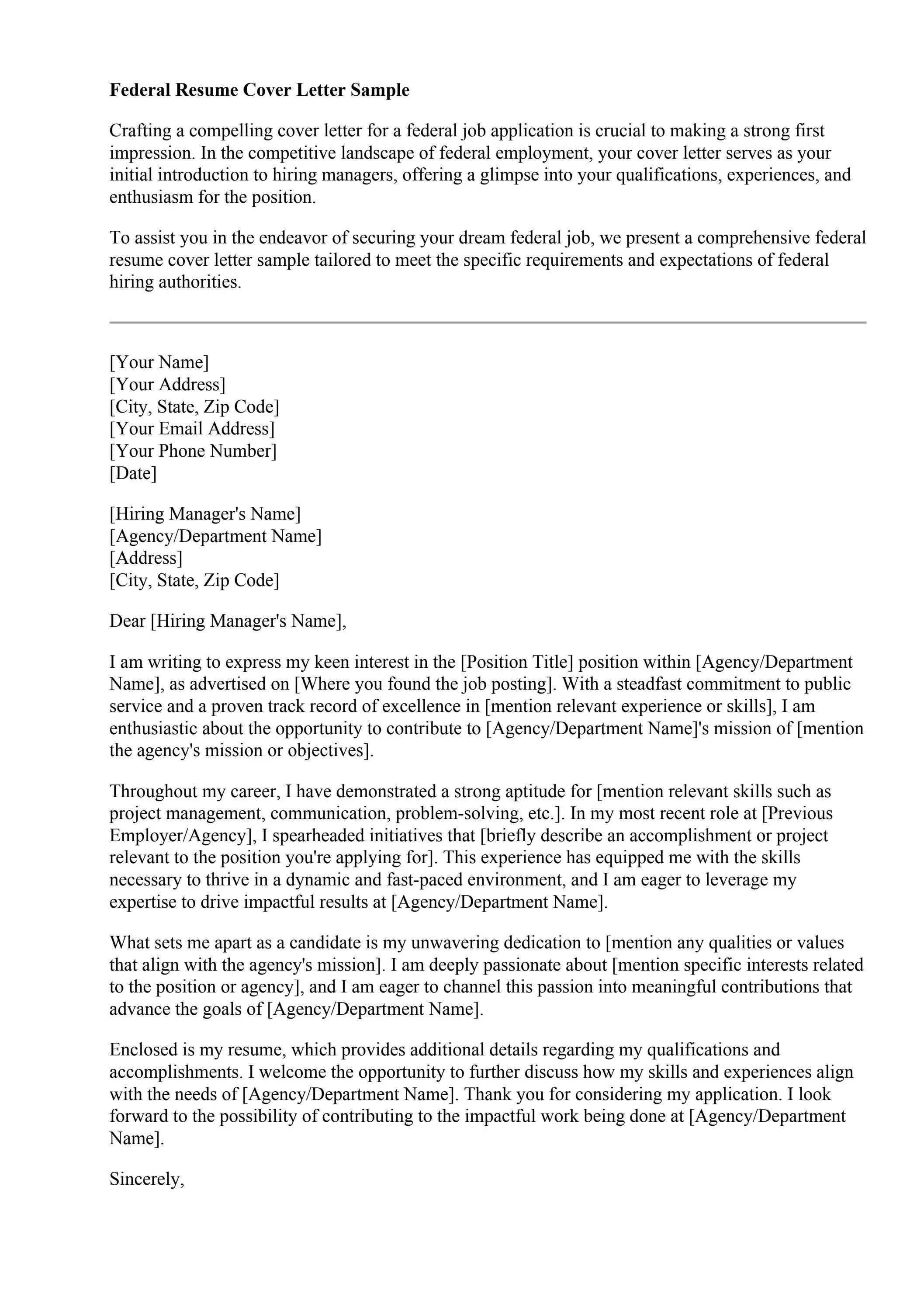
What is a Federal Resume Cover Letter?
A Federal Resume Cover Letter is a crucial document accompanying your federal resume when applying for government jobs through platforms like USAJOBS. Unlike a standard cover letter, it’s designed to provide specific details on how your skills, experience, and qualifications align with the requirements of a particular federal job announcement. It serves as a personalized introduction, highlighting your key accomplishments and demonstrating your understanding of the position and the agency’s mission. The cover letter is your first chance to make a positive impression, setting the stage for a thorough review of your qualifications. It acts as a bridge between your resume and the hiring manager, making a case for why you’re the ideal candidate.
Why is a Federal Resume Cover Letter Important?
The importance of a Federal Resume Cover Letter cannot be overstated. In the competitive world of federal hiring, where hundreds or even thousands of applications are received for a single position, your cover letter helps you stand out. It’s an opportunity to showcase your personality, enthusiasm, and genuine interest in the job and the agency. A well-crafted cover letter clarifies your value proposition, making it easier for the hiring manager to understand why you’re a great fit. It demonstrates your attention to detail, writing skills, and ability to follow instructions, all of which are essential in a federal work environment. Without a compelling cover letter, your application might get overlooked, even if your resume is impressive.
Secret 1 Tailor Your Resume

One of the most critical secrets to a successful Federal Resume Cover Letter is tailoring it to each specific job application. Generic cover letters simply won’t do. You must customize your letter to the specific requirements and responsibilities outlined in the job announcement. This involves carefully reviewing the announcement, identifying the key skills and qualifications the agency is seeking, and then highlighting how your experience and achievements align with those needs. Use the same keywords and phrases used in the job description to make your letter easily scannable by both human reviewers and applicant tracking systems (ATS). This will show that you’ve taken the time to understand the position and the organization’s needs.
Highlight Relevant Skills and Experience
When tailoring your letter, focus on the skills and experiences that are most relevant to the job. Don’t just list your past duties; instead, emphasize your accomplishments and how they relate to the specific requirements. For example, if the job description emphasizes project management skills, highlight projects where you successfully managed budgets, timelines, and teams. If the job requires strong communication skills, provide examples of successful presentations, reports, or interactions with stakeholders. The goal is to demonstrate that you have not only the necessary skills but also the proven ability to apply them effectively in a professional setting. Focus on accomplishments that directly align with the job’s core responsibilities.
Research the Job and Agency
Before you start writing, thoroughly research the job and the agency. Understand the agency’s mission, values, and strategic goals. Visit the agency’s website, read news articles, and, if possible, connect with people who work there. This research will help you tailor your cover letter to demonstrate your understanding of the agency’s needs and show your enthusiasm for working there. Mentioning specific agency initiatives, programs, or values in your letter will demonstrate that you’ve done your homework and that you’re genuinely interested in the position and the organization. This level of preparation can significantly enhance your chances of success.
Secret 2 Quantify Your Accomplishments

Quantifying your accomplishments is a powerful way to make your Federal Resume Cover Letter stand out. Instead of simply stating what you did, provide specific numbers and data to demonstrate the impact of your work. This approach provides concrete evidence of your achievements, making your claims more credible and compelling. Whenever possible, use metrics to showcase your successes, such as percentages, dollar amounts, or specific results. This helps hiring managers quickly understand the value you can bring to their organization. Quantification adds weight to your statements and gives the reader a clearer picture of your capabilities.
Using Numbers and Data to Demonstrate Impact
Use numbers and data to paint a clear picture of your contributions. Instead of saying, ‘Improved customer service,’ write, ‘Improved customer satisfaction scores by 15% in six months.’ If you managed a budget, specify the amount. If you led a project, provide the timeline and any cost savings. For example, instead of ‘Managed social media,’ try ‘Increased social media engagement by 30% within one year, resulting in a 20% increase in website traffic.’ This level of detail gives hiring managers tangible evidence of your effectiveness. Numbers provide objective proof of your abilities and achievements, making your letter far more persuasive.
Showcase Achievements not Just Duties
Focus on your achievements rather than simply listing your job duties. While mentioning your responsibilities is important, the real value comes from highlighting what you accomplished. For example, instead of ‘Responsible for writing reports,’ write ‘Developed and delivered over 50 reports, resulting in improved decision-making and a 10% reduction in processing time.’ Frame your accomplishments using the STAR method (Situation, Task, Action, Result). This approach helps you structure your narrative to clearly explain the context, the task you faced, the actions you took, and the measurable results you achieved. This strategy will significantly increase your chances of capturing the hiring manager’s attention.
Secret 3 Address the Specific Requirements

Addressing the specific requirements of the job announcement is crucial for creating an effective Federal Resume Cover Letter. Hiring managers are looking for candidates whose skills and experience align closely with the stated needs. Therefore, your cover letter should act as a roadmap, clearly connecting your qualifications to each requirement listed in the announcement. This direct approach ensures that the hiring manager can easily see how you meet the job criteria. It shows that you’ve carefully reviewed the announcement and understand what the agency is looking for.
Matching Qualifications to Job Announcements
Carefully match your qualifications to the job announcement’s requirements. Start by creating a list of the essential and preferred qualifications listed in the announcement. Then, for each qualification, write a brief paragraph or sentence explaining how your experience and skills meet that requirement. Be specific and provide examples. If the announcement requires experience with a specific software program, detail your experience using it. If it mentions a particular skill, provide examples of how you’ve used that skill successfully. This direct correlation helps the hiring manager see immediately that you possess the necessary qualifications.
Use Keywords from the Job Description
Incorporate keywords from the job description throughout your cover letter. Hiring managers often use applicant tracking systems (ATS) to screen applications, and these systems scan for specific keywords. By including the same keywords and phrases used in the job description, you increase the likelihood that your cover letter will pass through the initial screening process and be seen by a human reviewer. However, don’t just stuff keywords into your letter; use them naturally and strategically within the context of your explanations and examples. This ensures that the letter reads well and effectively demonstrates your qualifications.
Secret 4 Focus on Results

Focusing on the results of your work is a powerful strategy for writing a compelling Federal Resume Cover Letter. Hiring managers are primarily interested in what you’ve achieved in previous roles and how those accomplishments translate to the specific job you are applying for. Your cover letter is an opportunity to showcase your ability to deliver tangible outcomes. By emphasizing your results, you demonstrate your value and make a strong case for why you should be hired. This approach highlights the impact of your work and gives the hiring manager a clear picture of what you can bring to the agency.
Emphasize What You’ve Accomplished
Go beyond simply listing your responsibilities; emphasize what you’ve accomplished in each role. What did you achieve? How did you improve processes or outcomes? What were the measurable results of your actions? For example, instead of saying ‘Managed a team,’ write ‘Led a team of 10 employees, resulting in a 15% increase in project completion rates and a 10% reduction in budget overruns.’ Focus on the outcomes that you delivered, using specific data and examples to support your claims. This approach will give the hiring manager a clear understanding of your impact and potential contributions.
Provide Examples of Your Success
Use specific examples to illustrate your successes. Instead of making general statements about your skills, provide concrete examples of how you’ve applied those skills to achieve positive results. Use the STAR method to structure your examples. Clearly define the situation, the task you faced, the action you took, and the result you achieved. For example, “In my previous role, I faced a challenging project (situation) that required me to streamline our reporting process (task). I implemented a new reporting system (action) that reduced reporting time by 20% and improved data accuracy (result).” Providing clear and specific examples helps bring your accomplishments to life and demonstrates your capabilities.
Secret 5 Proofread and Edit

The final secret to a standout Federal Resume Cover Letter is to proofread and edit meticulously. A cover letter riddled with errors can quickly undermine your credibility, regardless of how strong your qualifications are. Spelling and grammatical errors, as well as inconsistencies in formatting, can give the impression that you’re not detail-oriented or that you lack the professionalism required for a federal position. Take the time to carefully review your letter, and ideally, have someone else proofread it for you. A fresh pair of eyes can often catch errors you might miss.
Common Mistakes to Avoid
Avoid common mistakes such as typos, grammatical errors, and using generic language. Ensure that you use consistent formatting throughout the letter. Avoid slang and contractions, and keep the tone professional. Make sure the letter is well-organized and easy to read. Also, avoid repeating information that is already in your resume, and don’t exceed the recommended length. Focus on adding value and providing information that supports your application. A clean and well-written letter makes a great impression and increases your chances of success.
Tips for Perfecting Your Letter
Use a clear and concise writing style. Keep your sentences and paragraphs short, and use active voice whenever possible. Use a professional font and formatting. Get feedback from career counselors, friends, or colleagues. Ensure that the letter is tailored to the specific job and agency. Proofread multiple times, ideally reading the letter aloud to catch any errors. Check for any inconsistencies in your contact information or dates. By taking the time to perfect your letter, you will significantly increase your chances of making a strong first impression and getting your application noticed.