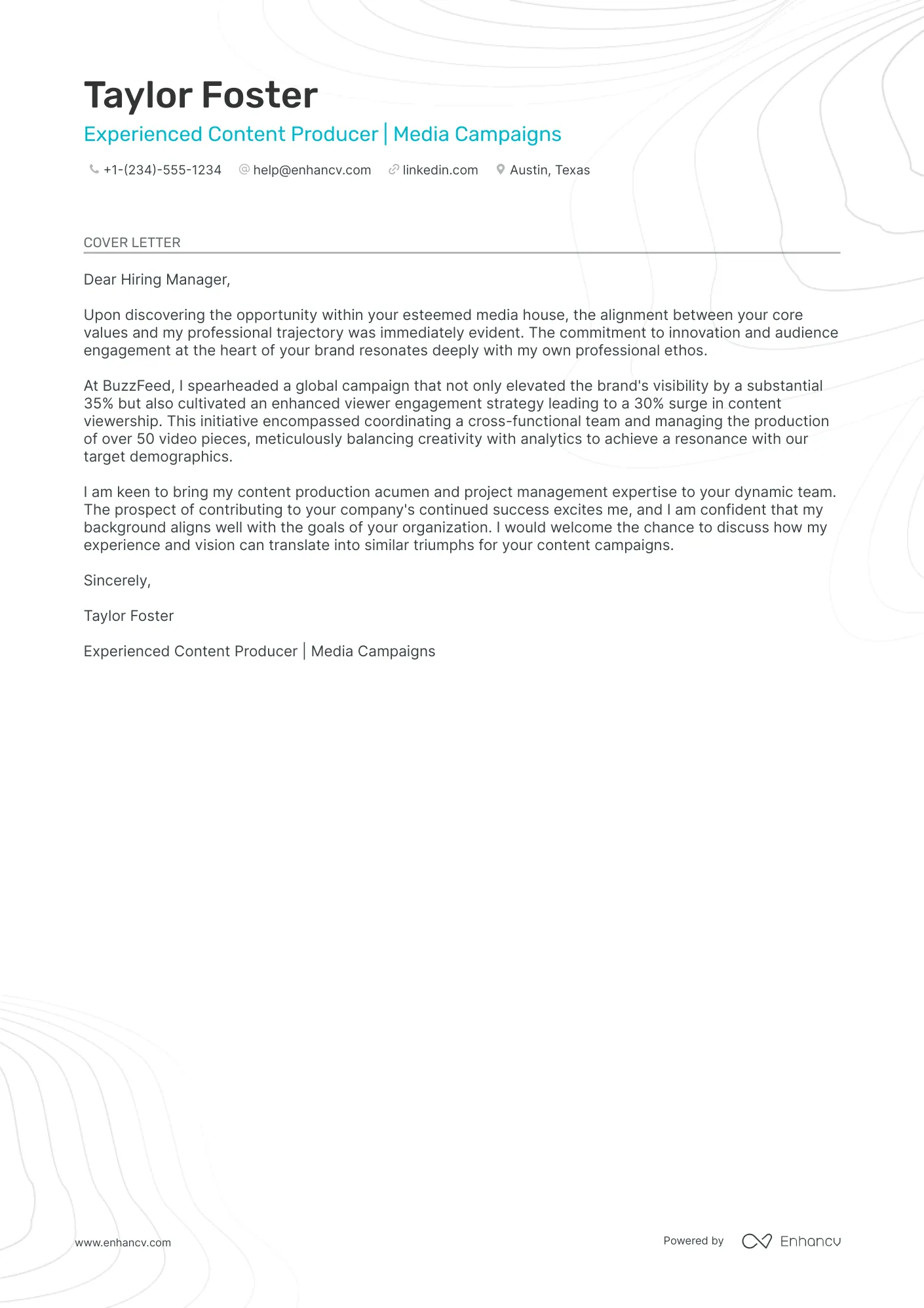
The Power of a Creative Producer Cover Letter
In the competitive world of creative production, a well-crafted cover letter is your first opportunity to make a lasting impression. It’s more than just a formality; it’s a crucial tool that showcases your skills, experience, and passion for the role. A strong cover letter can elevate your application, demonstrating to potential employers why you are the ideal candidate. It allows you to tell your story, highlight relevant achievements, and articulate your unique value proposition, ultimately increasing your chances of landing an interview and securing your dream job. A cover letter tailored to the specific role and company is the key to standing out.
Understanding the Role of a Creative Producer
Before you start writing, it’s important to understand the multifaceted role of a creative producer. This understanding informs the content and tone of your cover letter, ensuring that it resonates with the hiring manager. A creative producer is a pivotal figure in bringing creative projects to life, often acting as a bridge between the creative vision and its execution. They are responsible for managing all aspects of a project, from initial concept to final delivery, including budgeting, scheduling, team management, and ensuring the project aligns with the client’s or company’s goals.
Key Responsibilities of a Creative Producer

Creative producers wear many hats, managing various responsibilities. These include developing project concepts, creating budgets, managing schedules, and coordinating teams of creatives. They also oversee the production process, ensuring projects stay on track and within budget. A key responsibility is managing relationships with clients, stakeholders, and vendors. Furthermore, they are expected to identify and mitigate potential risks, ensuring projects meet the desired quality and creative standards. A strong understanding of these responsibilities allows you to tailor your cover letter to demonstrate your relevant experience and abilities effectively.
Why a Strong Cover Letter Matters
In today’s competitive job market, a strong cover letter distinguishes you from other applicants. It provides an opportunity to highlight your unique qualifications and experiences. Unlike a resume, which provides a factual overview of your career, a cover letter allows you to explain your motivations, connect with the hiring manager, and articulate why you are the best fit for the role. It lets you show your personality, passion, and enthusiasm for the position, all essential elements that can’t always be conveyed in a resume. A well-written cover letter can significantly increase your chances of getting an interview.
Highlighting Your Skills and Experience
Your cover letter is the perfect place to showcase your relevant skills and experience. Begin by identifying the key skills and qualifications mentioned in the job description, and then highlight instances where you have successfully applied these skills in your previous roles. Use specific examples to illustrate your abilities. For instance, instead of saying “I have strong project management skills,” describe a project where you successfully managed a complex project from start to finish, staying within budget and delivering on time. This approach makes your claims more credible and memorable.
Showcasing Relevant Projects

Use your cover letter to highlight projects that align with the job requirements. Briefly describe each project, emphasizing your role and contributions. Focus on projects that demonstrate your ability to manage budgets, coordinate teams, and deliver high-quality results. When describing a project, include the context, your responsibilities, and the outcome. For example, you might write, “As project lead for [Project Name], I was responsible for managing a team of 10 creatives, coordinating all stages of production, and ensuring the project aligned with the client’s vision. We successfully delivered the project ahead of schedule and under budget, resulting in [positive outcome].”
Quantifying Your Achievements
Whenever possible, quantify your achievements to make your claims more impactful. Use numbers and data to demonstrate your successes. Instead of saying “I improved efficiency,” say “I improved project efficiency by 15%.” Instead of saying “I managed a large team,” say “I managed a team of 20 creatives.” Using specific metrics to showcase your achievements makes your cover letter more compelling and demonstrates your ability to deliver results. This also helps the hiring manager quickly assess your value and potential contribution to their organization. Always provide quantifiable data whenever you can.
Tailoring Your Letter to the Job
Avoid sending generic cover letters. Customize each letter to match the specific job and company. This personalization shows that you have invested time and effort into understanding the role and the organization. Tailoring your cover letter also demonstrates your genuine interest in the position. By highlighting the company’s values, mission, and specific requirements, you create a compelling narrative that resonates with the hiring manager. This approach increases the likelihood of your application standing out from the competition.
Researching the Company and Role

Thorough research is essential for tailoring your cover letter effectively. Before you begin writing, investigate the company’s website, social media profiles, and recent news articles. Understand their mission, values, and recent projects. Review the job description carefully, noting the key skills, experiences, and qualities the company is seeking. Use this information to align your qualifications and demonstrate how your skills and experiences match the requirements of the role. Addressing specific aspects of the company demonstrates your interest and commitment, greatly enhancing your application.
Using Keywords Effectively
Incorporate keywords from the job description into your cover letter. These keywords are used to show the relevance of your skills and experience. Make sure to integrate the keywords naturally within the text, avoiding keyword stuffing, as this can make your letter sound unnatural and diminish its impact. Focus on using keywords in context while highlighting your relevant skills and accomplishments. This approach ensures your letter aligns with the job requirements and helps the hiring manager quickly see your fit for the role.
Formatting and Tone for Success
The format and tone of your cover letter significantly impact its effectiveness. Keep it professional, clear, and easy to read. Use a standard font and appropriate margins. Aim for a positive and enthusiastic tone. Your cover letter should reflect your personality and passion for creative production. It should be concise and well-organized, with a clear structure that guides the reader through your qualifications and experiences. A professional and engaging tone grabs the reader’s attention and leaves a positive impression. Always proofread and edit your letter to ensure that your writing is free from errors and professional.
Crafting a Compelling Opening

The opening paragraph is crucial. It must grab the reader’s attention and make them want to learn more about you. Avoid generic opening lines like “I am writing to express my interest.” Instead, begin with a statement that highlights your enthusiasm for the role or the company, or briefly summarize your key skills and experiences. You might also mention a specific project or achievement that aligns with the company’s needs. The goal is to immediately capture the hiring manager’s interest and encourage them to continue reading your cover letter.
Structuring Your Letter
Structure your cover letter logically to guide the reader through your qualifications and experiences. Start with an engaging opening, followed by a brief overview of your relevant skills and experience. In the body paragraphs, provide specific examples to illustrate your capabilities and accomplishments. Tailor each section to the job description. End with a strong closing that reiterates your interest and includes a call to action, such as expressing your availability for an interview. This structure ensures that your letter is clear, concise, and easy to follow.
Writing a Strong Closing
Your closing paragraph should reiterate your interest in the role and the company. Briefly summarize why you are the best fit for the position. Include a call to action, such as expressing your availability for an interview and providing your contact information. Thank the hiring manager for their time and consideration. A strong closing leaves the reader with a clear understanding of your enthusiasm and your readiness to take the next step in the hiring process.
Proofreading and Editing

Always proofread and edit your cover letter carefully before submitting it. Check for any typos, grammatical errors, and inconsistencies in formatting. Read your letter aloud to catch any awkward phrasing. Ask a friend or colleague to review your cover letter for clarity and accuracy. A well-proofread cover letter demonstrates your attention to detail and professionalism. It ensures your message is clear and makes a positive impression on the hiring manager.
Examples of Effective Cover Letter Phrases
Using powerful and compelling language can significantly enhance the impact of your cover letter. Here are phrases you can use to make your letter more persuasive. Incorporate phrases that highlight your creativity, leadership skills, and problem-solving abilities. Always be authentic and let your unique voice shine through.
Phrases to Use to Showcase Creativity
When demonstrating your creativity, use phrases such as “I excel at generating innovative ideas,” “I am adept at bringing creative visions to life,” or “My creativity is at the core of my approach.” To describe your creative projects, you might use “I conceptualized and executed” or “I developed a unique strategy.” Highlighting your ability to think outside the box and generate new ideas can set you apart as a creative producer. Show the projects that demonstrates your creative ability.
Phrases to Emphasize Leadership

To demonstrate your leadership skills, you could use phrases such as “I led and mentored a team of,” “I successfully managed,” or “I am skilled at motivating and inspiring teams.” If you have experience managing projects or budgets, use phrases like “I was responsible for” or “I effectively managed.” Emphasize how you guided your team to success. When you demonstrate leadership skills, you show your ability to lead projects and manage people.
Phrases to Highlight Problem-Solving
To showcase your problem-solving skills, use phrases such as “I am skilled at identifying and resolving issues,” “I have a proven track record of finding effective solutions,” or “I quickly assess and address challenges.” Mention specific instances where you overcame obstacles and found creative solutions. For instance, “When faced with [challenge], I developed a solution that [positive outcome].” Highlight the ability to solve problems and make critical decisions under pressure.
Common Mistakes to Avoid
Avoiding common mistakes can significantly increase the effectiveness of your cover letter. Be aware of these common pitfalls to ensure your letter showcases you in the best possible light.
Generic Cover Letters
Sending a generic cover letter is one of the biggest mistakes you can make. These cover letters often lack the personalization and specific details needed to capture the hiring manager’s attention. They fail to demonstrate your genuine interest in the role and the company. Always tailor your cover letter to each job application. Research the company, read the job description carefully, and highlight how your skills and experiences align with the specific requirements of the position.
Typos and Grammatical Errors
Typos and grammatical errors can undermine your credibility and professionalism. They suggest a lack of attention to detail, which can be a serious concern for creative producers who need to provide perfect results. Always proofread your cover letter carefully. Read it aloud to catch awkward phrasing and any missed mistakes. Ask a friend or colleague to review it for clarity and accuracy. Proofreading is essential to presenting your best possible image.
Focusing on “I” Instead of “You”
While it’s important to highlight your skills and experiences, avoid making your cover letter solely about you. Shift the focus from your accomplishments to how you can benefit the company. Show how your skills and experiences align with the company’s needs. Demonstrate that you understand their goals and are excited to contribute to their success. Focusing on “you” by showing your understanding of the company and the position demonstrates that you have invested the time and thought needed to create a solid application.
Finalizing and Submitting Your Cover Letter
Before submitting your cover letter, take a few extra steps to ensure it makes a positive impression. Always save it properly and submit it through the right channels.
Saving Your Cover Letter
Save your cover letter with a clear and professional file name. Use your name and the job title or company name. For example, use “JohnDoe_CreativeProducerCoverLetter.pdf” instead of “coverletter.doc.” This file name helps the hiring manager quickly identify your document and keep your application organized. Choosing a descriptive and professional file name ensures your application is easy to manage and present correctly. Always save your letter as a PDF to ensure the formatting remains the same no matter where it is opened.
Submitting Your Letter
Carefully follow the instructions provided in the job posting for submitting your cover letter and resume. Some companies may request that you submit your application through an online portal, while others may prefer email. Ensure that your cover letter and resume are properly formatted and easily accessible. If you are sending your cover letter via email, include a brief and professional subject line and a short message in the body of the email. By following the specific instructions, you ensure that your application arrives correctly and avoids any unnecessary delays.