What is a Referral Cover Letter?
A referral cover letter is a job application document that leverages a connection within a company to increase your chances of getting hired. It’s a strategic move that can significantly boost your application’s visibility and credibility. Unlike a standard cover letter, this type highlights your relationship with an employee or someone who can vouch for your skills and qualifications. The goal is to make a positive first impression and demonstrate your genuine interest in the position and the company. By mentioning the referral, you’re signaling to the hiring manager that you’re not just another applicant; you have a personal connection and have been recommended by someone they trust. This often leads to a more attentive review of your application and a higher probability of getting an interview. Remember that a well-crafted referral cover letter is more than just name-dropping; it’s about demonstrating how your skills and experience align with the job requirements and how the referral can attest to your suitability for the role.
Why Use a Referral?
Using a referral offers several compelling advantages in the job application process. First, it can significantly increase the likelihood of your application being reviewed. Hiring managers often prioritize referrals because they come with a degree of trust and validation from an existing employee. This means your application is less likely to get lost in the pile of resumes. Second, referrals can provide valuable insights into the company culture, the hiring manager’s expectations, and the specific requirements of the role. Your referrer can offer a realistic perspective and give you advice on how to tailor your application to best suit the company’s needs. This insider information can be invaluable in crafting a compelling cover letter and preparing for the interview. Third, referrals often demonstrate a strong alignment with the company’s values and goals. A referral suggests that the person recommending you believes you’re a good fit, which can be a powerful endorsement. Finally, referral often lead to a faster hiring process. With a trusted reference, the hiring team might expedite the process, leading to an interview faster than usual.
How to Find a Referral

Finding a referral requires proactive networking and relationship-building. Start by leveraging your existing network, including friends, family, former colleagues, and classmates. Reach out to people who work at the company you’re interested in and express your interest in the job. LinkedIn is an invaluable tool for this. Search for employees at the company and see if you have any mutual connections. If you do, ask your mutual connection to make an introduction. Be prepared to explain why you’re interested in the role and why you believe your skills align with the company’s needs. When reaching out to potential referrers, be polite and professional. Provide them with your resume and cover letter, and be prepared to answer any questions they might have about your qualifications. Remember, the person is putting their reputation on the line by recommending you. Always express gratitude for their help and keep them updated on your application status. If you do not know someone, research the company and the roles you are seeking. Find people in similar roles and connect with them by showing genuine interest in their work.
Key Components of a Referral Cover Letter
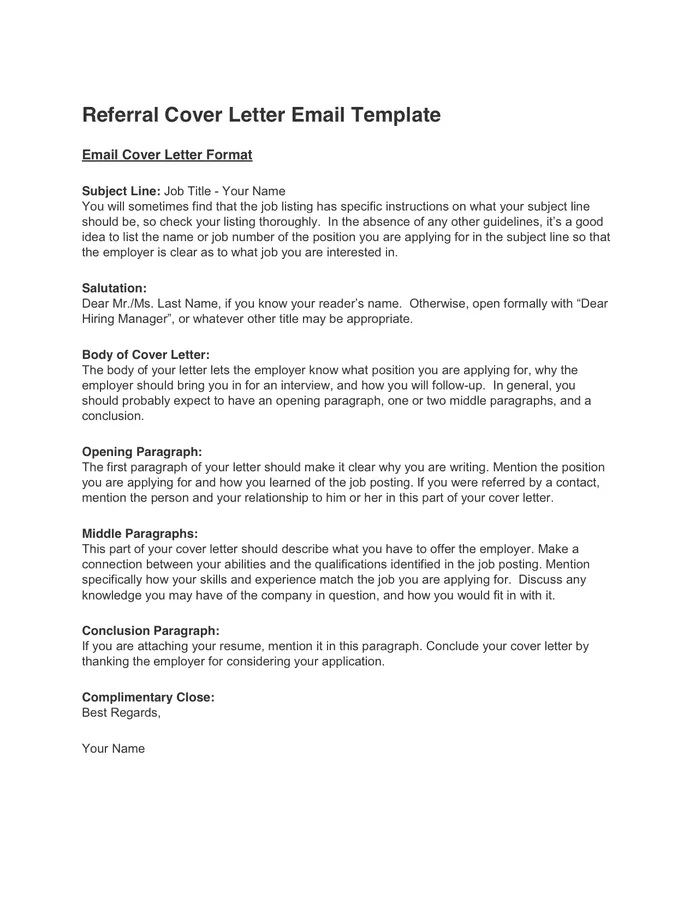
A well-crafted referral cover letter consists of several key components. Start with a professional heading that includes your contact information and the date. Address the letter to the hiring manager if possible; otherwise, use a generic salutation like “Dear Hiring Team.” In the opening paragraph, state the position you are applying for and, crucially, mention the name of the person who referred you. This immediately grabs the reader’s attention and establishes the connection. The body of the letter should highlight your relevant skills and experience, demonstrating how they align with the job requirements. Provide specific examples of your achievements and quantify your results whenever possible. Tailor each cover letter to the specific role and company, demonstrating your understanding of their needs and values. Be sure to use keywords from the job description to show your relevance. In the closing paragraph, reiterate your interest in the position, express gratitude to the referrer, and mention that you are available for an interview. End with a professional closing and your typed name. Be concise and ensure that your cover letter is free of grammatical errors.
Formatting Your Referral Cover Letter
Formatting your referral cover letter is essential for making a positive first impression. Choose a professional and easy-to-read font, such as Times New Roman, Arial, or Calibri, and use a font size between 10 and 12 points. Maintain consistent formatting throughout the document. Use single-spacing for the body of the letter, with a blank line between paragraphs. Use a standard one-inch margin on all sides. Ensure that your letter is well-organized with clear headings and subheadings. This will help the reader to quickly scan the document and find the information they need. Use bullet points to highlight your skills, accomplishments, and other relevant information. Keep paragraphs short and concise, ideally no more than five to six sentences. Proofread your cover letter carefully for any grammatical errors, spelling mistakes, or typos. A well-formatted and error-free cover letter demonstrates professionalism and attention to detail.
Tips for Including the Referral

When including the referral in your cover letter, there are several tips to keep in mind. Start by mentioning the referrer’s name and their relationship to you in the opening paragraph. For instance, you can state, “I am writing to express my interest in the [Job Title] position, as recommended by [Referrer’s Name], a [Referrer’s Title] at [Company Name].” Throughout the letter, briefly mention why the referrer believes you are a good fit for the role. Focus on the value you bring to the company. Avoid simply stating that someone referred you; go deeper by highlighting how your skills align with the job requirements and how your referrer can vouch for your abilities. If possible, mention something specific that the referrer told you about the company or the role, but keep it brief and relevant. Be sure to thank the referrer for their support and express your gratitude for their recommendation. Don’t overdo it with the referral mention. The primary focus should always be on your qualifications and how you can contribute to the company’s success.
Example Referral Cover Letter
Here is a sample cover letter:
[Your Name] [Your Address] [Your Phone] [Your Email]
[Date]
[Hiring Manager Name] [Hiring Manager Title] [Company Name] [Company Address]
Dear [Hiring Manager Name],
I am writing to express my strong interest in the [Job Title] position at [Company Name], as recommended by [Referrer’s Name], a [Referrer’s Title] at [Company Name]. I have been consistently impressed by [Company Name]’s [mention something specific about the company or its work].
In my previous role at [Previous Company], I [list a key accomplishment]. I am confident that my skills and experience in [mention relevant skills] align perfectly with the requirements of this role. [Referrer’s Name] has shared their positive experiences at [Company Name], and I am eager to contribute to your team.
Thank you for your time and consideration. I look forward to the possibility of discussing my application further.
Sincerely, [Your Typed Name]
Remember to tailor this template to fit your specific situation and the job you’re applying for. It’s a starting point that should be personalized.
Proofread and Submit Your Cover Letter
Before submitting your cover letter, it’s crucial to proofread it thoroughly. Check for any grammatical errors, spelling mistakes, typos, and inconsistencies in formatting. Read the letter aloud to yourself, which can help you catch any awkward phrasing or unclear sentences. Ask a friend, family member, or career advisor to review the letter. A fresh pair of eyes can often identify errors that you might have missed. Ensure that your contact information is correct and up-to-date. Double-check the company name, the hiring manager’s name, and the job title. Verify that the letter is addressed to the correct person and that it aligns with the specific requirements of the role. After proofreading, save your cover letter as a PDF to maintain the formatting. Finally, submit your cover letter along with your resume and any other required documents. By taking these steps, you’ll increase your chances of making a positive impression and landing an interview.