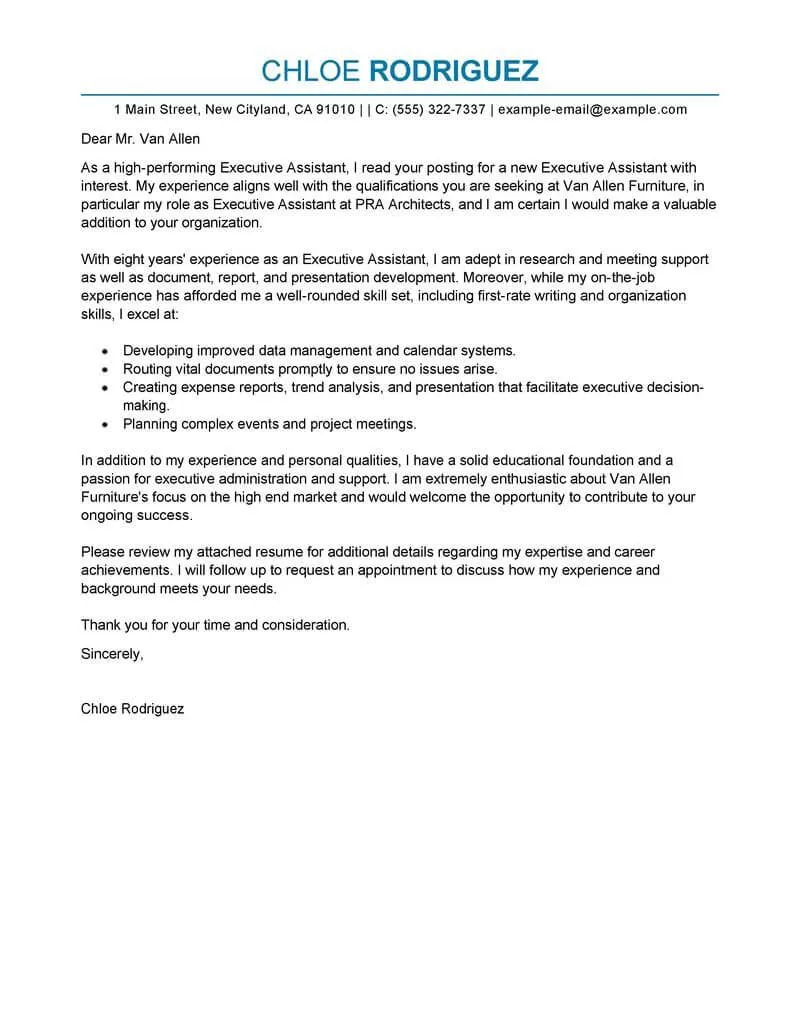
Understanding the Executive Assistant Role
An Executive Assistant (EA) is a crucial role in any organization, providing high-level administrative support to executives, managers, and sometimes entire teams. The EA acts as a gatekeeper, managing schedules, coordinating meetings, handling communications, and ensuring the smooth operation of the executive’s daily activities. This role requires a proactive individual who can anticipate needs, solve problems, and maintain confidentiality. EAs are often the first point of contact for clients, stakeholders, and employees, representing the executive and the company in a professional manner. Understanding the multifaceted nature of the role is the first step in crafting a cover letter that resonates with potential employers, showcasing your capabilities and experience.
Key Responsibilities of an Executive Assistant
The responsibilities of an Executive Assistant are diverse, encompassing various administrative, organizational, and communication tasks. Primary responsibilities include managing calendars, scheduling meetings, and coordinating travel arrangements, including flights, accommodations, and itineraries. Other duties involve preparing presentations, reports, and correspondence, often requiring proficiency in various software applications. EAs also handle phone calls, manage emails, and screen visitors, ensuring effective communication and information flow. Many EAs also handle expense reports, manage budgets, and assist with project coordination, making attention to detail and organizational skills essential. The best cover letters will reflect these skills and demonstrate an understanding of the specific needs of the role.
Essential Skills for Executive Assistants

Success as an Executive Assistant hinges on a strong foundation of essential skills. Excellent communication skills, both written and verbal, are paramount for interacting with executives, colleagues, and external stakeholders. Organizational skills, including time management, prioritizing tasks, and attention to detail, are crucial for managing schedules, coordinating projects, and maintaining efficiency. Proficiency in Microsoft Office Suite, including Word, Excel, PowerPoint, and Outlook, is also essential for creating documents, managing data, and handling communications. Additional skills include problem-solving abilities, discretion and confidentiality, and the ability to work independently and collaboratively. Highlighting these skills, with specific examples in your cover letter, will make you stand out. Consider including your proficiency in CRM software, travel booking systems, or other relevant tools.
Crafting a Compelling Cover Letter
A well-crafted cover letter is your opportunity to make a strong first impression and demonstrate your suitability for an Executive Assistant position. It complements your resume by providing a narrative that highlights your skills, experience, and enthusiasm. The cover letter should be concise, professional, and tailored to the specific requirements of the job. It should showcase your key accomplishments and articulate your value proposition as an EA, clearly articulating your capabilities and your understanding of the role’s demands. By following a strategic approach, you can write a cover letter that resonates with the hiring manager and increases your chances of securing an interview. Remember to be confident, yet professional in your tone, showcasing why you’re the best candidate.
Header and Contact Information
Begin your cover letter with a professional header that includes your contact information. This section typically includes your full name, phone number, email address, and optionally, your LinkedIn profile URL. Ensure your contact information is accurate and up-to-date. Place the header at the top of the page, either aligned to the left or centered. Then, include the date, followed by the hiring manager’s name (if known), their title, and the company’s address. If you are unsure of the hiring manager’s name, research online or use a general salutation such as “Dear Hiring Manager.”
The Salutation

Start your cover letter with a professional salutation. If you know the hiring manager’s name, use “Dear Mr./Ms./Mx. [Last Name].” This demonstrates you’ve done your research and taken the time to personalize your application. If you don’t know the name, use a more general, yet professional greeting such as “Dear Hiring Manager,” or “Dear [Company Name] Team.” Avoid generic greetings like “To Whom It May Concern.” Always ensure you spell the name correctly. A personalized salutation immediately sets a positive tone and shows your attention to detail. Remember the salutation is the initial point of engagement and should reflect your professional etiquette.
Opening Paragraph
The opening paragraph should immediately grab the reader’s attention and state your purpose. Clearly state the position you’re applying for and where you found the job posting. Briefly mention your most relevant qualifications and why you are interested in the role. Show enthusiasm for the opportunity and the company. Avoid generic opening lines; instead, craft a concise and engaging introduction that highlights your key skills and experience. The initial paragraph should make the reader want to read further. A strong opening paragraph can set the tone for the entire cover letter, immediately making you stand out from other applicants.
Highlighting Relevant Skills and Experience
The body of your cover letter is where you demonstrate your value as an Executive Assistant. Focus on highlighting the skills and experiences that align with the job description. Provide specific examples of your accomplishments, using the STAR method (Situation, Task, Action, Result) to illustrate your abilities. Discuss how you’ve managed complex schedules, coordinated travel arrangements, prepared presentations, or handled confidential information. Tailor the content to match the requirements of the specific role; avoid generic descriptions. Show, don’t just tell, by using quantifiable achievements and showcasing your problem-solving and organizational skills. Your cover letter should give the reader a vivid picture of how you can contribute to the team.
Quantifying Achievements

Whenever possible, quantify your achievements to make your accomplishments more impactful. Use numbers and data to demonstrate the results of your work. For example, instead of saying “Managed complex travel arrangements,” state “Coordinated travel for 10+ executives, resulting in a 95% on-time arrival rate.” Quantifying your achievements provides concrete evidence of your abilities and shows potential employers the value you bring. Use metrics to showcase your efficiency, productivity, and ability to manage resources effectively. Quantifiable data makes your application more credible and shows the hiring manager what you’ve accomplished in previous roles. This is one of the strongest ways to showcase value.
Tailoring the Cover Letter to the Job
Customize your cover letter for each job application. Review the job description carefully and identify the key skills, experiences, and qualifications the employer seeks. Then, align your cover letter with these requirements. Use the same keywords and phrases that appear in the job posting. Highlight the aspects of your experience that are most relevant. Generic cover letters are easily spotted and often discarded. Instead, demonstrate that you understand the company’s needs and have the skills to excel in the role. Personalizing your cover letter shows that you’ve invested time and effort and that you’re genuinely interested in the position.
Expressing Enthusiasm and Company Research
Show genuine enthusiasm for the company and the specific opportunity. Research the company and mention something that resonates with you – their mission, values, recent achievements, or industry position. Demonstrate that you’ve taken the time to understand their culture and business objectives. This shows you’re genuinely interested in joining their team and are not simply sending out generic applications. Mentioning specific projects, initiatives, or values that align with your interests will make your application more personal and memorable. Express your interest in contributing to their success and mention how your skills can help the company achieve its goals.
Closing the Cover Letter

In the closing paragraph, reiterate your interest in the position and express your confidence in your ability to excel. Thank the hiring manager for their time and consideration. Include a call to action, such as stating your availability for an interview. Reiterate your contact information one last time. Keep the closing concise and professional. End with a polite closing, such as “Sincerely” or “Best regards,” followed by your full name. Ensure the closing reflects your enthusiasm and desire to move forward in the hiring process, and thank them again for their time.
Common Mistakes to Avoid
Avoid common mistakes to ensure your cover letter makes a positive impression. Attention to detail is critical in the Executive Assistant role, and any errors in your cover letter could undermine your candidacy.
Generic Cover Letters
Avoid using generic cover letters that are not tailored to the specific job. Customize your cover letter for each position. Show that you have researched the company and understand their needs. Generic letters demonstrate a lack of effort and may be quickly discarded. Always personalize your application, highlighting the most relevant skills and experience for the specific role and company. Take the time to make your application stand out with a tailored approach.
Typos and Grammatical Errors

Typos and grammatical errors can undermine your credibility and professionalism. Proofread your cover letter carefully. Use a grammar checker and ask a friend or family member to review it. Errors indicate a lack of attention to detail, a crucial skill for an Executive Assistant. Thorough proofreading is essential before submitting your application. Review your cover letter several times and correct every error. Make sure your cover letter is polished and error-free.
Lack of Personalization
A cover letter that lacks personalization is a missed opportunity. Avoid using generic phrases and show that you understand the company and the role. Tailor your cover letter to the job and the company. Mention specific projects or initiatives that interest you. Highlight the specific skills and experiences that align with the job requirements. Ensure your cover letter reflects your understanding of the company’s needs and values. By demonstrating your interest and knowledge, you can significantly enhance your application.
Formatting and Design Tips
Formatting and design can make your cover letter more visually appealing and easier to read. A well-formatted cover letter increases readability and helps you make a strong impression. Proper formatting highlights your professionalism and your attention to detail. These elements will help make your cover letter stand out positively.
Choosing the Right Font

Choose a professional and easy-to-read font. Common fonts like Times New Roman, Arial, Calibri, and Helvetica are generally safe choices. Keep the font size between 10 and 12 points. Avoid using overly decorative or unusual fonts that could distract the reader. Consistency is key; use the same font throughout your cover letter. A clear and simple font increases readability and allows the hiring manager to focus on the content of your letter. Ensure the font is easily readable in both print and digital formats.
Formatting for Readability
Use clear and consistent formatting to make your cover letter easy to read. Use a standard business letter format. Include appropriate spacing between paragraphs and sections. Use bullet points to highlight key skills and accomplishments. Keep paragraphs concise and focused, using headings and subheadings to organize your content. Good formatting increases readability and helps the hiring manager quickly find the information they need. Ensure margins are set appropriately and the document is well-structured. Consistent formatting enhances the professional appearance of your cover letter and makes it more readable.
Proofreading and Editing
Proofread and edit your cover letter thoroughly before submitting it. Check for typos, grammatical errors, and inconsistencies. Ask a friend or family member to review your cover letter for feedback. Proofreading is a crucial step to ensure your cover letter is polished and professional. Ensure you spellcheck and grammar check your letter. A carefully proofread cover letter demonstrates your attention to detail and increases your credibility as a candidate.
Template Resources and Examples

Using cover letter templates can provide a solid foundation and guide you in structuring your document. However, always adapt the templates to your own experience and the specific job requirements. Numerous resources offer cover letter templates for Executive Assistant roles.
Where to Find Cover Letter Templates
Various online resources offer cover letter templates, including websites like Indeed, Resume.com, and various career sites. These templates provide a basic structure and help you get started. You can also find templates in Microsoft Word and other word processing programs. Be sure to select a template relevant to your experience and the specific role you’re applying for, tailoring them to your skills and experience.
Adapting Templates to Your Needs
While templates provide a starting point, it’s crucial to adapt them to your needs and the specific job. Customize the template to highlight your relevant skills and experiences. Replace the placeholder text with your information. Avoid simply copying and pasting; instead, use the template as a guide to create a unique and personalized cover letter. Make sure you tailor the template to match the job description and showcase your unique value proposition as an Executive Assistant. Ensure the final result accurately reflects your abilities.