Crafting Your Occupational Therapy Cover Letter
As a new graduate in occupational therapy, your cover letter is your first opportunity to make a strong impression on potential employers. It’s a crucial document that complements your resume, providing a platform to showcase your skills, experiences, and passion for the profession. A well-crafted cover letter can significantly increase your chances of securing an interview and landing your dream job. This guide will walk you through the essential steps of creating a compelling cover letter that highlights your qualifications and sets you apart from other applicants. The goal is to present yourself as a confident, capable, and enthusiastic occupational therapist ready to contribute to a healthcare team. Remember, this letter is not just a formality; it is a marketing tool that sells your unique abilities and potential.
Understanding the Purpose of a Cover Letter
The primary purpose of a cover letter is to introduce yourself to the hiring manager and express your interest in a specific position. It allows you to elaborate on the information presented in your resume, providing context and depth to your qualifications. Unlike your resume, which is a summary of your professional history, your cover letter gives you the opportunity to tell your story, explaining why you’re the ideal candidate for the job. It’s also a chance to demonstrate your communication skills, your understanding of the role, and your enthusiasm for the organization. Think of it as your personal introduction, a way to connect with the hiring manager on a more personal level and make a memorable first impression. A well-written cover letter demonstrates your attention to detail, your professionalism, and your genuine interest in the position, all of which are essential qualities in an occupational therapist.
Highlighting Your Skills and Qualifications

Your cover letter should effectively highlight the skills and qualifications that align with the job requirements. As a new graduate, focus on the skills you’ve developed through your academic training and clinical placements. Be specific about the assessments, interventions, and populations you’ve worked with. Mention any specialized training or certifications you’ve obtained. Emphasize your ability to collaborate with interdisciplinary teams, your communication skills, and your ability to adapt to different environments. Showcase your understanding of the occupational therapy process, including evaluation, planning, intervention, and outcome measurement. By emphasizing your key skills and demonstrating how they meet the employer’s needs, you can make a strong case for why you’re a good fit for the position. This also includes highlighting your understanding of ethical principles, professional standards, and your commitment to client-centered care.
Key Components of an Occupational Therapy Cover Letter
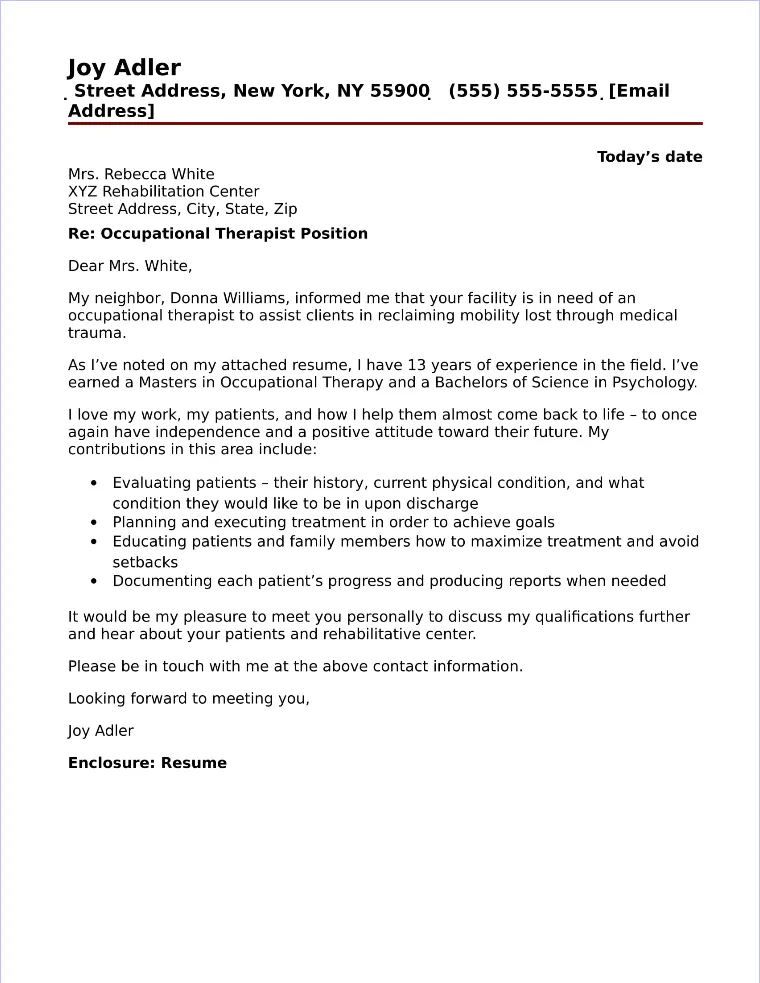
A well-structured cover letter includes several key components. Start with your contact information, followed by the date and the hiring manager’s contact information. Begin with a compelling introductory paragraph that states the position you’re applying for and how you learned about it. In the body of the letter, showcase your relevant experience, skills, and achievements, providing specific examples to illustrate your capabilities. Tailor each section to the specific job description. The concluding paragraph should express your enthusiasm for the opportunity and include a call to action, such as requesting an interview. Proofread the entire letter carefully to ensure it is free of errors and reflects a professional tone. The structure and organization of your letter is important because it will help you present yourself in the best possible light, demonstrating your attention to detail and ability to communicate effectively.
Your Contact Information
At the top of your cover letter, include your full name, address, phone number, and professional email address. Ensure your email address is professional and appropriate for job applications. Double-check that your phone number is accurate and that your voicemail is set up to receive messages. This information ensures the hiring manager can easily contact you. Making it simple for the employer to reach you is a key first step, and provides them with confidence.
The Introductory Paragraph

Your introductory paragraph should immediately grab the reader’s attention. State the position you are applying for and where you saw the job posting. Briefly express your interest in the position and the organization. If you have a personal connection to the organization or a specific reason for your interest, mention it here. This sets the tone for the rest of the letter and encourages the hiring manager to continue reading. A strong opening can significantly increase the likelihood that your application will be considered. Making it clear which position you are applying for will save the recruiter time.
Demonstrating Your Passion for Occupational Therapy
Expressing your passion for occupational therapy is critical. Use your cover letter to explain what drives you to work in this field. Share specific experiences or moments that solidified your commitment to helping others improve their quality of life. Talk about why you chose occupational therapy as a career and what you find most rewarding about the profession. Your enthusiasm will make you more memorable and show that you are not just looking for a job, but a fulfilling career. Personalize your letter to reflect your passion by explaining why you love the practice, and why it is important to the world.
Showcasing Relevant Experience
As a new graduate, your clinical placements are your most relevant experience. Provide details about the settings, populations, and types of interventions you were involved in. Quantify your accomplishments whenever possible. For example, mention the number of patients you worked with, the types of assessments you administered, or the improvements you saw in patient outcomes. Use the STAR method (Situation, Task, Action, Result) to describe your experiences. This method helps you provide clear, concise examples that demonstrate your skills and abilities. Focus on experiences that align with the job requirements, even if they come from volunteer work or extracurricular activities. This creates a clear presentation of skills.
Academic Achievements

While clinical experience is paramount, you can highlight any academic achievements that showcase your capabilities. Mention your GPA if it is strong. List any awards or honors you received. If you completed a research project or presented at a conference, be sure to include that information. These achievements demonstrate your dedication to learning and your commitment to excellence. They can also help you stand out, especially if other candidates have similar clinical experience. Including these academic achievements show a commitment to knowledge.
Clinical Placements
Clinical placements are the heart of your OT experience as a new grad. Provide detailed descriptions of your placements. Include the setting (e.g., acute care, outpatient pediatrics, skilled nursing facility). Describe the populations you worked with (e.g., stroke patients, children with autism, geriatric clients). Detail the types of interventions you provided (e.g., ADL training, cognitive rehabilitation, splinting). Quantify your experiences whenever possible. For example, state the number of patients you evaluated or the specific outcomes you helped achieve. Emphasize any specialized skills or training you gained during your placements. Your experiences will show the employer what you are capable of.
Quantifying Your Accomplishments
Whenever possible, use numbers and data to quantify your accomplishments. For example, instead of saying “I improved patient outcomes,” say “I improved patient outcomes by 15% through the use of evidence-based interventions.” Quantifying your accomplishments provides concrete evidence of your skills and abilities. It shows that you are results-oriented and that you understand the importance of measuring and evaluating your interventions. This also shows the employer that you are able to apply what you have learned in a practical setting. Using quantifiable language is a powerful way to impress potential employers, making your cover letter more impactful and memorable.
Highlighting Soft Skills

In addition to your technical skills, emphasize your soft skills. These include communication, empathy, teamwork, problem-solving, and adaptability. Provide examples of how you have demonstrated these skills in your clinical placements or academic experiences. For instance, describe a time you had to effectively communicate with a patient’s family or collaborate with a multidisciplinary team to achieve a common goal. Demonstrate your ability to work under pressure and adapt to changing situations. Soft skills are essential in occupational therapy because they enable you to build rapport with patients, collaborate effectively with colleagues, and provide holistic care. These soft skills are also important in the workplace to establish professionalism and respect.
Tailoring Your Cover Letter to the Job
Tailoring your cover letter to each job application is essential. Review the job description carefully and identify the key requirements and desired qualifications. Use the job description as a guide to highlight the skills and experiences that are most relevant to the position. Avoid using a generic cover letter. Instead, customize each letter to reflect the specific needs of the employer and the requirements of the job. This demonstrates your interest and shows that you have taken the time to understand the role and the organization. Make it clear that you are an excellent match for the specific opportunity. Tailoring shows you have read the job description and understood the requirements.
Researching the Employer
Before you start writing your cover letter, research the employer. Visit their website, read about their mission and values, and learn about their services. If possible, find out about the specific department or team you would be working with. This research will help you tailor your cover letter and demonstrate your interest in the organization. Mentioning specific programs or initiatives that resonate with you can show the hiring manager that you have done your homework and are genuinely interested in working there. The more you know about the organization, the better you can tailor your cover letter to match their needs and culture. Demonstrating your interest shows how much you care about the position.
Matching Your Skills to the Job Description

Carefully compare your skills and experiences with the requirements listed in the job description. Identify the keywords and phrases used in the description and incorporate them into your cover letter. Use specific examples from your clinical placements or academic experiences to demonstrate how your skills align with the employer’s needs. Avoid simply restating the job description. Instead, use your cover letter to show how you can apply your skills and experiences to the role. Provide examples that show you are able to perform the duties required of the position. Demonstrating how you meet these requirements will help your cover letter stand out.
Using Keywords Effectively
Many employers use Applicant Tracking Systems (ATS) to screen applications. To increase your chances of getting past the ATS, incorporate relevant keywords from the job description into your cover letter. However, avoid keyword stuffing. Instead, use keywords naturally and strategically throughout your letter. Make sure your writing flows well and is easy to read. Keywords help the recruiter search for skills required for the position. Placing keywords in your cover letter will help your application get noticed. Using the correct keywords helps the applicant tracking system properly recognize your application.
Formatting and Structure
Use a professional and easy-to-read format for your cover letter. Use a standard font, such as Times New Roman or Arial, and use a font size of 11 or 12 points. Use one-inch margins on all sides. Make sure your letter is well-organized, with clear paragraphs and headings. Proofread the letter carefully to ensure there are no errors in grammar or spelling. A well-formatted cover letter shows that you pay attention to detail and that you are capable of producing professional documents. Keep the layout clean, and avoid using complex designs or graphics. A clean layout is easy to read and quickly understood.
Maintaining a Professional Tone

Maintain a professional and respectful tone throughout your cover letter. Use formal language and avoid slang or jargon. Be positive and enthusiastic, but avoid sounding overly casual or informal. Address the hiring manager by name if possible. If you are unsure of the hiring manager’s name, address the letter to “Dear Hiring Manager.” Proofread your cover letter carefully to ensure it reflects a professional image. The language you use should be formal and demonstrate your attention to detail and understanding of professional communication. Your professionalism will provide the hiring manager confidence in your abilities.
Proofreading and Editing
Proofreading and editing are critical steps in the cover letter writing process. Errors in grammar, spelling, or punctuation can undermine your credibility and make a negative impression on the hiring manager. Proofread your letter multiple times, preferably with fresh eyes. Ask a friend, family member, or career counselor to review your letter as well. They may catch errors that you have missed. Ensure that your cover letter is clear, concise, and free of errors. You can also use online tools like Grammarly to help you identify and correct any mistakes. Proper grammar shows attention to detail.
Ensuring Clarity and Conciseness
Make sure your cover letter is clear, concise, and easy to understand. Use simple language and avoid overly complex sentences. Get straight to the point and avoid unnecessary jargon. Your cover letter should be easy for the hiring manager to read and quickly understand your key qualifications. Keep your letter concise, typically one page long. Avoid lengthy paragraphs and break up your text with bullet points or short sentences. You want your cover letter to be read, not skimmed. A clear and concise letter demonstrates your ability to communicate effectively.
The Closing Paragraph and Call to Action
The closing paragraph is your final opportunity to make an impression. Express your enthusiasm for the opportunity and reiterate your interest in the position. Provide your contact information again and include a call to action. For example, you can request an interview or express your availability for a phone call. Thank the hiring manager for their time and consideration. End your letter with a professional closing, such as “Sincerely” or “Best regards.” A strong closing paragraph reinforces your interest and encourages the hiring manager to take the next step. This could be the determining factor to secure your interview.
Expressing Enthusiasm
Reiterate your enthusiasm for the position and the organization. Show that you are genuinely interested in working there and that you have a clear understanding of the role and its responsibilities. Use enthusiastic language to express your excitement about the opportunity. Let the hiring manager know how excited you are about the opportunity. Your passion and commitment will distinguish you from other candidates.
Providing Contact Information Again
Include your contact information in the closing paragraph, including your phone number and email address. Make it easy for the hiring manager to contact you if they are interested in scheduling an interview. Double-check that your contact information is correct and up-to-date. Re-stating your contact information eliminates any chance of miscommunication and guarantees the hiring manager is able to contact you.
Thanking the Hiring Manager
Thank the hiring manager for their time and consideration. Express your appreciation for the opportunity to apply and for their review of your application. A simple thank you shows professionalism and respect. You can also mention that you look forward to hearing from them soon. This simple act of gratitude can leave a lasting impression and demonstrate your courtesy.
Following Up After Submission
If you haven’t heard back from the employer within a reasonable timeframe (typically one to two weeks), consider following up. Send a brief email to the hiring manager, reiterating your interest in the position and asking about the status of your application. Keep the email concise and professional. A follow-up email shows your continued interest and initiative. Make sure you are not too pushy. It’s best to respect the timeframe and follow up appropriately.