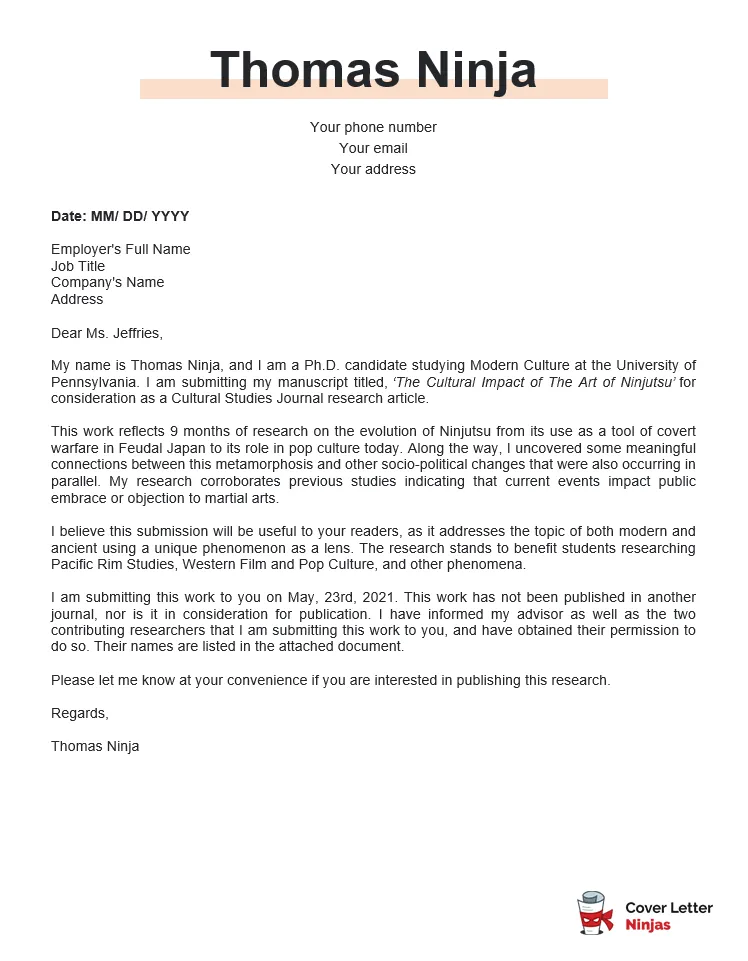
Cover Letter Example Scientific Journal Why It Matters
Submitting your research to a scientific journal is a significant step in disseminating your findings and contributing to the scientific community. However, the journey doesn’t end with the completion of your manuscript. A crucial, often overlooked, component of the submission process is the cover letter. A well-crafted cover letter can significantly influence the editor’s initial impression of your work and, ultimately, their decision on whether to send your manuscript for peer review. This guide provides a cover letter example to help you navigate the process of creating a compelling cover letter that increases your chances of publication. It highlights why a cover letter is not just a formality but a vital tool for effectively communicating the importance and impact of your research.
Understanding the Purpose of a Cover Letter
The primary purpose of a cover letter in the context of a scientific journal is to introduce your manuscript to the editor. It’s your first opportunity to make a positive impression and persuade the editor that your research is a valuable contribution to the field. The cover letter serves as a brief summary of your work, emphasizing its significance, novelty, and relevance to the journal’s scope. It allows you to highlight key findings and explain why your research is suitable for publication in that particular journal. A well-written cover letter demonstrates your understanding of the journal’s audience and editorial standards, showcasing your professionalism and attention to detail, which can set a positive tone for the review process.
What a Cover Letter Does

A cover letter does more than just introduce your manuscript it functions as a bridge between your research and the journal. It’s your chance to provide context for your work, explain its importance, and persuade the editor that your manuscript deserves consideration. It’s an opportunity to briefly summarize your study’s aims, methods, key findings, and conclusions, allowing the editor to quickly grasp the essence of your research. Moreover, the cover letter should articulate why your work is a good fit for the specific journal, demonstrating your understanding of its scope, readership, and editorial policies. A well-crafted cover letter indicates your respect for the journal and your commitment to publishing high-quality research. It helps the editor to make an informed decision about whether to send your manuscript for peer review.
Importance for Scientific Journals
In the competitive landscape of scientific publishing, a cover letter is a critical tool for making your manuscript stand out. Scientific journals receive a high volume of submissions, and editors often make initial decisions based on the cover letter. A strong cover letter demonstrates professionalism, clarity, and a genuine understanding of the journal’s focus. It allows you to explicitly state the importance of your work, its relevance to the journal’s readership, and any unique aspects that make it worthy of publication. Furthermore, it can be used to address any potential concerns or limitations of your study, showcasing your transparency and integrity. A well-written cover letter significantly increases your chances of your manuscript being sent for peer review, ultimately leading to publication. It is the first impression editors have of your work, making it an indispensable part of the submission package.
Key Components of a Cover Letter Example
A well-structured cover letter includes specific components. These components ensure that you provide all necessary information to the editor in a clear and concise manner. By including the correct information, you are setting your submission up for a higher chance of being accepted. The structure should be clear, allowing the editor to quickly grasp the essence of your research and its suitability for the journal.
Contact Information

Begin with your contact information, including your full name, affiliation, and email address. This makes it easy for the editor to contact you regarding the manuscript. Ensure that the email address is professional and monitored regularly.
Author’s Information
Include the names and affiliations of all authors. Specify the corresponding author and their contact details. If any authors have made significant contributions, briefly mention them in the cover letter.
Manuscript Details
Clearly state the manuscript title and the type of submission (e.g., original research article, review, case study). Also, provide the date of submission. Indicate if the manuscript has been submitted elsewhere or is under consideration by another journal. Include the manuscript’s word count, number of figures, and tables.
Why the Research Matters

Briefly summarize the main purpose of the study and its primary research questions. Highlight the novelty and significance of the research. Explain the potential impact of your findings on the field and its relevance to the journal’s scope.
Highlighting Key Findings
Summarize the key findings and their implications. Emphasize any groundbreaking results or major contributions. Explain how your findings advance current knowledge and offer new insights.
Addressing the Editors
Address the editor by name if possible (research the journal’s website). Express your enthusiasm for publishing in the journal. Mention why you believe your manuscript is a good fit for the journal’s audience and scope. State that you are open to feedback and revisions.
Tailoring the Letter to the Journal

Each scientific journal has its own specific focus, readership, and editorial preferences. Tailoring your cover letter to the journal’s unique characteristics is crucial for increasing your chances of acceptance. Research the journal’s website to understand its scope, target audience, and style guidelines. Pay attention to the types of articles it publishes and the topics it prioritizes. Use language and terminology consistent with the journal’s style. Highlight how your research aligns with the journal’s goals and interests. Demonstrating that you understand the journal’s specific requirements increases your credibility and shows that you’ve considered the journal’s unique profile.
Formatting and Style
The formatting and style of your cover letter are important for creating a professional and polished first impression. Adhere to standard business letter formatting, including a clear heading with your contact information and the date. Use a professional font, such as Times New Roman or Arial, with a font size of 11 or 12 points. Keep the letter concise and focused, typically within one page. Maintain a formal and respectful tone throughout the letter. Use clear and concise language, avoiding jargon that the editor may not understand. Ensure correct grammar, spelling, and punctuation. Proofread the letter carefully before submission. A well-formatted and professionally written cover letter showcases your attention to detail and commitment to quality.
Common Mistakes to Avoid
Avoiding common mistakes is crucial for creating an effective cover letter. Several errors can undermine your chances of getting your manuscript accepted. Ensure that the cover letter is free of grammatical errors and typos. Proofread your cover letter meticulously, and consider asking a colleague to review it. Generic content that is not tailored to the specific journal should be avoided. Customize your letter to show your understanding of the journal’s scope and audience. The use of overly technical language or jargon that the editor may not understand can be off-putting. Use clear, concise language, and define any specialized terms. Addressing the editor incorrectly or using the wrong journal name can be a sign of carelessness. Always verify the editor’s name and the journal’s title. Avoid these common pitfalls to improve the effectiveness of your cover letter and increase your chances of publication.
Grammar and Spelling Errors

Grammatical errors and spelling mistakes detract from the professionalism of your cover letter and suggest a lack of attention to detail. Always proofread your cover letter carefully, ideally several times. Use a spell-checker and grammar-checker, but don’t rely on them entirely. Have a colleague or a native speaker review your cover letter to catch any errors you might have missed. Correct grammar and spelling are crucial for making a positive impression on the editor and ensuring that your message is conveyed effectively. Always make sure your cover letter is impeccable.
Generic Content
Using generic content that is not tailored to the specific journal demonstrates a lack of understanding of the journal’s scope and audience. Avoid using a template that you haven’t customized for the target journal. Research the journal, understand its focus, and tailor your letter to highlight how your research aligns with its goals. Demonstrate that you have carefully considered the journal’s specific requirements and that your work is a good fit for its readership. Customized content shows that you value the journal and are committed to publishing high-quality research.
Overly Technical Language
Using overly technical language or jargon that the editor may not understand can hinder effective communication. While it’s important to use appropriate scientific terminology, avoid using jargon that is too specialized or that may not be familiar to the editor or the journal’s readership. Explain complex concepts clearly and concisely. Define any specialized terms that you use. The goal is to ensure that the editor can easily understand the essence of your research and its significance.
Example Cover Letter Template

A well-structured cover letter template can serve as a useful guide for creating your own cover letter. This template should include all the essential elements discussed earlier. Start with your contact information, the date, and the editor’s name (if known). In the body of the letter, introduce your manuscript, state its purpose, and highlight its key findings. Explain why your research is a good fit for the journal. Conclude by expressing your enthusiasm for publishing in the journal and your willingness to cooperate with the review process. Always adapt the template to the specific requirements of the journal and tailor it to your research. This will ensure that your cover letter is both informative and persuasive.
Customizing the Template
While a template provides a useful structure, it is essential to customize it to the specific journal and your research. Research the journal’s guidelines to understand its scope and editorial preferences. Identify the editor’s name and address the letter appropriately. Tailor the language and tone to match the journal’s style. Highlight the specific aspects of your research that align with the journal’s focus. Add the most important details to make the article stand out. By personalizing the template, you demonstrate your attention to detail and your commitment to publishing in that particular journal. This customization enhances the effectiveness of your cover letter and increases your chances of a positive outcome.
Final Review and Submission
Before submitting your cover letter, conduct a final review to ensure that it is error-free and well-crafted. Proofread the entire letter carefully, paying attention to grammar, spelling, and punctuation. Verify that all the information is accurate and up-to-date. Ensure that the letter is tailored to the specific journal and that it highlights the key aspects of your research. Consider asking a colleague or mentor to review your cover letter for feedback. Once you are satisfied with the letter, save it as a PDF. Submit the cover letter and manuscript according to the journal’s instructions. Following these steps ensures that your cover letter is well-prepared and increases your chances of publication.