Why a Strong CNA Cover Letter Matters
In the competitive field of healthcare, especially for Certified Nursing Assistants (CNAs), a well-crafted cover letter is your first opportunity to make a positive impression. It’s not just a formality; it’s a crucial tool that can significantly impact your chances of getting hired. A strong cover letter complements your resume by providing a personalized introduction, highlighting your skills and experience in a way that a resume alone cannot. It allows you to showcase your personality, enthusiasm, and commitment to patient care, setting you apart from other applicants. The cover letter is where you connect your qualifications with the specific needs of the employer, making a compelling case for why you are the ideal candidate for the position.
Understanding the Purpose of a Cover Letter
The primary purpose of a cover letter is to introduce yourself and express your interest in a specific job opportunity. Unlike a resume, which provides a factual overview of your qualifications, a cover letter allows you to communicate your personality and passion for the role. It explains why you are interested in working for that particular organization and how your skills and experiences align with their requirements. A well-written cover letter also demonstrates your communication skills, attention to detail, and understanding of the healthcare industry. It’s a chance to tell a story, connecting your professional journey with the employer’s needs, making them understand why you are the right fit.
Highlighting Your Skills and Experience

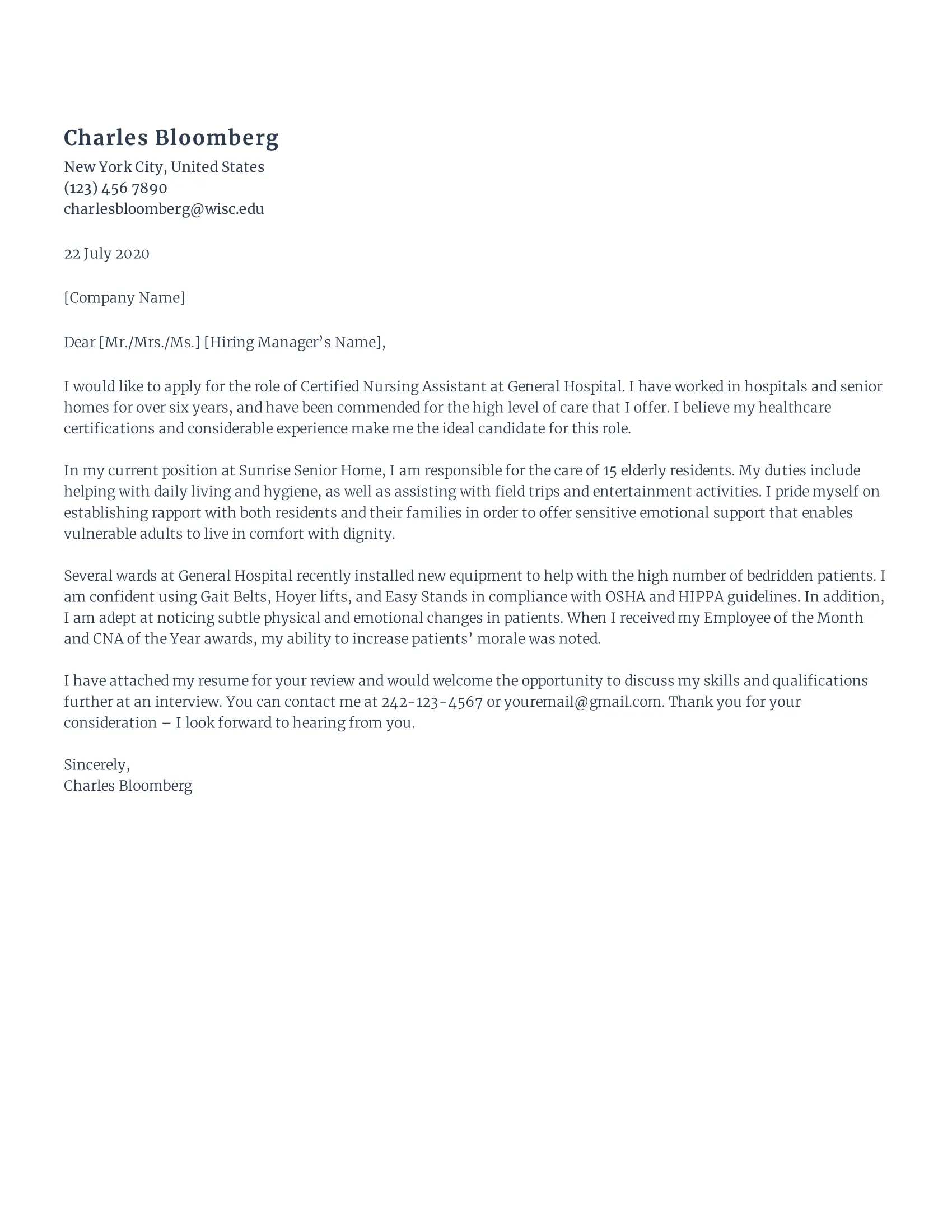
Your cover letter is the perfect place to spotlight the skills and experiences that make you a great CNA. Begin by identifying the key requirements listed in the job description. Then, choose a few of your strongest and most relevant skills and experiences to highlight. Provide specific examples that demonstrate your abilities, such as how you’ve handled difficult patient situations, managed multiple tasks, or collaborated with a healthcare team. Quantify your achievements whenever possible. For example, you could mention the number of patients you assisted daily, or any improvements you contributed to in patient care protocols. This approach helps the employer visualize your capabilities and understand the value you can bring to their team.
Key Skills to Showcase in Your CNA Cover Letter
As a CNA, you possess a diverse set of skills vital for providing quality patient care. When crafting your cover letter, emphasize these essential abilities. Focus on your ability to assist with daily living activities, such as bathing, dressing, and feeding patients. Highlight your proficiency in taking vital signs, monitoring patient conditions, and reporting changes to the nursing staff. Mention your experience with mobility assistance, including transferring patients and using assistive devices. Moreover, detail your skills in maintaining a clean and safe environment for patients. Be sure to include any specific skills or technologies you are familiar with that are relevant to the job description. This will help demonstrate your versatility and preparedness for the role.
Demonstrating Patient Care Abilities
Patient care is at the heart of a CNA’s role, and your cover letter must reflect your competence in this area. Describe your experience providing compassionate care, and helping patients with their physical and emotional needs. Include specific examples of how you’ve supported patients with their hygiene, nutrition, and mobility requirements. Showcase your ability to communicate effectively with patients and their families, ensuring they feel comfortable and informed. Mention your experience with specific medical conditions or patient populations if relevant to the job requirements. By providing these specific details, you demonstrate your dedication to patient well-being and your ability to provide excellent care, which is essential for any CNA position. Image: cna-patient-care
Showcasing Your Certifications and Training
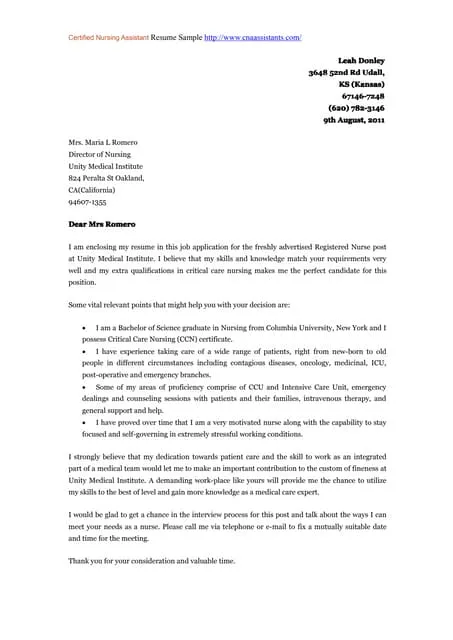
Your CNA certification is your ticket to this career. In your cover letter, clearly state that you are a Certified Nursing Assistant. Include the name of the certifying organization and the date of your certification, this verifies your credentials. You can also mention any additional training or certifications you have, such as specialized care techniques or certifications related to specific medical conditions. For example, if you have training in dementia care or hospice care, be sure to include it, as this can set you apart from other applicants. Highlighting your commitment to ongoing professional development shows that you take your role seriously and are dedicated to providing the best possible care. Image: cna-certification
Crafting a Compelling Opening Paragraph
The opening paragraph of your cover letter is your first, and potentially only, chance to capture the reader’s attention. Start by addressing the hiring manager or the person in charge of hiring, if possible. Avoid generic greetings like “To Whom It May Concern” if you can find a name. Then, immediately state the position you are applying for and where you saw the job posting. Briefly express your enthusiasm for the opportunity and the organization. The goal is to grab the reader’s interest from the start, setting the tone for the rest of the letter. Let your passion shine through, showing why this specific role and organization appeal to you. The initial paragraph is your hook – make it compelling.
Grabbing the Reader’s Attention
To grab the reader’s attention, you need to make your opening paragraph stand out. Start with a strong, direct statement that captures their interest. Instead of a generic introduction, consider mentioning something specific about the organization that excites you, or a personal anecdote related to patient care that showcases your empathy and dedication. You can also start by highlighting a key skill or experience that is relevant to the job description. For example, “I am writing to express my enthusiastic interest in the CNA position at [Facility Name], as I have a strong passion for providing compassionate care to elderly patients.” or “With over [X] years of experience in patient care, I am confident in my ability to contribute to [Facility Name]’s commitment to excellence.” Make your opening paragraph a glimpse into what you bring to the table.
Stating Your Purpose and Interest

In the opening paragraph, clearly state the position you are applying for and where you found the job posting. This helps the hiring manager understand why you’re writing. Immediately express your interest in the position and the organization, highlighting what draws you to this particular opportunity. Instead of a generic expression, specify what aspects of the role or the organization’s mission resonate with you. For example, “I am excited about the opportunity to contribute to [Organization’s Mission] as a Certified Nursing Assistant.” This demonstrates that you have researched the organization and are genuinely interested in the position. This initial declaration sets the stage for you to elaborate on your skills and experiences.
Detailing Your Relevant Experience
The body of your cover letter should delve into your relevant experience. Focus on providing detailed examples that showcase your skills and how they align with the job’s requirements. Start by listing the roles you’ve held, including the name of the facility, your job title, and the dates of employment. Describe the responsibilities you held, highlighting the tasks that are most relevant to the CNA role you are applying for. When explaining your experience, use action verbs to describe your accomplishments and achievements. For example, instead of saying “I assisted patients,” say “I assisted an average of 15 patients daily with personal hygiene, mobility, and feeding.” Image: cna-skills-experience
Providing Specific Examples of Achievements
To make your experience more impactful, provide specific examples of your achievements. Instead of just stating that you provided excellent patient care, describe a situation where you went above and beyond. For instance, “I noticed a patient was experiencing anxiety during mealtimes, so I worked with the nursing staff to implement a calming strategy that significantly improved the patient’s appetite and well-being.” This demonstrates your problem-solving abilities, your initiative, and your commitment to patient care. Include these specific examples of accomplishments to give the hiring manager a clear picture of the value you would bring to the role. Focus on experiences that highlight your skills, such as effective communication, teamwork, and your understanding of patient needs.
Quantifying Your Accomplishments

Whenever possible, quantify your accomplishments to make them more impactful. Using numbers and metrics gives the hiring manager a clear understanding of your impact. Instead of saying you improved patient satisfaction, state, “Implemented a new communication protocol that improved patient satisfaction scores by 15%.” Other ways to quantify your accomplishments include mentioning the number of patients you cared for daily, the efficiency of tasks completed, or any time-saving measures you introduced. By using numbers, you provide tangible evidence of your capabilities and results. The more concrete your examples, the more compelling your cover letter will be.
Highlighting Your Soft Skills
While technical skills are crucial, your soft skills are equally important in the healthcare field. In your cover letter, make sure you highlight your interpersonal abilities, communication skills, empathy, and any other qualities that make you a great caregiver. Use specific examples to illustrate these qualities, such as how you handled a difficult patient, resolved a conflict, or worked as part of a care team. Highlight your ability to adapt to different situations, communicate effectively with patients and families, and your ability to show empathy. Remember that soft skills help create a positive and supportive environment for patients and their families. Image: cna-soft-skills
Showcasing Communication and Interpersonal Skills
Effective communication and strong interpersonal skills are essential for CNAs. In your cover letter, emphasize your ability to communicate clearly and compassionately with patients, families, and healthcare team members. Provide examples of how you’ve used effective communication in challenging situations. You might mention how you explained medical procedures to a patient, addressed a family member’s concerns, or facilitated communication between patients and doctors. Highlight your ability to build rapport with patients, creating a supportive and trusting environment. Mention your ability to work collaboratively as part of a team, demonstrating your ability to understand and follow instructions, contributing to a cohesive work environment.
Demonstrating Empathy and Compassion

Empathy and compassion are vital qualities for a CNA. When writing your cover letter, highlight your ability to connect with patients on an emotional level and provide compassionate care. Describe situations where you showed empathy, such as when a patient was scared or in distress. You can mention how you comforted a patient, listened to their concerns, or offered support and encouragement. Highlight specific instances where you provided not only physical care but also emotional support. Demonstrating these qualities shows that you understand the emotional needs of patients and are dedicated to providing comprehensive care. This will show the hiring manager that you possess the qualities that are most crucial in the role.
Mentioning Your CNA Certification
Your CNA certification is the most essential qualification you possess. Ensure that you clearly state your certification status in your cover letter. Include the full name of your certification, the issuing organization, and the date you obtained your certification. You should state “I am a Certified Nursing Assistant (CNA) certified by [Certifying Organization]” and include the date. This ensures that the reader can easily confirm your credentials. If your certification is nearing renewal, you can mention that you are up-to-date with your continuing education requirements. This is a reminder that you meet the minimum requirements for the position and are dedicated to your profession. Image: cna-cover-letter-format
Emphasizing Your Commitment to Patient Care
Throughout your cover letter, emphasize your commitment to providing high-quality patient care. Showcase your dedication to helping patients with their daily needs and ensuring their well-being. Highlight any experiences that illustrate your commitment to patient safety, such as adhering to infection control protocols or reporting any incidents. Mention your experience with the handling of specific patient needs, or any additional training you have. Be sure to describe how you work to make the lives of patients easier, such as assisting with mobility, providing nutritional support, or offering emotional support. Make it clear that you are passionate about providing care to patients.
Creating a Strong Closing Paragraph

The closing paragraph is your last chance to reinforce your interest and make a lasting impression. Reiterate your enthusiasm for the position and your commitment to the organization. Thank the hiring manager for their time and consideration. You should restate the most important points from your letter to remind the hiring manager of your qualifications and interest. Keep the tone confident and enthusiastic, summarizing your key strengths and reiterating your interest in the role. Your closing paragraph should leave the hiring manager with a positive and memorable impression.
Reiterating Your Interest and Enthusiasm
In your closing paragraph, restate your strong interest in the CNA position and express your enthusiasm for the opportunity. Refer back to any key points that highlight your skills or qualifications that make you a strong fit for the role. Mention something you find appealing about the organization, such as their mission, values, or reputation for patient care. For example, “I am particularly drawn to [Organization’s Mission], and I am eager to contribute my skills to support your commitment to patient-centered care.” Expressing your genuine excitement will make the hiring manager see your interest. Show that you are genuinely enthusiastic about the opportunity and the organization.
Adding a Call to Action
Include a clear call to action in your closing paragraph to prompt the hiring manager to take the next step. State your availability for an interview and your willingness to provide additional information. Provide your contact information again, including your phone number and email address. Make it easy for the hiring manager to contact you. For example, “I am available for an interview at your earliest convenience. Thank you for your time and consideration. I can be reached at [Phone Number] or [Email Address].” This prompt indicates your availability and eagerness to take the next step in the hiring process. Make the call to action clear and easy.
Formatting Your CNA Cover Letter

Proper formatting is essential to make your cover letter professional and easy to read. Use a standard business letter format, which includes your contact information, the date, and the hiring manager’s contact information. Make sure your letter is well-organized and easy to follow. Use clear headings and subheadings to break up the text and improve readability. Keep the formatting consistent throughout the letter, and use appropriate font sizes and spacing. A well-formatted letter shows that you pay attention to detail and professionalism. A cover letter that is organized correctly demonstrates respect for the reader’s time.
Choosing the Right Font and Font Size
The font and font size you select can greatly impact the readability and professionalism of your cover letter. Stick to standard, easy-to-read fonts, such as Times New Roman, Arial, or Calibri. Make sure your font size is between 10 and 12 points to make your letter easy to read. Avoid using overly fancy or decorative fonts, which can be distracting. Keep the font size consistent throughout the letter. A well-chosen font will enhance readability and ensure that your cover letter makes a good impression. It is best to choose a professional-looking font for your cover letter.
Properly Addressing the Letter
Addressing the cover letter correctly is one of the most important aspects of a professional letter. If possible, find the name of the hiring manager or the person in charge of hiring. Use their name and title to address the letter. Address the letter to the person’s name, “Dear Mr./Ms. [Last Name].” If you cannot find the hiring manager’s name, use a formal salutation such as “Dear Hiring Manager” or “Dear [Department Name] Hiring Team.” Avoid generic greetings such as “To Whom It May Concern” as they show a lack of effort. Addressing the letter correctly shows you have taken the time to research the organization.
Proofreading and Editing Your Cover Letter
Proofreading and editing your cover letter is the most important step in the writing process. Before submitting your letter, carefully review it for any errors in grammar, spelling, and punctuation. Check for any awkward phrasing or unclear sentences. Read your letter aloud to catch any mistakes you may have missed. Use grammar and spell check tools, but do not rely on these tools alone. Have a friend or family member proofread your cover letter. A well-proofread cover letter demonstrates your attention to detail and professionalism and makes a positive first impression. Image: cna-proofreading
Common Mistakes to Avoid in Your Cover Letter
Avoid these common mistakes to ensure your cover letter impresses the hiring manager. Reviewing and editing can help prevent these mistakes from appearing in your cover letter. Make sure the tone is positive and professional. If you avoid these common mistakes, you are likely to make a positive first impression.
Using Generic Language
Avoid using generic language in your cover letter. Refrain from using phrases that are vague or overused. The letter should not have the same information as other generic cover letters. Instead, tailor your letter to the specific job you are applying for. Provide examples from your own experience to illustrate your skills. Describe your unique qualifications. Demonstrate that you have the skills and experience that make you the best candidate for the job.
Focusing Solely on Yourself
Although the purpose of a cover letter is to introduce yourself and your qualifications, avoid focusing solely on yourself. Instead, emphasize the needs of the employer and how your skills and experience meet those needs. Make your cover letter about solving the employer’s problems. Show how you can contribute to their team. Give examples of how you have helped others in similar situations. Mention your communication skills, which are essential to teamwork. Demonstrating that you understand the employer’s needs is the key to demonstrating that you are the best candidate for the job.
Ignoring the Job Description
Make sure to tailor your cover letter to match the job description, which contains the specific requirements and the expectations the employer has. Carefully review the job description and address each of the requirements. Highlight the skills and experience most relevant to the role. Demonstrate how your qualifications align with the job’s demands. This will show that you are familiar with the role and have the skills needed to succeed. Customizing your cover letter will dramatically improve your chances of getting hired. Mentioning skills listed in the description will show your attention to detail.
Tailoring Your CNA Cover Letter
Tailoring your cover letter is an essential step in getting a job as a CNA. Customize your cover letter to fit each job opportunity. This shows that you are genuinely interested in the position. Tailoring your cover letter gives you the best chance to make a positive impression. Doing some research before submitting the letter will help you make the right impression.
Researching the Facility
Before you start writing your cover letter, research the facility where you are applying. Understanding the facility’s mission, values, and services will help you tailor your letter to their specific needs. Visit their website to learn about their patient care philosophy. If possible, look for information on their specific needs or any challenges they are facing. When you understand the facility, you can better address the hiring manager’s needs in your cover letter. Mentioning things that are specific to the facility will show that you have researched the organization.
Customizing the Letter for Each Application
Customize each cover letter to match the specific job requirements. Although you may have a general template, adapt it for each application. Review the job description and highlight the skills and experiences that match the requirements. Use the employer’s preferred terminology. In your cover letter, show how you will contribute to the facility’s goals. Avoid sending generic letters. Taking the extra time to customize your cover letter for each application will improve your chances of getting the job. Image: cna-customization